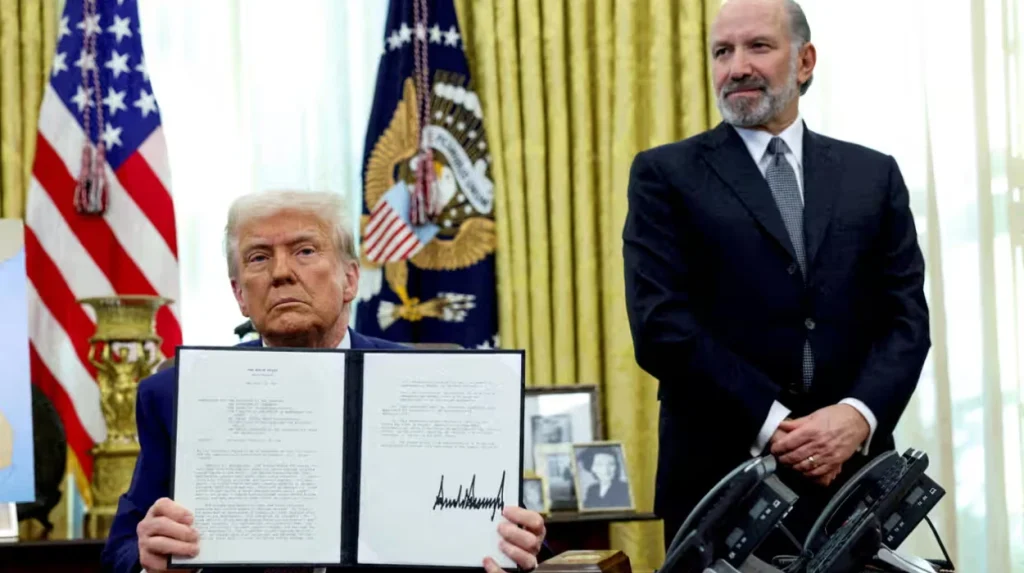
Mark Zuckerberg’s motto in launching Facebook 20 years ago was ” Move fast and break things. ” This approach appeared to be the opposite of traditional management practices. Nonetheless, it was effective enough to inspire imitation among figures like Elon Musk, Jeff Bezos, and other successful digital magnates. Now, Donald Trump is testing its efficacy within the realm of government.
Many believed that following the chaos of Trump’s first term, his second would feature a more conciliatory president, mindful of his public image. He would engage in outreach, seek advice, and strive to be a peacemaker, driven by a desire to attain the Nobel stature of Barack Obama Obama.
How mistaken that has turned out to be. Trump is taking steps that few leaders would dare to take. He is acting as a cultural revolutionary, akin to Mao Zedong, boldly dismantling existing systems. His goal is to redefine Washington’s position within the United States and the US’s role globally. He understands that he might only have two years before “the system” – encompassing the electoral cycle, the judiciary, and state governments – obstructs his progress. If he genuinely seeks a revolution, he must act decisively and swiftly.
Historians argued that the US requires periodic jolt to clear the cobwebs, bureaucracy, and grime of an increasingly unwieldy union. If things spiral out of control and disaster looms, the Constitution serves as a safeguard to steer the nation back from the edge. This mechanism facilitated the removal of Richard Nixon, yet not before his aggressive approach towards China led to the US’s withdrawal from Vietnam. Does this situation resonate with Trump’s presidency?
A glimpse of the so-called new realism has disrupted NATO’s complacency. Trump does not view Russia as a threat to the US or Western Europe; instead, he focuses on its historical fixation with its border regions, such as the Baltics, Belarus, Ukraine, Georgia, and the’ stans’- countries that he shows little interest in defending. Since the conclusion of the Cold War – and for much of its duration – NATO has based its reasoning on a widely held belief that Russia aims to dominate Western Europe. If Keir Starmer believes, as it seems, that Russia’s invasion of Ukraine poses a risk to Britain, then Trump’s stance suggests that Britain ought to reduce its welfare state and quickly bolster its military. American taxpayers are not willing to support such efforts.
It was a Republican, Dwight Eisenhower, who cautioned against overemphasizing the Russian threat to justify NATO, already the largest and wealthiest military alliance in history. The defence lobby insisted on limitless deterrence. Trump has challenged that notion. For him, U.S. defence means protecting its own borders, which should be the same for Europe. This perspective is not outrageous. No one demanded war when Russia invaded Georgia or Ukraine in 2014. Disagreeing with this stance is one thing; dismissing it as a 1939-style appeasement, as western defence lobbyists have done, is another matter entirely.
In terms of borders, Trump is not taking an extreme stance. The US welcomes around 150,000 Mexican immigrants each year, adding to the existing 11 million. Mexico, Canada, and China heavily supply the US with imports. Trump believes that Americans should pay a price equal to what it costs to produce goods in the US. If consumers wish to buy Chinese cars, they would need to contribute an additional 25% of the price as a tariff to the government. Regarding fentanyl, imposing significant tariffs is Trump’s strategy for persuading countries like China to reduce its flow and the associated fatalities. At times, diplomacy requires decisive actions – actions reinforced by unpredictability.
Nearly every president arrives in Washington vowing to reduce bureaucracy. This was the case for Warren Harding, Richard Nixon, Ronald Reagan, and George W. Bush. However, an active president tends to create more bureaucrats. The concentration of power in a democracy naturally attracts additional authority. Trump realises he cannot afford a long struggle. It’s either Musk and the chainsaw or nothing at all. While education should not fall under federal jurisdiction, it is a responsibility of the states. Therefore, the US Department of Education should be shut down. The same goes for USAID, and there should be significant cuts to the State Department. Plunder the Treasury if necessary. Sure, some things might break in the process, but it’s no worse than inaction. This embodies what cultural revolution entails.
Trump and his administration have, in numerous ways, acted appallingly. Reneging on Joe Biden’s aid to Ukraine during an ongoing conflict, labeling Volodymyr Zelenskyy a dictator, insulting Canada, threatening Greenland, halting famine relief for Africa, proposing a beach resort in Gaza, intimidating lawyers, and leaking information from security meetings are truly unbelievable actions. Trump and his team resemble playground bullies in their lack of decorum and civility.
Yet, this signifies the collapse of certain systems. It highlights the reason Washington constructs a protective “swamp” to shield against unseasoned presidents. Currently, the likelihood of Trump achieving his ambitious goals is quite low. It’s challenging to initiate a significant revolution within a mere two years.
A counter-revolution is imminent. Greenland is expected to differ from Ukraine in American context. Tariffs are likely to decrease again. The Democrats may regain their confidence. Many of Trump’s “broken things” will be repaired. However, within the turmoil, there are necessary challenges to the status quo. NATO might attain a more practical stance. A prolonged conflict in Ukraine – or beyond – could be prevented, allowing for Russia’s reintegration into the global community, similar to China’s reacceptance after Nixon.
This is at least feasible. More specifically, the US might reassess its global role, which has included a commitment to moral engagement for the past twenty-five years belligerence, with shocking expenses and loss of life. It should return to its essence: just another nation among others. This could happen if someone acts swiftly and disruptively.