The Trump administration’s decision to end funding for a U.S.-backed natural-hazards monitoring programme in Nepal has come under renewed scrutiny after catastrophic Himalayan floods killed hundreds and left thousands missing.
This initiative, called SERVIR-Hindu Kush Himalaya, had been discontinued in January 2025, more than a year prior to a natural disaster involving glaciers and rockslides, which produced a wall of water and debris that swept through the communities at the border between Nepal and China. It did not give a guaranteed warning system for all types of sudden flooding; moreover, there is no proof that continuing this programme could have prevented such a catastrophe. However, by discontinuing this project, the development of plans and monitoring related to landslides, glaciers and floods in one of the climate-sensitive areas on Earth was interrupted.
The moment has become politically sensitive because of the question – whether the initiative has deprived the country of a level of protection from the disaster.
A programme built around hazard monitoring
SERVIR-Hindu Kush Himalaya was a regional project which consisted of a collaboration among NASA, the United States Agency for International Development, and the International Centre for Integrated Mountain Development or ICIMOD. Headquartered in Kathmandu, ICIMOD serves as an institution for the Hindu Kush Himalaya, a chain of mountains that encompasses a number of Asian nations and includes some of the most vulnerable regions of glaciers and rivers of the world. SERVIR-HKH had been in operation from around 2010. It employed the use of satellite imagery and geographic information systems and environmental data to comprehend natural hazards.
Its work covered a wide range of risks, including:
- Landslides triggered by rainfall.
- Flash floods and river flooding.
- Glacial-lake expansion and possible outburst floods.
- Glacier and snow-cover changes.
- Flood-inundation mapping.
- Forest fires and other environmental hazards.
The programme was more than just an array of siren alarms. It generated data and means meant to help in making decisions for national agencies, disaster management, scientists and local authorities. This is a crucial point. In the programme’s tasks included improving pre-disaster and during the disaster information, rather than ensuring that everyone will get the signal in time to evacuate from their community. Ex-director of the programme, Birendra Bajracharya told that the programme got a “stop work” directive towards the end of January 2025. The project had to last until 2026; however, this decision ended its operations abruptly. According to Bajracharya, it interfered with the work being done to enhance “landslide situational awareness in connection with extreme rainfall.” Also, according to him, the work on the system which would detect slope movement and aid in the development of future landslide forecasts was not completed yet.
The disaster that followed
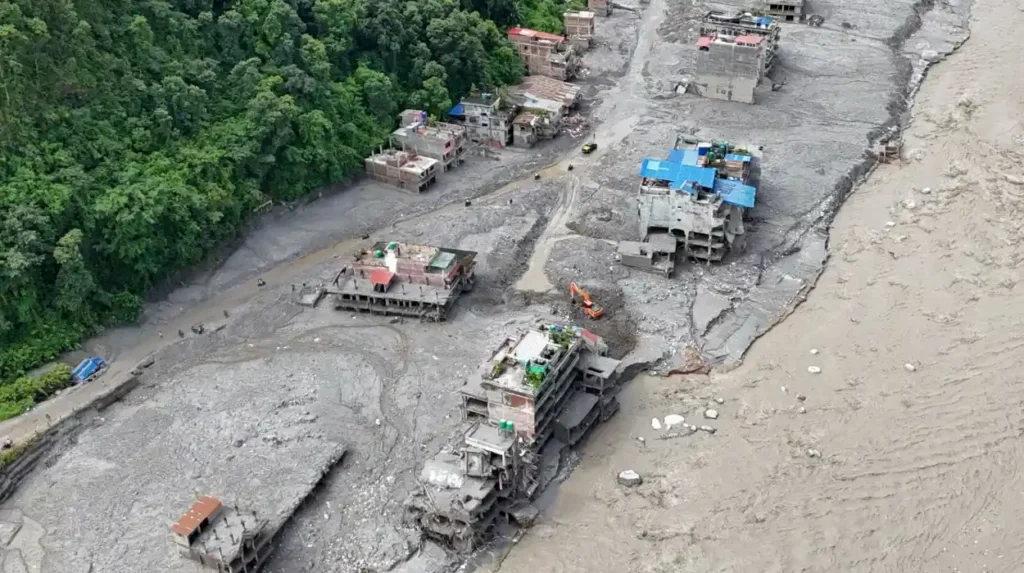
There was an occurrence of a flash flood in the Himalayas that occurred on 26th August, 2026 due to a collapse of ice and rocks. This resulted in devastation in many buildings, roads, bridges and various infrastructures. It happened in an important border region between Nepal and Tibet. The affected regions were the ones associated with tourism, infrastructure related to hydropower and the Kerung-Rasuwagadhi border corridor that was an important one for trade and transport purposes. It involved devastating waves of about thirty feet in some places.
The rescue process involved damaged roads and bridges, unstable slopes, and the difficult situation in accessing the isolated communities. The number of victims kept changing because bodies kept being recovered and updating the list of missing people. The initial number of deaths was several hundred but then later it rose to more than a thousand. It was reported that more than a thousand one individuals had died and about four thousand were missing.
The uncertainty was partly caused by the geography of the disaster. Many people were swept away in remote valleys, while others were believed to be trapped in tunnels, hydropower facilities or border settlements. Foreign tourists and workers were also among the missing.
At one stage, the United States said approximately 90 Americans might have been affected or unaccounted for. Several were later rescued, while U.S. officials said they had no confirmed reports of American deaths in the early response period.
What the funding supported
The programme’s supporters say its importance lay in building long-term capacity, rather than responding only to one emergency.
Satellite-based monitoring can help authorities identify areas where slopes are becoming unstable, track changes in glaciers and glacial lakes, and map the communities and infrastructure most exposed to flooding. Such information may be used to improve land-use planning, evacuation routes, bridge design and emergency exercises.
SERVIR-HKH also developed flood-related tools. According to reporting on the programme, some of its materials described flood forecasts covering approximately 10 to 15 days for certain vulnerable areas. These tools could provide authorities with more time to prepare for some river floods and weather-driven events.
However, those forecasts should not be confused with precise prediction of a sudden glacier collapse. A flood caused by a rapid ice-and-rock failure can occur with little warning, particularly when the collapse begins in a remote and poorly monitored location.
The programme was therefore part of a wider disaster-risk system. It could improve knowledge, but it could not eliminate the underlying hazard or guarantee that warnings would reach residents before floodwaters arrived.
Could the disaster have been prevented?
Available evidence does not prove that SERVIR-HKH could have predicted the August 2026 event in time to save lives.
According to CNN, this programme probably would not have offered enough advance warning for this particular calamity. As mentioned in several fact-checking studies, the water from the glacial collapse would take just around seven minutes to flow down from the point of collapse to the concerned border areas. Seven minutes would be too less time to confirm the incident, issue the warning, and complete the evacuation process. This could have been even further reduced in case of mountainous regions, where the infrastructure of communication and transport facilities are poor.
Glacial collapses are not always predictable events. Sometimes there are certain signs of these catastrophes in terms of changes in the slope movement, water level or changes in the glacier structure. At other times, glacial collapses are sudden events caused due to various factors like geological instability, glacier failure, rockfall, heavy rainfalls or earthquakes. It is not correct to say that this terminated programme would have helped prevent these floods. What it did was, it hindered the ongoing research which could have increased the readiness for such types of hazards.
Why critics blame the Trump administration
Critics connect the programme’s termination to the Trump administration’s wider effort to reduce U.S. foreign aid and reorganise USAID.
After President Donald Trump returned to office in January 2025, his administration initiated a broad review and freeze of foreign assistance. The Department of Government Efficiency, or DOGE, was associated with efforts to identify programmes for cancellation or reduction. SERVIR-related funding appeared in documents circulated during the review process, according to reporting cited by fact-checkers.
Jeremy Konyndyk, a former USAID official who worked on the U.S. response to Nepal’s 2015 earthquake, criticised the decision to close climate- and disaster-focused programmes. He argued that long-term technical projects are precisely the type of initiatives needed in regions facing growing climate risks.
Critics say the decision was short-sighted for several reasons. The Himalayas are experiencing rapid environmental change, while Nepal has limited resources to independently maintain satellite monitoring, technical modelling and regional data networks. Programmes that combine U.S. technology with local scientific expertise can take years to build and may be difficult to replace once terminated.
They also argue that disaster monitoring should not be judged only by whether it predicts a single extreme event. Mapping landslide zones, identifying dangerous glacial lakes and improving river forecasts may reduce losses across many emergencies, even if the tools fail to predict one exceptionally rapid collapse.
The U.S. defence of the decision
The State Department has rejected the implication that the funding decision directly caused the Nepal disaster.
US officials stated that the January 2025 announcement came before the greater restructuring of USAID. Officials also clarified that services and products developed under the SERVIR programme would still be accessible via ICIMOD and elsewhere. The Department described SERVIR as a tool to supply satellite data and decision-making tools to bolster national forecast capabilities, and not an entirely operational early-warning system managed by the United States. Moreover, the US cited ongoing US assistance for flood preparedness in Nepal.
The Department of State said the US backs a project that assists the meteorological and hydrological agencies of Nepal in establishing flash-flood warning systems. The project is part of a greater initiative that involves tens of countries and collaboration between the National Oceanic and Atmospheric Administration and the Nepal Department of Hydrology and Meteorology. This stance does not imply that no capacity was lost upon the shutdown of the SERVIR-HKH programme.
Washington’s response after the floods
The United States announced emergency assistance after the disaster. The State Department expressed condolences to the victims and said Washington was closely monitoring the situation.
The initial pledge consisted of $500,000 provided through Catholic Relief Services. It was aimed at emergency shelters, relief items, clean water, and hygiene facilities. Additionally, the U.S. dispatched a disaster response adviser who was supposed to help evaluate needs and assist in distributing the aid. Later reports stated that the United States pledged an additional sum of $3.6 million, which added up to $4.1 million in total. Additional aid was said to consist of food provision for about 10,000 affected families during three months. This emergency aid illustrated the essence of the conflict. While Washington offered its aid after the disaster, critics claimed that the current administration had cut the funds from the program aimed at strengthening the preparedness before a disaster struck.