Tens of thousands of demonstrators across Spain have turned the Ceuta border crisis into a nationwide political confrontation, exposing deep fractures over migration policy, security and governance. What began as a deadly two‑day surge of irregular crossings in late July has evolved into a protracted humanitarian and political emergency that now threatens the stability of Prime Minister Pedro Sánchez’s government ahead of next year’s election.finance.
A holiday turned into a verdict on Sánchez
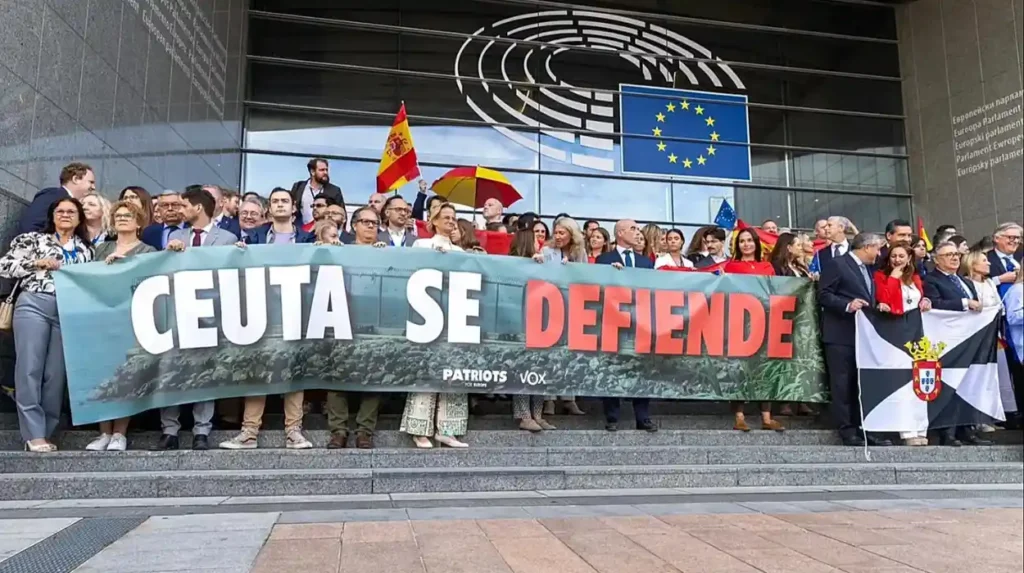
Ceuta’s Sept 2 official holiday, traditionally a low‑key local observance, became the focal point for mass mobilization after the Spanish Federation of Municipalities and Provinces (FEMP), dominated by the opposition People’s Party (PP), called gatherings in more than 260 municipalities. In Madrid alone, authorities estimated around 50,000 protesters, while thousands more rallied in Ceuta, Barcelona, Bilbao and other cities under slogans such as
“Ceuta no se vende, Ceuta se defiende” —
“Ceuta is not for sale, Ceuta is defended”.
It was the sheer scale and unity of the protesters that turned the event, which was initially presented as an expression of support for Sánchez’s actions in the face of the crisis, into what observers call “a verdict on his performance.” The cries of those protesting against the Spanish leader’s resignation – or even his arrest – were heard at Plaza de Cibeles.
The numbers behind the emergency
The outbreak occurred in the period of 30-31 July 2026 when an estimated number of 72,000 people made their way to Ceuta from Morocco through swimming, climbing, or rushing into the border in the largest wave of irregular migration into Europe in recent years. The human toll was immediate as according to the reports from Ceuta authorities at least 100 died on the Spanish side, which combined with the deaths from Morocco increased the total death toll to 80-100 people. In the following weeks, the authorities in Spain performed fast rejections, although there were still significant numbers. According to government data, the remaining population was around 5,000 people, out of which around 1,200-1,400 unaccompanied minors, although some sources mention significantly higher numbers, above 10,000 people. The inconsistency itself has been politically significant with criticism of the Spanish government for understatement of the situation.
Local anger and the demand for order
In Ceuta itself, the protests have been carried out by citizens who claim that their way of life has been disrupted by the influx of many migrants living in temporary camps as well as in beach areas. Protesters have continuously demanded the relocation of migrants either to their own country or to different places within Spain, claiming that Ceuta’s resources would not be able to support such numbers of people. At times, the situation has become quite heated. Citizens have continuously organized protest actions, some of which included attacks against temporary shelters in the area of El Trampolin beach, while migrants have ceased using public spaces due to fear of violence. The president of Ceuta, Juan Jesús Vivas, has declared that the territory is “on the verge of collapse,” and the opposition has taken hold of this quote in order to criticize the inadequate reaction of Madrid.
Government response: speed, law and denial of prior warning
The Sánchez government has defended its actions as both swift and lawful, while insisting it received no credible prior warning of the scale of the surge. Speaking to parliament, Sánchez said it is
“absurd to think the government knew and did nothing”,
rejecting opposition claims that intelligence services failed to alert ministers. He has also emphasized that there is
“no information from any of our intelligence services that points to the participation of Moroccan authorities”,
seeking to avoid a diplomatic rupture with Rabat.
On the operational front, Madrid has highlighted the speed of returns. Sánchez described the repatriation of most irregular entrants as
“one of the fastest return processes ever carried out in recent European history”,
a claim the government uses to counter accusations of inaction. Interior Minister Fernando Grande‑Marlaska has repeatedly called for calm, stating after clashes that “violence is not the answer”, while deploying more than 1,600 police officers to the enclave and expanding shelter capacity from about 500 places to more than 3,400.
Disinformation, foreign actors and the social media factor
A critical point in the government’s story is that the disinformation campaign via social media contributed to or even caused the situation to escalate. Sanchez stated that Russian, Israeli, and extreme right-wing accounts spread fake news about immigrants being granted the right to live in Spain after their arrival in Ceuta by boat. In an interview with Cadena SER radio station, Sanchez said that the wrong interpretation of the Supreme Court ruling along with the disinformation campaigns encouraged people to break into the country. Such a story has received much backlash from political opponents of the Spanish premier.
Nevertheless, the government has pledged full transparency, with Sánchez telling Congress:
“The Government has nothing to hide in this matter and I have ordered the publication of a dossier with all the documents so that the public can examine them. Absolute transparency and public access to all documents.”
Political weaponization and the opposition’s strategy
The rallies have been enthusiastically welcomed by the PP and the far-right Vox party, who believe the Ceuta crisis will serve as a platform to rally their voters against Sánchez’s leftist alliance. The members of Vox and some of the PP have demanded that all the immigrants present in the city be deported, including the minors, arguing that it is an issue related to laws, order, and finance. The government has tried to show that the protests have a political motive and not in favor of Ceuta.
Territorial Policy Minister Ángel Víctor Torres told RNE radio:
“This is not to show support for the city of Ceuta or its residents; it is to attack the government of Spain.”
That framing has done little to defuse tensions; instead, it has deepened the perception that the crisis is being fought over as much as it is being managed.
EU involvement and the hardening of the border
Knowing its limitations, the Spanish authorities have officially turned to the European bodies for help. Specifically, the Interior Ministry appealed to the agencies Frontex, Europol, and the EU Asylum Agency (EUAA), asking for their cooperation in conducting interviews, interpretation, screening, and processing of the documents of the irregular migrants still staying in Ceuta. Besides that, Spain wanted to prolong Operation Minerva, which is a collaboration of the police and Frontex. While taking these measures, the Spanish government has taken steps to reinforce the borders by other means. Among the actions announced, there are the following: the expansion of the Tarajal and Benzú breakwaters, the establishment of the system of containment buoys at sea, and an increased aerial monitoring using drones, light intervention vessels, and remotely controlled underwater systems.
Economic aid and the question of long‑term sustainability
Beyond security, Madrid has rolled out a significant economic package aimed at stabilizing Ceuta. The Council of Ministers approved an emergency fund of €165–168 million, described as roughly 8% of the enclave’s GDP, to revive the local economy and strengthen public services, on top of an earlier €180 million commitment for medium‑term recovery. An additional €25 million was earmarked for the care of unaccompanied minors, who enjoy special legal protections under Spanish and EU law.
While substantial in relative terms, critics argue that cash injections cannot resolve the underlying governance dilemma: Ceuta’s status as a small Spanish territory on the African coast makes it uniquely vulnerable to migration pressures, and ad‑hoc emergency measures are unlikely to suffice over the long term.
A crisis that could define Sánchez’s premiership
What started out as a failure in managing borders has now turned into a test of whether Sánchez’s government survives. The combination of numerous deaths, disorder in Ceuta and the protests all around the country have provided the opposition with an easy story to sell about incompetence and loss of control. What is more, the use by the Spanish authorities of the fast return tactic, along with European Union assistance and the disinformation explanation for the crisis, has not managed to reassure either Ceuta residents or Spaniards. There are also some international consequences to the situation in Ceuta: the way Spain deals with the enclave will impact future EU debates about its external borders and cooperation with its North African neighbors. As of now, the crisis continues: thousands of migrants have nowhere to go, tensions remain high, and Sánchez’s government’s credibility continues to be eroded until 2027.