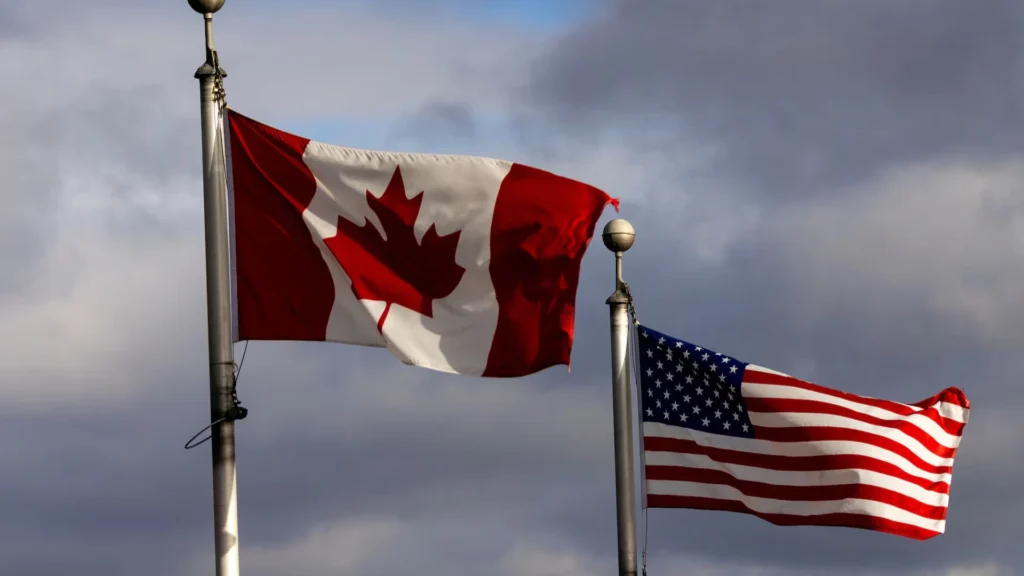
The current showdown between Washington and Ottawa is not just another spat over steel, dairy or automobiles; this is a pressure test for Canadian economic sovereignty in a new North American arrangement, which President Donald Trump is keen to create. Following failed last minute negotiations, the United States slapped 50 percent tariffs on about $20 billion worth of Canadian exports, which comprised over 500 items, starting August 22, 2026.
In response, Prime Minister Mark Carney announced “dollar‑for‑dollar” retaliatory tariffs on U.S. goods, set to begin on September 8, 2026, targeting steel, dairy, appliances, agricultural equipment, pulp and paper, and electronics. The political temperature rose further on August 24, when Trump told Canadian leaders to “fall in line” or face consequences “far WORSE” than existing levies, while threatening fresh 50% duties on Canadian vehicles, auto parts and steel. Carney’s reply was equally stark:
“You’re at war when you get attacked. We got attacked,”
framing the U.S. move as an economic assault requiring a symmetrical response.
What distinguishes this episode from earlier Trump‑era spats is the explicit linkage of trade terms to constraints on Canada’s ability to act as an independent trading nation. Ottawa says Washington demanded terms that were
“uneconomic, unfair, and undermined the net benefits to Canada,”
including language that would curtail Canada’s ability to forge new trade deals and pressure on French language and Quebec culture—which the government called unacceptable. In Carney’s summary, the U.S. “asked too much, offered too little,” a phrase that now anchors Ottawa’s narrative of defending sovereignty rather than merely negotiating tariff lines.
The numbers that define the battlefield
The arithmetic behind this dispute is relatively straightforward but highly strategic. The U.S. tariff of 50 percent applies to around $20 billion worth of Canadian exports, which amounts to 5–5.5 percent of the total amount of Canadian exports to the United States per year – a sizable chunk which is bound to harm certain industries and regions, but not such an overwhelming figure that it could be considered an embargo. Canada’s response to the tariff follows in a similar vein; as Carney said, he plans on “matching the American tariffs dollar for dollar” with further details being released in the next week.
This is a map of politically charged supply chains through which these goods flow. The list for Canada includes tariffs by the U.S. government on alcohol products (beer, wine, liquor, cider); dairy products; technology products (smartphones, cameras, radar/antennae); sports/athletic and hockey equipment; wood/lumber and furniture products; seasonal items; clothes and cosmetics – all protected by USMCA. The list for the U.S. includes the imposition by Ottawa of tariffs on steel products, dairy products, appliances, agricultural equipment, pulp/paper and electronics, along with some other goods that have been singled out earlier by the U.S. government against Canada. The product lists would be published “in the coming days,” but the focus on sectors suggests where Ottawa believes the leverage lies.
Why the deal collapsed: vehicles, sovereignty and culture
These figures are backed up by three fundamental concerns, which turned what was essentially a technical negotiation into a quasi-constitutional one. To begin with, vehicle coverage. Canada wanted to have the tariffs on light duty vehicles extended to include medium- and heavy-duty trucks, as otherwise the production of the vehicles like the Ford F-350/450/550 and GM Silverado becomes uncompetitive. The Americans were opposed, which Ottawa considers will make the production in the integrated North American assembly plants less viable. Second, sovereign limits.
According to Ottawa, the American proposals contained language that would limit Canada’s ability to conduct trade negotiations without U.S. approval. While this might have been tolerable decades ago when Canada had little economic choice but to conduct all trade negotiations through its big neighbor, the current government has spent the last few years actively diversifying away from the American market through the CPTPP, CETA with the EU, bilateral deals with the UK, and other partners.
As such, in the current environment, this is absolutely unacceptable, according to Carney, and any attempt to negotiate should recognize Canada as a sovereign partner and not
“an attitude… that Canada is a subsidiary of the United States.”
Third, culture and language. Carney pointed out the pressure on Canadian language protection and Quebec culture as unacceptable, and that carries a lot of weight within Canada’s domestic politics. Language protection policies are one of the fundamentals of Canada’s national policy, and the perception that Canada could sign off on a trade agreement that undermines it will be met with cross-party opposition in Ottawa.
Political unity in Ottawa, escalation in Washington
One of the most consequential features of this crisis is the rare unity across Canada’s political spectrum. Carney’s government has been quick to portray the U.S. move as an external shock requiring national cohesion, and the opposition has obliged. Conservative leader Pierre Poilievre echoed the government’s line, urging Canadians to
“stand united to defend our country against these unfair attacks on our jobs and businesses.”
That alignment gives Ottawa room to sustain a hard line without immediate fear of partisan fracture, even as the economic costs begin to bite.
Provincial leadership adds another layer of resolve. Ontario Premier Doug Ford said he opposed a preliminary deal, calling it “a bad deal” for Ontario’s auto, steel and manufacturing sectors. He warned “everything is on the table” if the dispute worsens, including cutting off electricity and critical minerals to the U.S., and said Canadians are at a “fever pitch” ready for an “economic war.” Ford’s rhetoric is calibrated for a province whose industrial base is tightly interwoven with U.S. supply chains; his threat to leverage energy and minerals underscores how deeply integrated—and therefore how vulnerable—cross‑border infrastructure has become.
In Washington, the tone has shifted from transactional bargaining to overt hierarchy. Trump’s “fall in line” message, paired with the threat of new 50% levies on autos, auto parts and steel, signals a willingness to expand the battlefield if Ottawa does not concede. U.S. Trade Representative Jamieson Greer called the breakdown
“a missed opportunity for Canada to partner with the United States”
and said
“no new talks were planned”
with Canada, adding that Washington would move forward with measures responding to Canadian retaliation. That posture—closing the door on immediate re‑engagement—raises the risk of a prolonged, tit‑for‑tat cycle where each side waits for the other to blink first.
Economic stakes: asymmetry, exposure and the price of symmetry
The logic of the Canada-U.S. tariff war is asymmetric in its nature. Approximately 73% of all Canadian exports go to the US, and while there were some successes regarding increased exports to the UK, EU and China, diversification remains problematic. It is important to notice that
“dollar-for-dollar retaliation creates political symmetry, not economic symmetry.”
While Ottawa can match the dollar value of US duties, it is much more difficult to mirror the structural dependency and vulnerability of Canadian exporters to US changes in policy. From the short-term perspective, for Canada, the consequences can be seen in increased costs and prices, possible job losses and bankruptcies in industries especially vulnerable to the changes – alcohol, dairy products, furniture, lumber and sporting goods.
Household-level effects may come in form of canceled shifts, deferred hiring and weakened local spending, especially in those places where the main point of the economy is just one plant or mill. For the United States, the impact can be less pronounced, but still felt: higher prices or lack of choice of certain Canadian products (wine, furniture, clothing, cement, sporting equipment). There are also some possible vulnerabilities in automobile and defence/aerospace sectors if Canada decides to switch suppliers from the US. In business community, the measures are said to
“risk raising costs for American businesses and families.”
This statement will become critical in 2026, when the inflation issue becomes relevant again. The automobile sector is the turning point here. In order to function properly, the integrated assembly lines need predictability in terms of origin and tariffs on parts crossing the border several times prior to assembling. The 50% tariffs on medium- and heavy-duty trucks, or on auto parts, mean re-pricing, re-sourcing or relocation decisions. These steps take months to implement, but the new trade relationships can last for years. Thus, Ottawa’s insistence on including trucks in the discussion means something more than technical aspect here.
The USMCA shadow and the future of North American rules
This dispute unfolds under the shadow of the USMCA, the 2020 replacement for NAFTA that was supposed to stabilize rules for a decade. Yet the current crisis suggests that even a modernized agreement cannot fully insulate trade from political recalibration when one party treats the relationship as hierarchical rather than reciprocal. Many of the products now targeted—alcohol, dairy, lumber, sporting goods—were previously shielded or managed under USMCA disciplines. The fact that Washington is willing to impose 50% tariffs on them anyway signals a willingness to test the agreement’s limits, or to use tariffs as leverage to extract concessions beyond the text.
As compared to this, Canada’s approach consists in making its actions based on the logic of partnership and regulation. The position of Carney with regard to how the negotiations should be conducted and how Canada should be viewed as a sovereign partner has both domestic and international dimensions: Ottawa does not intend to accept any conditions which would make it a junior participant in decision-making processes, and other trading partners are supposed to see in Canada a reliable and rule-based partner. In case the deadlock continues, Ottawa will speed up its diversification plans and use the situation as an opportunity to adopt industrial policies in certain sectors.