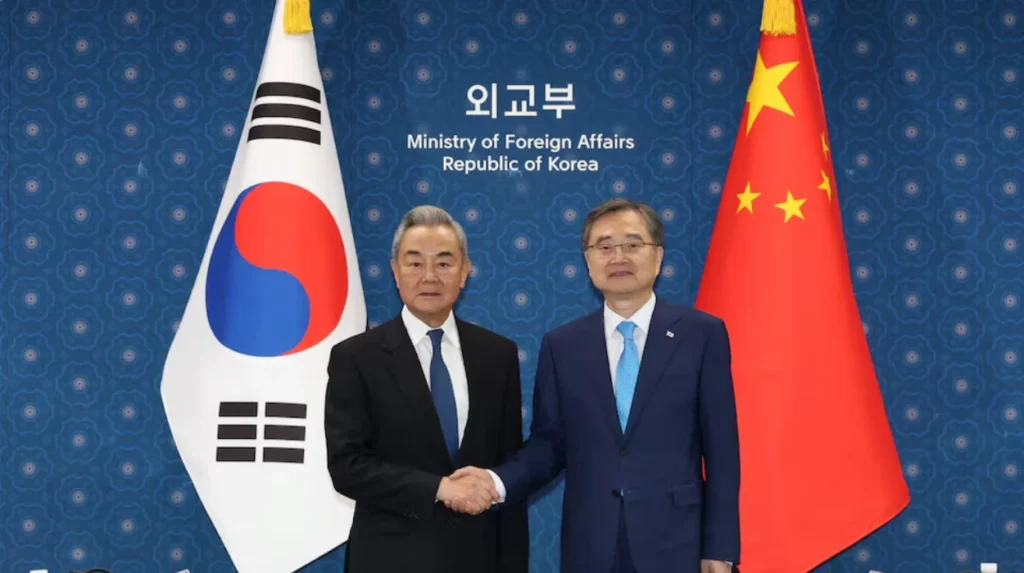
China’s top diplomat used a high-profile visit to Seoul to deliver a clear strategic message: South Korea should not align itself with Washington against Beijing, and the root cause of rising Korean Peninsula tensions lies in U.S. policy toward North Korea. During talks on 19–20 August 2026, Chinese Foreign Minister Wang Yi told his South Korean counterparts that Seoul must
“achieve genuine strategic autonomy, refrain from bloc confrontation and taking sides, and develop relations with major powers including China and the United States in parallel and without contradiction.”
The language is calculated diplomatic rhetoric, but the message is unambiguous: China is asking South Korea not to get itself involved in a U.S.-backed security structure, which is viewed by Beijing as part of containment strategy. This is a very important point in time. Wang made his statement just after U.S. President Donald Trump said he will be meeting the leader of North Korea, Kim Jong Un, sometime in 2026 and at the same time pointed out that the country had 57 “very powerful” nuclear warheads, while also instructing Pentagon to “significantly scale back” joint military drills between U.S. and South Korea. In this context, China is trying to convey a clear message to Seoul.
Root causes, not symptoms: China’s diagnosis of the crisis
At the heart of China’s public position is a specific diagnosis of what drives instability on the peninsula. Wang told reporters and officials that
“the fundamental solution to the tensions on the Korean Peninsula lies in addressing the root causes of the problem and urging the United States to abandon its hostile policy toward North Korea.”
In the Chinese diplomatic discourse, “root causes” usually means Washington’s maximum pressure tactics, sanctions regime, and military stance, and not Pyongyang’s weapon program and provocations. This discourse gives Beijing an opportunity to appear as a responsible player who is committed to peace, and at the same time shifts the responsibility to Washington. Through this discourse, China implies that the United States should first modify its policy, which means that denuclearization cannot be the only condition for negotiations. It coincides with the demands of Pyongyang for years to have security guarantees from Washington and freedom from its hostile policy. This discourse is complicated for Seoul because it has to find a balance between its alliance with Washington and a neighboring country that has a strong influence on its economy and borders North Korea.
Strategic autonomy as a euphemism for non-alignment
Wang’s call for “genuine strategic autonomy” is the conceptual core of China’s appeal to South Korea. On the surface, it sounds like a neutral plea for independent decision-making. In practice, it is a challenge to the depth and scope of Seoul’s alignment with Washington on security issues, from joint drills to missile defense cooperation and broader Indo-Pacific strategies that Beijing interprets as containment.
The phrase “refrain from bloc confrontation and taking sides” is particularly pointed. It implicitly casts U.S.-led minilateral arrangements and trilateral cooperation with Japan as “bloc” politics that exacerbate tensions. By urging Seoul to develop relations with both China and the U.S. “in parallel and without contradiction,” Wang is signaling that Beijing will judge South Korea’s China policy by whether it appears to dilute or counterbalance U.S. influence in the region. For a South Korean government seeking to stabilize ties with Beijing after years of friction over issues like THAAD and supply chains, this is both an opening and a constraint: improve relations with China, but not at the expense of appearing to join a U.S.-led camp.
Economic statecraft under the shadow of security
China did not limit its message to security rhetoric. Wang coupled his strategic appeal with a push for deeper economic integration, calling for an early conclusion to second-stage talks on a China–South Korea free trade agreement. He argued that the two sides should promote regional economic integration amid
“intensifying fragmentation in the global economy and rising trade protectionism.”
It is traditional Chinese statecraft to combine a security message with an economic incentive, thus ensuring that the price of “taking sides” is paid in the form of trade, investment, and market access. For Seoul, such reasoning is standard, but complicated by China’s growing role in its economy. China continues to be South Korea’s biggest trading partner and, as important, a critical market for Korean exports of semiconductor products, petrochemicals, and consumer goods. Meanwhile, South Korea’s IT industry has a lot to do with U.S. logistics and restrictions regarding advanced chips and equipment. Wang’s focus on wrapping up FTA negotiations is his attempt to make economic interdependence work as a safeguard against Seoul’s potential inclination to align with U.S. strategic initiatives.
The missile factor: timing that amplifies the message
The diplomatic pressure received new urgency because, on the very same day that reports of Wang’s statements became public, Japan announced that a suspected North Korean ballistic missile was launched into the ocean. While missile launches are a regular part of the security environment of the peninsula, there is never an accident as to their timing vis-à-vis high level diplomacy. To Beijing, it provides evidence that the tensions are systemic and the result of unresolved security dilemma, not just a provocation.
To Washington and Seoul, it highlights the importance of deterrence and preparedness, despite President Trump’s intentions to curtail joint military drills. This is because, while China demands that the United States renounce its “hostile policy” to decrease tensions, another missile launch demonstrates that North Korea continues to develop its missiles despite diplomatic overtures from others. South Korea finds itself caught between two stools, having to respond to yet another missile test without endangering its alliances with both Washington and Beijing.
China’s role: constructive, but not a mediator
Wang was careful to define China’s role in narrow, non-committal terms. He stated that Beijing is
“always committed to playing a constructive role in the peace and stability of the Korean peninsula,”
yet when asked whether China would mediate a potential U.S.–North Korea summit, he replied that
“that is a matter for North Korea and the United States to decide.”
This is a deliberate positioning: China wants to be seen as indispensable to any lasting settlement, but it does not want to assume responsibility for breakthroughs that may not materialize.
By leaving the issue of a summit in the hands of Washington and Pyongyang, Beijing will avoid being perceived as the culprit of failure or breakdown of any negotiations that may occur. In addition, this strategy maintains Beijing’s bargaining power: If there is progress, China will be able to say that its approach of focusing on root causes led to this situation; if not, that U.S. policy is still an obstacle. This is something that South Korea cannot hope for from China’s side.
Seoul’s balancing act in a shifting alliance landscape
South Korea’s response to Wang’s message is shaped by two overlapping realities. First, the U.S.–South Korea alliance remains the cornerstone of Seoul’s security strategy, especially in the face of North Korea’s advancing nuclear and missile capabilities. Second, economic and geographic realities make conflict with China prohibitively costly. Wang’s assertion that a
“rational, pragmatic, and positive policy towards China is entirely in line with South Korea’s interests and the trend of the times”
is designed to resonate with domestic audiences in Seoul who prioritize stability and growth.
The challenge for President Lee Jae Myung’s administration is to demonstrate that closer ties with Beijing do not come at the expense of security cooperation with Washington. Chinese reporting notes that Wang described the Lee government as one that “safeguards South Korea’s interests,” implying that cooperation with China is compatible with Seoul’s national interest. Yet every joint statement, trade deal, or security consultation with Beijing will be scrutinized in Washington for signs of drift. Conversely, every new trilateral initiative with the U.S. and Japan will be read in Beijing as evidence of “bloc” alignment.
Trump’s drill cuts: a variable China is quick to exploit
The decision to “significantly cut back on” joint U.S.-South Korean military drills adds yet another element of complexity. According to Chinese state media, the measure is a political move for the midterms and an attempt to open negotiations with North Korea – showing that the United States realizes that the pressure tactics are reaching their limit.
In the eyes of China, this confirms its claims that it is impossible to solve the problem via military provocations and sanctions alone. For South Korea, it is another tricky situation – while it may help de-escalate the situation and provide room for negotiations, at the same time it casts doubts about the reliability of U.S. commitments to the region, which may be viewed as one-sided or dictated by domestic politics. In such conditions, Wang’s appeal not to take sides sounds more reasonable: if the United States becomes less reliable, then the idea to be more independent and closer to China seems to be more logical.
What the nuclear claim adds to the stakes
Trump’s claim that North Korea holds 57 “very powerful” nuclear weapons, while not independently verified in these reports, elevates the perceived stakes of any miscalculation. Whether or not the figure is accurate, it signals a U.S. narrative that Pyongyang’s arsenal is both large and advancing. In that context, China’s insistence that the U.S. abandon its “hostile policy” reads as an attempt to cap escalation and prevent a new arms race or preemptive strike scenario that could spill over into China’s border regions.
For South Korea, the implication is clear: the margin for error is shrinking. Any policy that appears to encourage U.S. maximalism risks provoking Pyongyang and alienating Beijing; any policy that appears to accommodate Beijing too readily risks undermining deterrence and alliance cohesion. Wang’s visit and statements are designed to narrow Seoul’s room for maneuver by making the cost of “taking sides” explicit in both security and economic terms.
The road ahead: managed competition, not resolution
The most probable course of events would be not a deal but rather a long period of managed competition between China, the United States, and South Korea, whereby these countries would be competing against each other without going into military conflict. China would continue to urge Seoul to take a more balanced position through the use of diplomatic talk about “strategic autonomy” and economic means such as FTA negotiations. Meanwhile, the United States would attempt to convince Seoul of its loyalty at the same time conducting reduced-scale drills and dialogue with Pyongyang on the highest level. South Korea would try to derive some benefit from both parties without being made to choose sides. Thus, Wang’s statement that Seoul could not afford to “take sides” should not be seen as an offhand comment; it represents rather a key principle that would be implemented through Wang’s future visits, statements, and economic concessions. The test for the South Korean leadership would be its ability to develop a strategy that would allow keeping the alliance credible, dealing pragmatically with China, and still having enough room to react to the next missile test, summit announcement, or change in U.S. policies.