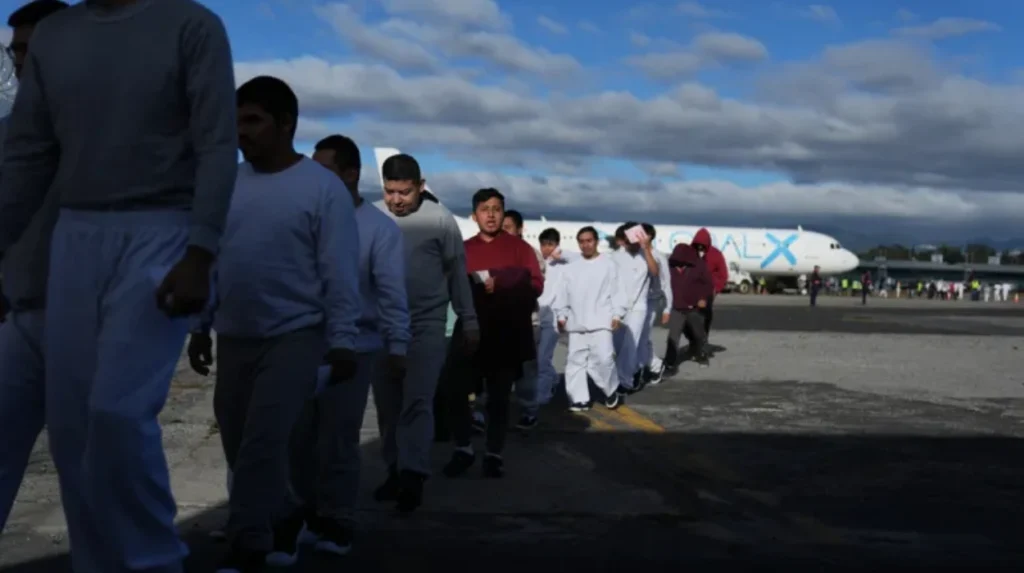
The United States has deported nearly 2,300 Mexican nationals to Guatemala so far in 2026, with dozens more sent to Honduras, in a move that marks a sharp escalation of the Trump administration’s third-country deportation strategy. This practice, which has drawn formal objections from Mexico, represents a notable departure from the long-standing norm of returning Mexican deportees directly across the southern border. Instead, U.S. authorities are routing Mexican citizens through Central American transit points before they are bused back into Mexican territory, a maneuver designed to disrupt rapid re-crossing attempts and complicate migration flows.
The way such operations are carried out has been revealed by officials’ statements and reports about the region, thus creating an image of a consistent – although somewhat controversial – policy of enforcement. As was stated by the president of Guatemala, Bernardo Arévalo, 2,284 Mexicans who were deported from the United States landed in Guatemala in the course of what he called a “transit stopover” and were then sent to Mexico. It is noteworthy that these people stay in Guatemala for no more than 24 hours and are then transferred to Mexico according to the “arrangement” with this state, having no status of refugees or asylum seekers.
The Mechanics of Third-Country Deportations
It is clear from the logistics of these deportations that there is a very well-choreographed deportation process. The deportees are brought from the United States aboard a flight that contains other deportees who are either from Guatemala or, at times, Honduras. Once they are in Guatemala or Honduras, they are held for some time – usually just less than a day – before they are bussed southward to Mexico, all the while under arrangements with Mexican immigration authorities. This contrasts with the usual land deportation process to the northern border towns of Mexico, from where many of the deportees would easily attempt re-entry soon after their departure.
The rationale behind this arrangement has been stated without equivocation. INM of Mexico commented to the Associated Press that
“the reason for this is that the United States does not want them to re-enter its territory.”
This is consistent with the general strategy of the Trump administration to disrupt migration networks and minimize the “catch and release” phenomenon by increasing the difficulty of re-entry into the United States.
Transport costs for these operations are reported to be covered by either Mexico or the United States, depending on the case, though neither government has provided detailed public accounting. The lack of transparency around funding and logistics has fueled criticism from rights advocates and Mexican officials, who argue that the practice undermines consular protection and due process for Mexican citizens.
Mexico’s Firm Objections and Diplomatic Pushback
Mexico’s response to these deportations has been unequivocal. The Mexican Foreign Ministry has issued multiple statements rejecting the practice, asserting that it violates the right of Mexican citizens to enter their own country directly. In a formal declaration, the ministry stated,
“The government of Mexico has informed the U.S. authorities of its rejection of this practice.”
This language reflects a diplomatic but firm stance, signaling Mexico’s unwillingness to tacitly endorse a policy it views as inconsistent with bilateral norms and citizens’ rights.
Further, the Foreign Ministry emphasized that
“the Mexican government has expressed its opposition to this practice to U.S. authorities and has reiterated that every Mexican citizen has the right to enter the country.”
This assertion rests on the principle that sovereign states have the authority to control the entry of their own nationals, and that third-country deportations complicate consular access, legal representation, and the ability of deportees to reintegrate safely. Mexico has also noted that it is coordinating with Guatemala and Honduras to ensure the “safe and dignified return” of its nationals, but it stresses that it accepts the return of all its nationals and has no agreement for third-country deportations.
The absence of a formal safe third country agreement is a critical point of contention. Under international and U.S. domestic law, safe third country arrangements typically require explicit treaties or memoranda of understanding that outline responsibilities for asylum processing, protection standards, and return procedures. Mexico’s repeated statements that no such agreement exists for these transfers raise questions about the legal basis and procedural safeguards governing these deportations.
Guatemala’s Position: Transit, Not Resettlement
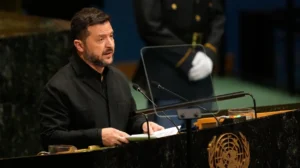
The Guatemalan leadership has tried to explain its role in these operations, presenting the operation as a temporary transit system and not an asylum process or resettlement program. President Bernardo Arévalo has made sure to make it clear that his country’s operation does not use the safe third country system, which is normally used elsewhere. Arévalo said that the Mexicans who have been deported to Guatemala are not asylum-seekers nor refugees and that they will be moved to Mexico within hours of arriving.
In doing so, Guatemala avoids becoming legally and morally responsible for providing services to the deportees but continues to cooperate with the deportation policies of the United States. Arévalo made it clear that Guatemala was not using the “safe third country” model, a position which could be politically sensitive as well as legally relevant. Describing the policy as a “transit stopover” makes it clear that Guatemala is not accepting the responsibility of taking care of the deportees; it only serves as a point where the deportees will transit through and move to another place.
Rights Concerns and Humanitarian Implications
The third-country deportation strategy raises significant human rights and humanitarian concerns. Mexican officials argue that the practice undermines the right of Mexican citizens to enter their own country directly and complicates consular protection and due process. When deportees are routed through third countries, they may face delays in accessing consular assistance, legal counsel, and family reunification services. This can be particularly problematic for vulnerable populations, including minors, victims of crime, or individuals with medical needs.
Additionally, the absence of any legal status in Guatemala during their time there leaves open the question of what kind of rights they can claim. Because they do not go through the process as refugees or asylum seekers, their status and what will happen to them during transit and what they can do in case of a violation are uncertain in media reports. The concern expressed by human rights groups is that deportees might become vulnerable to being mistreated, exploited, or arbitrarily detained because of the uncertainty. In an interview, Savi Arvey, policy director of Human Rights First, said that since May 2026, “the United States systematically has been deporting Mexicans to Honduras and Guatemala” instead of the old practice of land deportation into northern Mexico.
Broader Policy Context and Strategic Calculus
Such deportations are connected with the third-country deportation strategy of the Trump administration, which in 2026 has become broader by using more of Guatemala and Honduras for Mexican nationals. According to officials from DHS, U.S. agencies have been flying the Mexican deportees in and out of Mexico through Guatemala and Honduras even though Mexico has been willing to accept all of its citizens.
Thus, the indirect deportation method is being preferred over the direct deportation, despite the possibility of carrying out the latter, in order to achieve greater deterrent effect. This measure also shows the ongoing U.S. tendency to move border control outside of the country and utilize its partnerships in the region in order to regulate migration flows. Deporting immigrants via other countries helps the United States to shift the responsibility for managing the migrants and to complicate their journey. Nevertheless, such a practice can lead to the deterioration of diplomatic relations as well as to legal challenges.
Implications for U.S.-Mexico Relations and Regional Dynamics
The issue of third-country deportations provides yet another dimension to an already complex relationship between the United States and Mexico, marked by differences regarding trade, security and immigration issues. The adamant stand taken by the Mexicans indicates their preparedness to counter US measures they consider as undermining their sovereignty and citizens’ rights. In that case, the deportation issue may give rise to further diplomatic difficulties if not solved through some official accord.
Regionally, the participation of Guatemala and Honduras in deportation actions illustrates the rising importance of Central American countries in US immigration policy. Although that may provide some short-term benefit for Washington, it puts more stress on developing countries with limited resources and unstable governance. There is a danger that such countries will become transit points for US deportation activities.
Looking Ahead: Legal, Diplomatic, and Humanitarian Questions
With the current Trump Administration trying to improve its deportation policies, there are several outstanding questions. Firstly, the lack of a formal agreement about safe third countries can bring up the legality of this process. Secondly, diplomatic relations between the United States and Mexico will be deteriorated because of their disagreements about the deportation practices. Finally, there is a question about the treatment of deportees while being transported.