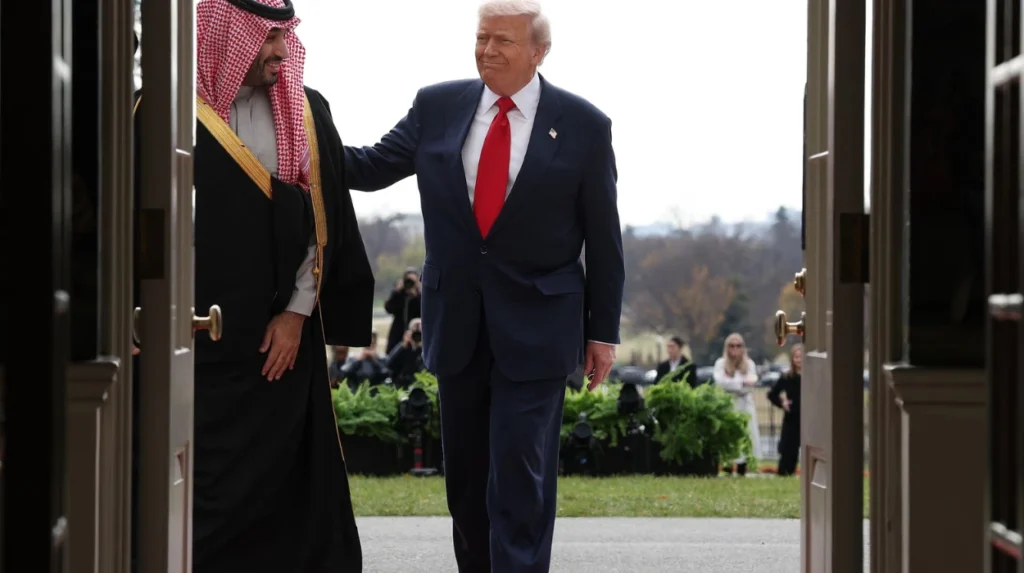
The reported U.S.-Saudi nuclear agreement marks one of the most consequential shifts in Washington’s long-running approach to the kingdom’s atomic ambitions. According to multiple reports, President Donald Trump has approved a deal that could allow Saudi Arabia to enrich uranium for civilian nuclear reactors on its own soil, a move that critics say could bring the kingdom closer to a latent weapons capability.
What lies at the heart of the debate is the very nature of the uranium enrichment process as dual use technology. While it is used for producing nuclear fuel for civilian reactors, it could be modified by any state to produce bomb-grade materials if that was the objective. This dual use nature of the technology is what has raised alarm bells right from the beginning.
What the reported deal includes
This deal, according to sources, will be named as a 123 Agreement, which is the legal framework used by the U.S. for nuclear cooperation with other countries. Sources have reported that this agreement may last up to 30 years, may include the participation of American companies in developing and constructing the program, and even pave way for an uranium enrichment facility within Saudi Arabia if the joint study of the project proves to be practical. According to sources from The Wall Street Journal, Trump finally approved this agreement late last week, and the signing is scheduled on July 22 in presence of the energy ministers of the two countries. Reuters, on the other hand, has reported that the agreement will be sent to the Congress in a few days. This deal is reported to be financially important as well.
Why enrichment is so sensitive
Saudi Arabia’s push for domestic enrichment is the element most likely to dominate the political fight. If the kingdom imports fuel, the nonproliferation risk is far lower; if it enriches uranium at home, it acquires a sensitive capability that can shorten the technical path toward weapons material. That is why past U.S. policy has generally tried to keep enrichment and spent-fuel reprocessing off the table in civilian nuclear deals.
Reuters reported in February that Trump had already informed Congress he was pursuing a civil nuclear pact that did not include the nonproliferation guardrails Washington has traditionally demanded. That report said the draft deal discussed enrichment and reprocessing while also placing U.S. industry at the center of Saudi Arabia’s nuclear buildout. In other words, the U.S. appears to be balancing commercial, geopolitical, and security goals while loosening restrictions that once served as the core of American nuclear diplomacy.
Safeguards and inspection concerns
Probably the biggest criticism of the alleged deal is that it might not have the necessary guarantees considered by experts as critical. According to Reuters, there are no typical guarantees required by the United States in order to avoid a possibility of nuclear weapon program development, while another source mentions the absence of guarantees related to the IAEA. The first question is about the possible absence of the Additional Protocol of IAEA that allows inspections in a much wider range than usual. The second question is related to the fact that the deal might allow Saudi Arabia to both enrich and reprocess uranium or prohibit the country from doing so.
Political stakes in Washington
The deal is headed into an unusually sensitive phase because Congress will almost certainly scrutinize it. Reports say the agreement is expected to be submitted for congressional review, but lawmakers may struggle to stop it unless they can assemble a veto-proof majority.
That makes the White House’s position especially important. If the administration is committed to the deal, opponents may find it difficult to block. One report explicitly said lawmakers appear unlikely to be able to stop the agreement because of the hurdles involved in overturning a presidentially backed nuclear pact. That reality could turn the debate into a symbolic as much as a legislative one, with members of Congress using hearings and public statements to register opposition even if they cannot defeat it outright.
Saudi ambitions and regional context
A nuclear energy program for Saudi Arabia has been pursued by the country for quite some time now because, apart from wanting to diversify its energy production sources, it would ensure that there is strategic parity in the region. It has always been reported that the kingdom is demanding that it be allowed to enrich uranium in its territory, which has long been one of the toughest issues in any negotiation on nuclear energy between the two countries. The regional element cannot be discounted since Iran is already at the heart of nuclear controversy in the Middle East region, and giving Saudi Arabia enrichment capability may only heighten the danger of an existing regional competition. “Allowing Saudi Arabia enrichment capabilities might explode the conflict between Iran and Saudi Arabia and the US and Iran,” said Senator Edward J. Markey.
Statements shaping the debate
The public statements surrounding the deal reveal the fault lines clearly. Senator Edward J. Markey warned that the administration was “caving to Saudi demands” and, in his view, writing “a recipe for disaster” by giving the kingdom nuclear technology without the strongest safeguards. He also called for a blanket prohibition on enrichment and reprocessing and urged adoption of the IAEA’s Additional Protocol.
On the other side of the policy debate, Energy Secretary Chris Wright told reporters in Riyadh in 2025 that he saw “a path forward” for a commercial nuclear power sector in Saudi Arabia and suggested that viable solutions existed for managing enrichment-sensitive technologies. That statement is important because it shows the administration has been moving toward this position for months, not days, and that the current approval appears to be the culmination of an extended diplomatic process.
According to several sources, it is clear that this agreement can now be made public at a time which is just around the corner. According to one report based on insider information, the deal might come into light as early as Wednesday and will be officially signed by the energy ministers of both nations. This is important because this indicates that the government needs to act fast while it has the momentum on its side. This also means that there is a possibility that the White House is counting on the fact that Congress cannot and will not intervene in stopping the deal once it is officially presented to them.
What is known and what is not
The question remains regarding the exact terms of the agreement, especially relating to the issue of safeguards, inspections, and whether the agreement will permit enrichment outright or delay it. The importance of the unknowns is due to the fact that the true significance of the nuclear deal rests more in what is under the heading rather than the heading itself. A Saudi program with strong safeguards and international oversight would have an entirely different meaning than an enrichment program with weak inspection mechanisms.
For Washington, this is more than an energy agreement. It is a test of whether the Trump administration is willing to trade away traditional nonproliferation guardrails in pursuit of deeper ties with Riyadh, broader regional alignment, and a major strategic win. For Saudi Arabia, it is a major diplomatic breakthrough that could strengthen its energy future and enhance its technological sovereignty. But for critics, it is also a warning sign: once a state acquires enrichment, it acquires leverage, ambiguity, and an option set that can unsettle an entire region.