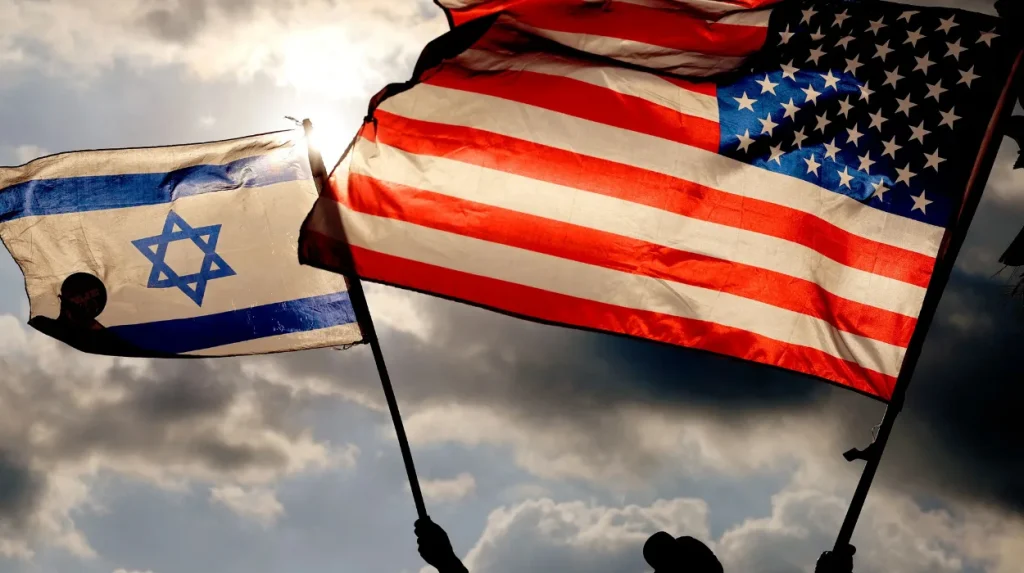
In 2025, the American nation stands very divided regarding its relationship with Israel which has been long-running. The polarization which was previously limited to domestic matters has extended to foreign policies, and it has reconstructed the bipartisan agreement that has long characterized the American support towards Israel. The 2025 Chicago Council Survey shows that Republicans have consistently expressed overwhelmingly positive opinions regarding the government and military activities of Israel but the Democrats, especially liberals and younger voters are growing increasingly critical of Israel and U.S. actions.
A solid majority of liberal democrats now (almost 69 percent) feel that the United States supports Israel too much, which is the view of only 29 percent of moderate democrats. It is also important to note that among the Republicans, there has developed a great generational gap where the younger and more conservative republicans have been questioning the level of American aid to Israel and many have put forward a more balanced approach to the region. The support of older Republicans, especially the MAGA group, is still resolute to support Israel to defend itself unconditionally. This shifting popular sentiment is an indication of a scenario in which the nature of political calculations in the U.S.-Israel relationship may have to be reshaped.
Generational Gaps and Changing Ideological Values
The attitudes of younger Americans, especially Americans aged below 35 years, are quite different compared to that of the predecessors. Polls indicate that Gen Z and millennial voters on both sides of the political divide are more interested in human rights, proportionality, and global responsibility. As older generations are more focused on strategic alliances, the younger citizens are doubting military aid without the corresponding investment in peacebuilding or humanitarian aid to Palestinians.
These differences will not just be an academic difference, they will be translated to political behavior. College campuses and the mainstream movements have reanimated the discussions on Israeli policies in Gaza and the West Bank, which affect party platforms and congressional discussion. The generation transformation is not merely a demographic transition, it is also a basic overhaul of what American global leadership ought to be in a moralistic era.
The Rise of Polarized Media Narratives
Divisions have also been enhanced by media ecosystems in the United States. Conservative media largely depict Israel as a major democratic partner in combating terrorism whereas the progressive media highlights on humanitarian costs and proportionality in war. The outcome is a two-polarized discourse that reflects a more general polarization of the domestic, which does not give much room to consensus-based accounts. This kind of polarization influences the perception of the general population about things such as the 2025 Gaza ceasefire, which is viewed as either diplomatic achievement or a moral defeat.
Policy Formulation Amidst Political Fractures
Among the Democrats, it has become even harder to reconcile ideological differences within the party. The administration of President Biden tried to take a moderate line, preserving the traditional relations of diplomatic relations with Israel and encouraging restraint in the situation of conflict escalation. Nevertheless, in July 2025, the Democratic National Committee tried to vote on a single resolution on Israel, but failed because of internal divisions. Moderate Democratic members, such as Representative Alexandria Ocasio-Cortez, insisted on clear terms on military assistance conditional to human rights adherence, a concept opposed by established and pro-Israeli Democrats.
This intra party conflict is a greater identity dilemma on what American foreign policy should be. Although the establishment democrats focus on maintaining the status quo and forming alliances with like-minded Democrats, progressives argue that unconditional aid is not in line with the reported ideas of the administration to provide justice and equality in international relations. The failure to develop a unifying position is a sign of how homegrown polarization is directly made into a foreign policy split in the making of decisions.
Republican Unity and Subtle Internal Dissent
Once believed to be a solidly thinking group, Republicans are themselves encountering ideological difficulties. The newfound adoption of Israel restoring policies by the Trump administration which reversed the policies of the Biden administration and enhanced military collaboration has cemented the conservative control in shaping Republican foreign policy. Nevertheless, other members of the party, particularly the young conservatives and libertarians, are doubting the sustainability of the strategy in the long run.
Varying numbers of 2025 GOP senators have raised alarm over the increasing expense of foreign assistance as household fiscal discussions focus on the spread of defense assets. The outcome has been a slight, but significant change: although the party leadership remains deeply aligned with Israel, its foundations start to crack due to generational and financial pragmatism.
Broader Impact on Middle East Policy and Diplomacy
The interaction of internal national partisan politics has concrete effects on U.S. foreign policy in the Middle East. The extension of the Trump administration into a post-2024 default back to a hardline position in favor of military support over peacebuilding has tightened short-term security relationships with Israel and loosened the reputation of Washington as an unbiased mediator. These contradictions were revealed during the 2025 Gaza ceasefire, through large part by pressure from the Americans. Although Washington said he had succeeded in diplomacy, critics noted that no long term political system had been put in place that can resolve the Palestinian governance, reconstruction and sovereignty.
The increasing division among the domestic factions in America also makes it difficult to coordinate with the international allies. European and Arab diplomats are becoming more inclined to think about the policy of Washington towards Israel as something reactive instead of being strategic. This undermining of predictability is a setback to the U.S. control in stabilizing the region.
Humanitarian and Security Dimensions
Humanitarian agencies in Gaza say that the U.S. policy is too much biased towards military containment at the expense of reconstruction. Even though the Congress has already sanctioned a 2-billion humanitarian package in early 2025, the majority of it was conditional upon strict oversight, which restricted the freedom of providing aid. The Israeli government, in its turn, remains focused on the goals of demilitarization, security of the border, which is fully backed by the U.S. defense agencies, however, disapproved by the international observers as inadequate to the long-term stability.
Security wise, the alliance is very strong. Joint exercises and intelligence sharing between the U.S and Israel have been stepped up as they concentrate on curbing the effects of Iran and smuggling of arms into Gaza. However, such a tactical agreement tends to marginalize more general diplomatic efforts, which strengthens the image of a militarized peace and not a lasting solution.
Navigating Complexity and Diverging Public Mandates
With the politics of America remaining disjointed, it is even harder to make sense of the foreign policy towards Israel. The very old-fashioned two-party system which had been the mainstay of how Washington was doing things was disintegrating due to the generational transformation, the influence of the media polarization and the divergence of ideologies.
The future policymakers are left with a fine balancing act between sustaining strategic alliances that are so crucial to the security interest of the United States and balancing with the newfound focus on the emerging demands of the people that focus on accountability, humanitarianism, and equity. This changing landscape may reconsider the meaning of being a supporter of Israel: it is not only by supporting Israel with military and financial assistance, but by maintaining a continuous process of diplomatic dialogue, which will contribute to sustainable peace.
In 2025, U.S. domestic divisions are no longer peripheral to foreign policy, they are its driving force. As American society grapples with competing visions of justice, power, and identity, the country’s approach to Israel mirrors these internal struggles. The coming years will test whether Washington can bridge its own divides to maintain credible leadership abroad or whether domestic polarization will continue to fragment its role in shaping peace across one of the world’s most enduring conflicts.