The 55th Pacific Islands Forum (PIF) leaders’ meeting, held in Koror, Palau from 31 August to 4 September 2026, was always going to be a high-stakes gathering on climate change, transnational crime and regional security. Instead, it has been instantly overshadowed by a sharper geopolitical confrontation: China’s explicit warning of “consequences” over Taiwan’s presence at the forum.
The language used by Beijing constitutes perhaps the clearest intervention by the Chinese state into the inner functioning of the PIF within recent years, elevating a supposedly technocratic regional conference into a platform for the ongoing battle for Taiwan’s place in international affairs. The core of the conflict is found in the decision made by Taiwanese Foreign Minister Lin Chia-lung to take part in PIF events held in Palau, based on an announcement made by him on 26 August, in which he said he would take part because Taiwan and certain other non-member “development partners” had been denied access to last year’s conference.
For Beijing, Lin’s presence is not routine diplomacy but a provocative act by what it calls “Taiwan independence separatists,” and it has responded with unusually blunt rhetoric and an open-ended threat of repercussions.
What triggered China’s warning
China’s objection crystallised around two issues: Taiwan’s physical presence at the summit and its status as a development partner within the PIF framework. Beijing’s foreign ministry stated that Taiwan has “no qualifications” to take part in the forum and described Taipei’s move as a “futile attempt to grab attention.” The ministry added that
“the Taiwan authorities sending Lin Chia-lung and other Taiwan independence separatists scurrying about all over to curry favour is a futile attempt to grab attention,”
framing the delegation’s participation as political theatre rather than legitimate engagement.
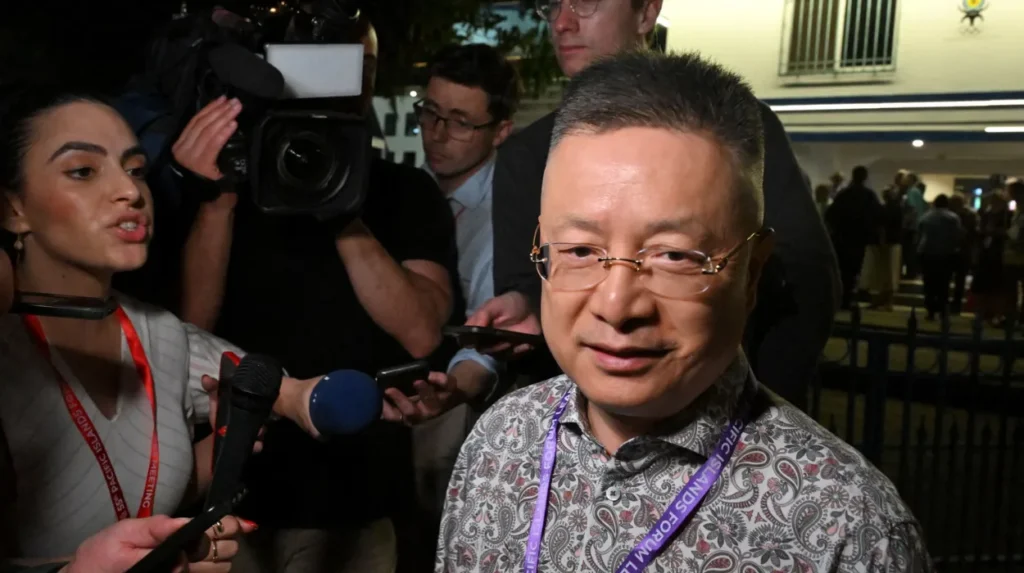
On the ground in Koror, China’s special envoy for Pacific island affairs, Qian Bo, took the message further. After Taiwan’s delegation appeared at the opening ceremony, Qian told reporters:
“There will always be consequences,”
while insisting “it’s not a threat.” He offered no detail on what those consequences might entail, but the ambiguity itself is a tool: it leaves Palau, the PIF secretariat and Taiwan to imagine the worst while allowing Beijing to deny it is issuing an ultimatum.
Qian also asserted broad regional opposition to Taiwan’s role, saying:
“This is objected to by all, so this should not have happened. We think it’s very inappropriate to do so.”
He added:
“Taiwan is not a dialogue partner for the forum so we have serious concerns,”
signalling that Beijing views Taiwan’s development-partner status as illegitimate and is prepared to challenge it directly. According to multiple reports, Qian said China had made its position “very clear” to both Palau’s government and the PIF secretariat, effectively demanding that the forum’s own rules be bent to accommodate China’s One China policy.
Palau in the crosshairs
Palau’s location has made it a host and a target. Consisting of more than 500 islands, it is one of the few countries in the world that maintains diplomatic relations with Taiwan as a holdover from the era of Cold War alignments and a common democratic value system. This explains why Palau agreed to host Lin’s delegation amid China’s strong efforts to bar Taiwan. However, this makes Palau susceptible to Chinese pressure on an issue on which it is particularly vulnerable – tourism. Palau’s President Surangel Whipps Jr. has informed journalists that China has responded to Lin’s presence in Palau by labeling it an “unsafe” destination for travellers. This reflects previous instances of economic coercion on the part of China against countries that do not toe the Chinese line in politically sensitive matters.
US and Taiwanese officials have already called the travel warning an example of economic coercion meant to make Palau revise its diplomatic position vis-a-vis Taipei. For a small economy dependent on tourism, especially Asian tourism, such actions send a clear message with immediate practical consequences. Whipps has gone public in his disagreement with Qian’s conduct, saying it is disrespectful and that Pacific leaders need to make the rules for themselves. He is reflecting the mounting exasperation of some Pacific countries at the efforts of outside powers to interfere in regional diplomatic affairs despite these countries’ dependence on Chinese investment, infrastructure financing, and development aid.
The forum’s agenda versus the China–Taiwan drama
The PIF was never meant to be a theatre for great-power rivalry. Its 2026 agenda is packed with issues that directly affect the daily lives of Pacific citizens: transnational drug trafficking, climate change, food security, renewable energy and preparations for later-year climate negotiations, including a pre-COP in Fiji and Tuvalu and COP31 in Türkiye. Leaders were expected to consider a Belau declaration on climate change and to endorse a Regional Peace and Security Action Plan for 2026–2030, which links climate risks to broader security challenges such as illicit drugs and humanitarian emergencies.
Instead, the summit opened with at least five leaders absent, in part due to the Taiwan issue and the broader tension among external partners. Palau’s own president warned that
“tensions among the region’s external partners should not distract from Pacific priorities such as renewable energy, drug crime, food security, and climate change,”
a clear plea to keep the focus on substance rather than symbolism. Yet the very presence of Qian Bo, a former Chinese ambassador to Fiji now serving as special envoy for Pacific island affairs, and the high-profile Taiwanese delegation ensured that the China–Taiwan contest would dominate headlines.
Why this matters beyond Palau
This incident has implications which go much beyond this particular meeting of a particular island nation. From the perspective of China, it is yet another challenge to its ability to influence regional institutions in accordance with the country’s One China policy. Beijing has strived for decades to isolate Taiwan in international forums ranging from the United Nations to international sporting organizations, and the Pacific region is no exception. In this case, by dispatching a special envoy and making public statements warning against Taiwan’s actions, China shows that it will not tolerate any kind of normalization of Taiwan’s participation in the Pacific regionalism even in those formats which used to include the participation of the Taiwanese delegation as a development partner of the US, Australia, New Zealand, and other countries in addition to China.
As far as Taiwan is concerned, the importance of the issue is equally significant. Being partially excluded from last year’s forum, sending Taiwan’s foreign minister to Palau is an intentional signal to the fact that the nation will not stay away from regional diplomacy in such forums which include some members officially recognizing its existence as a sovereign state.
For Pacific island states, the episode highlights a painful dilemma. Many governments seek to maximise benefits from all external partners—China, the US, Australia, Japan, the EU and Taiwan—while guarding their own autonomy. But when those partners clash openly, smaller states are forced to choose sides or absorb the fallout. The PIF’s credibility as a member-driven organisation is also at stake: if external powers can effectively veto participation by certain partners, the forum risks becoming an arena for proxy disputes rather than a vehicle for Pacific-led solutions.
What “consequences” could look like
It is fitting that Qian Bo chooses not to elaborate on his vision of consequences, given the approach typical for China in such situations. Based on past experience, there can be several measures employed. For one, tourism bans can either be formalized or intensified against Palau, as mentioned by Whipps. Other potential instruments include the dragging of development projects, withholding aid disbursement or conveying to Chinese businesses that investments in Palau or any other state which allows Taiwan’s representation are politically problematic. On a diplomatic front, Beijing can reduce engagement with the PIF secretariat or any of its member countries which allow Taiwan’s presence and instead engage more in media and diplomatic efforts to portray them as being destabilizing for the region. In the long run, China will most likely seek to have Taiwan’s exclusion from the forum officially codified through new rules of engagement of development partners within PIF.
A test of Pacific agency
The most important question raised by this crisis is not whether China will follow through on its warning, but whether the PIF and its members can assert their own agency in the face of external pressure. Australia and New Zealand have already signalled that
“the forum – not another country – will determine who attends,”
a pointed reminder that the rules of participation are set by Pacific governments, not by Beijing or any other capital.
Should the forum bow to China’s objection on the issue, it would have set a precedent of being able to have an external power dictate the position of their partner, who is disliked by them. If not, then it might have to endure an extended period of tension with China, at least economically and diplomatically, for some of its members. Whatever the outcome, the 2026 conference of the Pacific Forum held in Palau will go down in history as one where the rivalry between China and Taiwan made it decide whether to stick to its institutional integrity or please an external power.
For now, the words
“There will always be consequences”
hang over Koror like a storm cloud, a reminder that in today’s Indo-Pacific, even a regional meeting on drugs and climate cannot escape the shadow of great-power competition. How Pacific leaders navigate that shadow in the coming days will say as much about the future of the PIF as it does about the future of Taiwan’s place in the region.