This latest clash between the United States and Iran is one of the most dangerous in about a month, breaking the recent period of peace from direct attacks and emphasizing how fast things can escalate in the half-year war in just a day. On Sunday, 30 August 2026, American troops attacked two Iranian rocket launchers stationed on Larak Island, an important but tiny Iranian island close to the strait.
Hours later, Iran’s Islamic Revolutionary Guard Corps (IRGC) launched what it called “Punishment of the Aggressor,” firing ballistic missiles at U.S.-used air bases in Jordan and, by some accounts, striking a facility in the UAE. The sequence is textbook escalation: a preemptive U.S. strike framed as maritime self‑defense, followed by an Iranian punitive operation framed as sovereign retaliation.
The Larak Island strike: what Washington says it stopped
U.S. Central Command (CENTCOM) confirmed that American forces struck two Iranian launchers on Larak Island after observing IRGC personnel preparing to fire rockets carrying sea mines into the Strait of Hormuz. In a statement that set the tone for Washington’s narrative, CENTCOM spokesperson Capt. Tim Hawkins said,
“I can confirm that earlier today U.S. forces struck two Iranian launchers on Larak Island,”
adding that the action followed the observation of forces preparing to deploy rockets with sea mines into the strait.
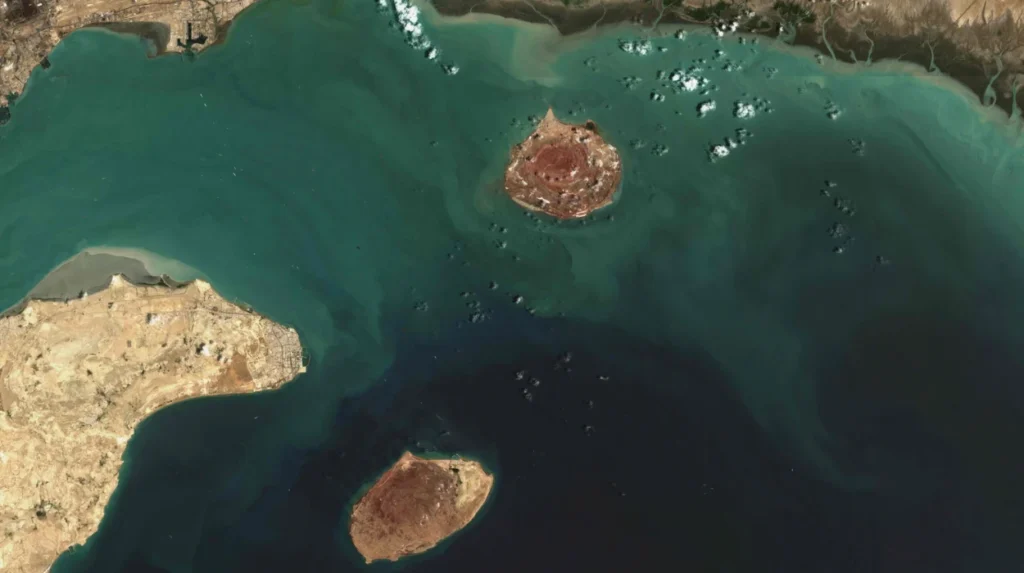
The U.S. reason is limited to self-defense and security of shipping lanes: stop the placement of mines in a strategic chokepoint for global energy flows that might endanger both tankers and warships. Larak’s geographical position provides the answer. This island is located off the southern shore of Iran, near Bandar Abbas, east of Qeshm, not far from the eastern entrance of the strait, which is only 50 kilometers wide at its narrowest point. Prior to the recent crisis, about one-fifth of world oil and LNG cargoes were shipped through this strait, which makes the mining issue especially pressing.
As one analysis put it,
“Any missile launcher, fast‑attack vessel or sea mine positioned near Larak therefore threatens more than an individual American warship. It can impede a maritime artery carrying energy from Saudi Arabia, Iraq, Kuwait, the UAE and Qatar to global markets.”
From Washington’s perspective, hitting launchers on Larak was a targeted, proportional move to deny a specific mine‑laying capability rather than a broad campaign against Iranian territory.
Tehran’s retaliation: targets, claims, and the “Punishment of the Aggressor” narrative
The reaction from Iran came quick and unequivocal. The IRGC declared that it had carried out ballistic missile strikes on two bases in Jordan which the Americans used—King Hussein (Al Muwaffaq Salti) Air Base and Al-Azraq Air Base—and that the move was directly triggered by the attack on Larak Island. In their announcement, the Guards stressed they were targeting “technical and maintenance infrastructure,” as well as “the locations of military aircraft.” State-run media in Iran also echoed this claim, emphasizing the extent of damage done to the facilities as well as the sites where the Americans stationed their planes, while U.S. sources claimed missiles bound for Jordan were shot down by America’s defenses.
The IRGC’s framing is deliberate. By naming the operation “Punishment of the Aggressor,” Tehran casts the U.S. strike on Larak as an act of aggression against Iranian soil that demands a punitive response, reinforcing a deterrence logic aimed at domestic audiences and regional allies. The Guards’ statement, as reported, emphasized that the strikes were carried out
“in response to the US‑Israeli enemy’s attack on Larak Island,”
tying the action to the broader six‑month conflict dynamic and signaling that Washington cannot strike Iranian territory without triggering retaliatory costs against its regional footprint.
Some Iranian and regional reports have also referred to a drone attack against UAE’s Al Minhad Air Base, though again confirmation levels may differ as initial conflict reporting is usually filled with such discrepancies until damages are assessed. One thing is clear – Tehran tried to extend the list of targets beyond Jordan, thus emphasizing the fact that U.S. air power centers in the region can be hit.
Casualties and the fog of early reporting
According to Iranian sources, the American attack on the island of Larak reportedly caused two deaths and two injuries, an estimate that has been widespread in state-sponsored media coverage. There have not been many confirmed reports so far, and casualties in an ongoing theater of war are always subject to revision as more data is gathered. On the Jordanian side, the IRGC has claimed “heavy damage” to infrastructure and aircraft positions, and the U.S. sources say that the incoming rockets were intercepted. The difference between the two claims is common for the first 24-48 hours after the exchange, since each party tends to present its own narrative to prove the effectiveness of its actions.
Why Larak Island matters: geography, mining threats, and oil markets
Larak is small in area but outsized in strategic weight. It sits near the northern entrance of the Strait of Hormuz, the waterway that connects the Persian Gulf with the Gulf of Oman and the Arabian Sea. Analysts note that
“Larak lies off Iran’s southern coast near Bandar Abbas, within the wider Strait of Hormuz area,”
and that the strait
“is one of the world’s most important energy chokepoints,”
carrying large volumes of crude oil, petroleum products, and LNG.
According to the Strategic Studies Institute of the US Army War College, Larak, Qeshm, and Hormuz are the three most important islands in the strait, as the former one is described as a vital chokepoint for traffic passing through the strait, as well as being home to substantial IRGC facilities. The issue of mining is central here. Sea mines are inexpensive, hard to find and destroy, and can effectively shut down or divert shipping lines. Insurance rates go up because of this, and delivery may be delayed. It is the mere threat of mining that has an influence on the oil market. This is why the threat of rocket attack coupled with mining was considered a serious danger.
As one briefing summarized,
“The strait is a critical route for global energy supplies, with about one‑fifth of the world’s oil and liquefied natural gas shipments passing through it before the current conflict disrupted traffic.”
Any action that threatens to re‑close or constrict that flow invites immediate market reaction and diplomatic pressure.
The Jordan bases: expeditionary airpower in the crosshairs
The two Jordanian bases hit by Iran’s missiles are central to U.S. and allied air operations in the region. Muwaffaq Salti Air Base at Al‑Azraq lies roughly 100 kilometers east of Amman and possesses two long runways, making it Jordan’s principal fighter station and an important American expeditionary hub. Defense reporting notes that
“the installation hosts Jordanian F‑16 squadrons and has supported an American aircraft presence involving F‑35As, F‑15Es, A‑10Cs, EA‑18Gs, MQ‑9s, transport aircraft and helicopters assigned to regional combat‑support missions.”
There was extensive investment by the U.S. in this infrastructure in the form of at least US$143 million in airlift, intelligence, close-air-support, special-operations, and personnel-recovery aprons, along with the construction of cargo aprons, taxiways, utilities and a new air-traffic-control tower in 2019. King Hussein Air Base located in the Azraq region also hosts operations and provides air defenses for the coalition, and is equipped with advanced air defenses like THAAD batteries, which are part of the anti-missile system protecting the region from attacks from Iranian missiles and drones. In taking out these infrastructure facilities, Iran is telling the world that it is capable of reaching the backbone of the U.S. air power deployment capabilities in the eastern Levant and northern Gulf, despite the fact that the extent of damage remains in dispute.
Missile capabilities and the interception debate
Iran’s ballistic missile arsenal remains a core pillar of its deterrent. Despite months of U.S. and Israeli strikes, Iranian officials insist production continues. The IRGC has dismissed claims that Iran’s missile stocks are depleted, stating,
“However, that assumption proved incorrect, as Iran’s missile capability has remained sustained and its missile production has continued.”
Tehran has also touted advances in guidance, with claims that some missiles can adjust course mid‑flight to evade defenses. One analysis noted that Iranian officials claimed their missiles now possess
“guidance and course‑changing capabilities enabling some weapons to bypass hostile air‑defence systems,”
a claim that, if true, complicates the calculus for Patriot, THAAD, and Arrow interceptors.
In the current confrontation, American reports indicate that Iranian missiles aimed at Jordan were shot down, while the IRGC has focused more on the damage inflicted on infrastructure. In reality, it is probably a little bit of both; there may have been some intercepts and others might have hit the perimeter or support areas, which will be clearer with satellite images and reports on the ground. What is important from the strategic point of view is the continuation of the threat: any success at all strengthens the message of Iran.
Statements in context: how each side frames the escalation
The language each side uses reveals its intended audience and strategic logic. Washington’s statement, delivered by Capt. Tim Hawkins, centers on prevention and proportionality:
“I can confirm that earlier today U.S. forces struck two Iranian launchers on Larak Island,”
with the justification that IRGC forces were preparing to deploy rockets with sea mines into the strait. This framing casts the U.S. as a guardian of maritime security, acting to stop an imminent threat to global shipping.
Tehran’s narrative, by contrast, is punitive and sovereign. The IRGC tied its Jordan strikes directly to the Larak attack, saying they were carried out
“in response to the US‑Israeli enemy’s attack on Larak Island,”
and described the operation as “Punishment of the Aggressor.” Iranian state media went further, claiming the attacks “destroyed” parts of the Jordan bases and caused “heavy damage,” language meant to project strength and deterrence. These statements are not just for external consumption; they reinforce internal cohesion and signal to regional partners that Iran retains the will and capability to strike back.
What this means for the next phase of the conflict
This sets the escalation clock back to zero. About one month after there have been no American strikes inside Iran, the incident at Larak shows that Washington can strike the launcher associated with mine-laying threats despite the possibility of getting barraged by missiles in retaliation. The reaction from Tehran makes clear that it will exact punishment for such a strike and increase the price tag of future U.S. actions.
The problem is that the two may go down a spiral where each sees what the other does as provocations and tightens its targeting cycle and increases its target list. In terms of the market and international diplomacy, the Strait of Hormuz continues to be the flashpoint. The slightest threat to mining, attacks on ships, or strikes against regional bases is enough to affect oil prices and pull in additional participants in the region. For reporters and analysts, the critical things to follow would be: damage assessments in Jordanian bases, any indications of mine laying/clearance in the strait, and casualty numbers from both sides.