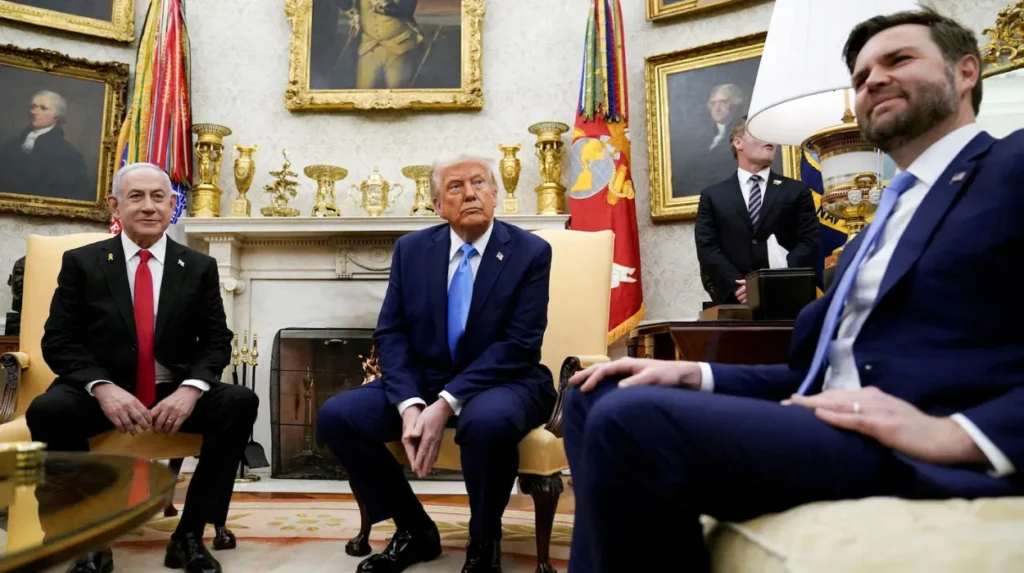
The Israeli government has rejected a 15-point roadmap backed by US President Donald Trump that aims to disarm Hamas, establish a new governing structure in Gaza and advance a phased Israeli military withdrawal from the territory.
Prime Minister Benjamin Netanyahu announced the decision during a cabinet meeting on Sunday, August 9, saying Israel would not accept the document in its current form. His position puts Israel at odds with the Trump administration, which has presented the plan as a major step towards ending the Gaza conflict and beginning reconstruction.
“Israel rejects the 15-point document,”
Netanyahu said, according to the official translation of his remarks.
“The IDF will not carry out any withdrawal until Hamas is genuinely disarmed, and it will continue to thwart threats against our forces and citizens.”
This refusal is important as the peace plan is not only about ceasefire. It is about settling the toughest questions that arise after the war: who will be controlling Gaza, who will manage the security of Gaza, when and how Hamas will give up their arms, and when Israel will withdraw its troops from Gaza. What is the main problem of the peace plan? It is about the chronology of the process. While Hamas and the Trump administration advocate phased withdrawal of Israel and phased disarmament of Hamas, Netanyahu says that Israel cannot leave its military positions unless Hamas gives up all arms and stops being an armed force.
Netanyahu’s Demand for “Genuine” Disarmament
Netanyahu has repeatedly argued that Hamas cannot be allowed to retain even a reduced military capability. He said Israel’s demand includes the removal of heavy weapons, lighter weapons, rockets, explosives, tunnels and other infrastructure that could be used to attack Israel.
“When I say Hamas is disarmed, that means the heavy weapons, the less heavy weapons — all the weapons,”
Netanyahu said. He also rejected what he described as a symbolic or incomplete arrangement.
“It must be genuine disarmament, not fictitious disarmament.”
The language used clearly shows Israel’s key security argument – prior deals and ceasefire have not stopped the Palestinians from regaining their capacities. The Israeli government has therefore made it a point of demanding the total disarmament before any sustainable ceasefire can be established. In addition, the Israeli government has called for demilitarisation of the Gaza Strip and the disarmament of weapons.
According to a statement issued by the Israeli government, no withdrawal will occur along the Yellow Line without the disarmament of Hamas and demilitarisation of the Gaza Strip. Therefore, for the Israelis, the matter goes beyond the disarmament of Hamas. It also encompasses the prevention of the recreation of weapon factories, command centers, smuggling networks and tunnels among others.
What the 15-Point Plan Proposes
The roadmap has been formulated using the Board of Peace created by the Trump administration, with the participation of international and regional mediators including Egypt, Qatar and Türkiye. According to a United Nations document, the mechanism is described as a tool for the implementation of the broader Gaza peace and reconstruction agreement. The plan suggests the establishment of a provisional Palestinian government called the National Committee for the Administration of Gaza.
The committee will deal with civil administration and governance, while the armed groups including Hamas will be excluded from administration and military control. The roadmap also includes the suggestion of forming the International Stabilization Force.
Its underlying principle is described as “one authority, one law and one weapon.” In practical terms, that would mean that no faction, including Hamas, could maintain an independent armed wing or parallel security structure.
These include conditional amnesties, buyback programs of the weapons and assistance for reintegrating individuals who will give up armed activities. The idea is to distinguish people who can be reconciled to being civilians from the armed military wing of the organization. According to one version of the plan as described in Reuters, the destruction of tunnels and disarmament of Hamas is to be implemented gradually during a period of about eight months. It is suggested that Hamas will be required to disclose information on tunnels and military bases of its and to permit verification by some international organizations of weapons surrendering.
The idea of gradual disarmament is meant to tackle the problem that an underground armed group will be quite hard to disarm within a day. The gradual disarmament process will give an opportunity to check whether the party fulfills its obligations prior to each further Israeli withdraw.
The Dispute Over Sequencing
The most serious disagreement concerns what happens first.
Israel requires Hamas to disarm totally prior to any Israeli withdrawal of its Defense Forces from Gaza. On the other hand, Hamas conditions its disarmament upon an Israeli withdrawal from the territory of Gaza as well as other guarantees of no military activities on the part of Israel after Hamas disarms itself. The plan based on US support under the Trump administration intends to reconcile the two conflicting approaches through a reciprocal solution. According to the approach in question, Israeli troops should gradually withdraw in return for the disarmament of Hamas as well as transparency regarding the disclosure of the tunnel networks and recognition of the newly established Gaza authority.
Netanyahu refuses such an approach because, according to Israel, it may give Hamas secret weapons and the chance to regain its strength after Israeli troops withdraw from Gaza. In turn, Hamas fears that Israel will remain in control of Gaza without ever withdrawing its forces. Thus, the mutual mistrust constitutes the major drawback of the plan in question. It requires the trust in each step on the part of both parties.
The plan could therefore fail even if all parties formally endorse the same document. The issue is not only the language of the roadmap but also the interpretation of terms such as “complete disarmament,” “withdrawal,” “security perimeter” and “international oversight.”
Hamas and Washington Support the Framework
Hamas has said it remains committed to the proposal and has called on Washington to pressure Israel to accept the arrangement. The group’s position is that the second phase of the US-brokered framework should proceed through reciprocal commitments rather than unilateral Israeli demands.
A Hamas official previously told NPR that Israel must withdraw first or at least begin withdrawing before the group completes the surrender of its weapons. Hamas has also argued that disarmament must be connected to the end of Israeli military operations, the lifting of restrictions and the establishment of a Palestinian administration.
Trump, meanwhile, has described the disarmament agreement as a historic breakthrough. His Board of Peace announced in late July that Hamas and other armed groups in Gaza had agreed in principle to complete disarmament.
The Trump administration has an interest in demonstrating that its Gaza initiative can produce results. A failure to secure Israeli acceptance would weaken Washington’s claim to be directing the postwar diplomatic process and could revive criticism that the plan was announced before the core dispute between Israel and Hamas had been resolved.
The US also faces the challenge of maintaining its close military relationship with Israel while pressing Netanyahu to accept a withdrawal timetable. Trump’s influence over Israel is substantial, but Netanyahu has now made clear that he is prepared to resist pressure if he believes the proposal threatens Israel’s security or his political survival.
Far-Right Pressure on Netanyahu
The decision made by Netanyahu cannot be divorced from the political realities of the ruling coalition. Ministers of the far right wing have been against the proposed deal which might give Hamas political relevance or necessitate withdrawal of Israel from Gaza areas controlled by the Israeli troops. National Security Minister Itamar Ben-Gvir described the deal as unacceptable and advocated for the use of military force against Hamas. Other ministers of the far right wing of the ruling coalition have called for continuation of the war until the destruction of Hamas. These ministers might pose a challenge to the stability of Netanyahu’s government.
If the far-right wing leaves the ruling coalition, then the prime minister might lose the parliamentary majority and his government may collapse before time. Netanyahu is trying to reconcile two contradictory political messages. While in front of Washington, he must prove that his country is taking part in the peace process, on the other hand, to his far-right partners, he must prove that he will not accept the withdrawal.
His cabinet statement was designed to make that distinction clear. Israel is not necessarily rejecting negotiations with the United States, but it is rejecting a roadmap that places Israeli withdrawal on a timetable linked to gradual rather than completed disarmament.
Election Pressure and Netanyahu’s Political Future
Israel is due to hold its national election on October 27, 2026. It will be the first general election since the Hamas-led October 7, 2023 attack and the wars that followed. Reuters described the vote as an opportunity for Israelis to judge Netanyahu’s handling of the Gaza conflict, the security crisis and the wider regional confrontation.
The election is viewed by many commentators as a referendum on Netanyahu’s administration. Netanyahu’s supporters maintain that only further military pressure will ensure no attack and concessions before Hamas is totally disarmed will put Israel in danger. Netanyahu’s opponents believe that the government has not won the decisive victory in the war, extended the hostilities, harmed Israel’s reputation abroad and did not find a political solution to the problem.
The destiny of the other hostages and humanitarian situation in Gaza are likely to play a role in voters’ decisions. Israel’s electoral system provides the principle of national proportional representation in the 120-member Knesset. Political parties need to get at least 3.25% of the vote in order to get into the parliament and a majority to form a government needs 61 seats in total. According to current polls, Netanyahu’s party may fail to win the majority.
That uncertainty makes the Gaza issue especially sensitive. Netanyahu may calculate that refusing a phased withdrawal protects him from losing far-right support. At the same time, an open confrontation with Trump could alienate voters who believe Israel needs American diplomatic, military and economic backing.
Humanitarian Costs of the Deadlock
The diplomatic dispute is unfolding while Gaza remains in a severe humanitarian crisis. OCHA reported that more than 150 Palestinians were killed in Gaza in July, including dozens of civilians, making it the territory’s deadliest month since the beginning of 2026.
According to the statistics provided by the Gaza Ministry of Health through OCHA, there have been 1,254 fatalities and 4,121 injuries among Palestinians from the announcement of the ceasefire agreement on October 10, 2025, until August 5, 2026. OCHA has also stated that 804 people have been retrieved from under the rubble within the same time period. These statistics are provided by the Gaza Ministry of Health, without the verification of the United Nations in all cases. UN agencies have continued to report on civilian casualties, attacks against schools and hospitals, displacement, and restrictions on humanitarian operations.
According to UNICEF, 300 children had been killed during the first 300 days since the announcement of the ceasefire agreement, showing the difference between the diplomatic definition of ceasefire and its realities for civilians. The humanitarian situation provides a need for the signing of an agreement; however, it makes the process of disarmament more difficult. International agencies will require safe passage, credible security guarantees, and functioning civilian administration.
The near-future course of the roadmap will depend on whether the U.S. can convince Israel to agree to an alternative sequence of events. Possibilities may involve an Israeli withdrawal from certain territories accompanied by arms transfers and further withdrawals. But the rhetoric coming from Netanyahu suggests that Israel will not withdraw on the basis of promises from Hamas alone. The proposed new approach will likely have to entail independent verification of weapons sites, tunnel systems, command posts, and the disposition of Hamas forces.
The core contradiction has yet to be addressed. Israel claims that it cannot withdraw unless Hamas is first disarmed. Hamas insists that its disarmament needs to be matched by Israeli withdrawal and political concessions. President Trump’s roadmap seeks to turn that contradiction into a step-by-step process, but Netanyahu’s rejection demonstrates that the fundamental bargain has not yet been made.
Unless the United States can produce a formula that satisfies Israel’s security demands without abandoning the reciprocal structure supported by Hamas, the 15-point plan may become another diplomatic framework trapped between incompatible conditions. Its fate will shape not only the future of Gaza but also the stability of Netanyahu’s government, the credibility of Trump’s Middle East policy and the political direction of Israel before the October election.