President Donald Trump’s latest retreat from threatened military escalation against Iran has handed Tehran a powerful talking point: the United States, not Iran, appears uneasy about where the confrontation is headed. What is remarkable about the turnabout is not just the fact that it indicates yet another sharp change of position by the administration, but also the way in which it squares so perfectly with the storyline that the Iranian officials have been trying to tell their own citizens, as well as their regional friends and enemies, all along: that the president is more afraid of getting drawn into a bigger war than they are. The fact that the president has threatened action, backed down, and offered a chance at negotiations has thus become the defining characteristic of the new phase of the conflict, as described by Reuters and television reports.
How the latest turn unfolded
The most recent episode came when Trump said he had canceled a planned attack on Iran after, as he put it, being told by Iran and other Middle Eastern countries to hold off because
“the perimeters of a deal has been agreed to.”
He said the arrangement would include the
“Immediate, Complete, and Total OPENING OF THE HORMUZ STRAIT”
and an end to Iran’s nuclear threat, and he added that he had agreed to pause the strike “for the future benefit of the WORLD” and for what he called the
“survival of a successful and prosperous Iran.”
That was not an isolated statement. Earlier reports show Trump repeatedly announcing planned strikes, then canceling them or suggesting they were unnecessary because an agreement was close. In one June episode, he wrote on Truth Social that discussions with the Islamic Republic had reached the highest level of Iranian leadership and had been approved, leading him to cancel
“the scheduled strikes and bombings.”
The war talk behind the pause
Whiplash is an essential part of the equation that explains why this tale is so resonant in Tehran. As Axios noted, Trump had said he was prepared to take “strong military action” in case of a breakdown of talks with Iran, while other sources had mentioned that he had already foreshadowed new attacks but decided to back down. The language could be even stronger at one point. In June, some media outlets said that Trump had threatened to strike Iran “VERY HARD” and considered attacking its oil infrastructure, including the Kharg Island, but then changed his mind toward a deal. This narrative works well for Iran politically because…
Why Tehran’s message works
Iranian officials are not simply reacting to Trump’s latest pause; they are actively shaping the interpretation of it. The line they want to reinforce is simple: if the U.S. President repeatedly threatens force, then pulls back, it suggests Washington is constrained by fear of a broader war and the regional fallout that could follow. That is the essence of the narrative captured in the reporting:
“They are not the ones who fear war — Mr. Trump is.”
That framing is especially effective because Trump’s reversals are public, dramatic and easy to cite. They allow Iranian officials to present U.S. strategy as reactive rather than dominant, and to tell audiences that even the threat of American power has limits when faced with sustained conflict risk, market volatility and regional blowback.
The Hormuz factor
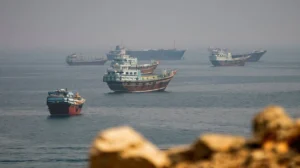
The Strait of Hormuz lies right at the heart of Trump’s demands, and that is no coincidence. By making any pause in hostilities contingent upon the complete reopening of the strait, Trump elevated the conflict above the level of a bilateral confrontation between the U.S. and Iran. The strait’s opening was suddenly elevated to an issue of international energy trade, maritime security, and the general welfare of the whole region. It is important for the reason that control over the strait is one of the strongest levers of pressure for Iran. Even if the strait remains open, just the mere threat of its closing will increase prices, destabilize markets and cause panic in the capitals of the world.
Signals from the region
The regional dimension is also important. Trump said Iran and other Middle Eastern countries asked the U.S. to stand down, and he claimed Israel had joined in that commitment. Reports also indicate that mediation efforts were underway through Oman and that Saudi Arabia’s crown prince urged Trump to “prioritise dialogue” in the widening crisis.
That suggests Trump’s pause was not simply a unilateral retreat. It reflected pressure from allies and intermediaries who appear to have judged that another round of escalation could rapidly escape control. In that sense, the pause itself can be read two ways: as evidence of Trump’s flexibility, or as proof that the diplomatic and military costs of escalation were becoming too high even for Washington’s preferred pressure campaign.
Military readiness and the risk of collapse
Notwithstanding the ceasefire, the military background continues to operate actively. As per Reuters-affiliated live coverage, the military leaders of the United States were reported to have been informed about the plans to increase strikes and even return to the state of full-fledged war in case such decision would be made. At the same time, as per the same report, the military in the USA remained “quite ready,” and preparations for possible combat appeared to be better developed compared to the previous stages of the conflict. It is crucial since it implies that the current ceasefire is not an element of real peace but only a conditional pause in the course of an armed conflict.
What Trump is signaling
Trump’s public rhetoric is founded on leverage. His intent is to convey to Tehran that there is a credible threat of military strikes, but also leave room for a deal that he can spin as a victory. That is why his rhetoric vacillates so drastically from threats of “very hard” attacks to cancellation of those attacks because a deal is imminent. However, the issue is that repeated changes in policy undermine the concept of deterrence. If a leader makes a threat, but constantly postpones actions, then the adversary might understand that a threat can be negotiated away. That opens up new opportunities for Iran to play the weakling and to portray the US as indecisive and afraid of a war. Instead of a diplomatic episode, this confrontation becomes a battle for perception. On the one hand, Trump needs to look tough, but at the same time, he does not want a war in the region. On the other hand, Iran wants to demonstrate that it can withstand pressure.