Hamas has made commitments regarding a plan that entails the gradual disarmament of its military branches and other Palestinian groups in Gaza, a development that has been greeted with praise by U.S. President Donald Trump, who described it as a landmark towards the eventual disarmament of Hamas and the establishment of a unified Palestinian state. The commitment, which has been reached under the auspices of the Board of Peace of Trump’s administration, with the assistance of Egypt, Qatar, and Türkiye, comes at a critical moment of the second phase of the 20-point Gaza plan developed by Trump.
Trump announced the deal on Thursday, calling it
“a HISTORIC agreement for the COMPLETE DISARMAMENT of Hamas and all other armed groups in Gaza. This is a monumental step toward lasting PEACE and SECURITY.”
As stated in a Truth Social post, with an approval from the Board of Peace officials, the deal is the first time where both Hamas and its fellow militias agree on a framework that leads to giving up their arms and handing over their control of security to a new governance system of Gaza. However, while this is said in a triumphal manner, the truth about how the deal is carried out shows the extent to which it is vulnerable. The agreement is made through a “zero trust” framework of implementation, where there is the assumption that neither Israel nor Hamas would do what they promise to without taking any reciprocal action.
The architecture of the deal: one authority, one law, one weapon
At the core of the disarmament framework is the principle that Gaza will operate under “one authority, one law, one weapon,” a formula long championed by Palestinian unity advocates and now embedded in the U.S.-led plan. Under this formula, only the National Committee for the Administration of Gaza (NCAG)—a 15-member Palestinian technocratic body established under the Board of Peace—will hold the legitimate monopoly on force and governance.
Hamas is to cease its involvement in governing Gaza, while its armed formations and other militias are to either disband themselves or merge into the NCAG security framework. The document calls for creation of a new Palestinian police force under the NCAG control, that will be responsible for recruitment, vetting and deployment of policemen to seize and register firearms throughout the Strip. First of all, police weapons are to be surrendered, while in later stages the plan foresees dismantling of heavy weaponry, ammunition depots, tunnels and military infrastructure. Importantly, it is all armed forces in Gaza that the document mentions, including not only Hamas but also Islamic Jihad and militias opposing Hamas that were supplied by Israel during the war, so that no parallel armed forces can come to life again.
It seems that the document suggests a different governance structure to destroy the vicious cycle of two governments ruling over Gaza almost throughout the last two decades, when Hamas had its own government in Gaza as well as its own military wing. Nevertheless, the success of this gamble depends upon NCAG’s ability to provide the services, security and law and order independently of foreign influence.
A phased, monitored disarmament over six to eight months
The disarmament roadmap is structured in five phases spanning roughly 200–250 days (about six to eight months), with each stage contingent on verified compliance by both Palestinians and Israel. The first phase, lasting about 15 days, tasks NCAG with assuming security and administrative control and preparing for weapons collection.
The second phase, from days 16 to 40, requires Israel to remove heavy weaponry such as tanks and artillery from areas it controls, while an International Stabilization Force (ISF) begins deploying as a buffer. The third phase, from days 31 to 90, is the most intensive: Hamas must surrender all heavy arms and military equipment, and consent to the destruction of its tunnel network, weapons-production facilities and related infrastructure.
Phase four is a period from days 91 to 250 and concerns gathering and registration of remaining small arms, some 60,000 AK-47 type rifles belonging to Hamas, based on Palestinian laws which will include buy back schemes for voluntarily submitted small arms. In phase five, there is total verification, after which Israeli troops will be withdrawn from Gaza except for some undefined security zone, and the large scale rebuilding process can begin. Weapons Collection Verification Committee headed by chief diplomat for Board of Peace, Nickolay Mladenov, is supposed to oversee the process and certify each phase. ISF, a multinational force under the Board of Peace, will help train the new Palestinian police force, aid in gathering weapons and act as a buffer between Palestinian controlled regions and Israeli troops.
What Hamas says: agreement with conditions, not capitulation
Hamas officials have framed their acceptance of the plan not as surrender but as a negotiated compromise that preserves Palestinian rights and links disarmament to concrete Israeli concessions. A senior Hamas official told the BBC and other outlets that the group has agreed to the Board of Peace’s plan to completely disarm in Gaza, with an official statement expected. Ghazi Hamad, a member of Hamas’s negotiating delegation, said:
“These negotiations were difficult and hard, and we tried to reach the best possible formula that was achievable”
while safeguarding Palestinian rights.
Crucially, Hamas has insisted that disarmament will not begin before Israel withdraws. Hamad told Al Jazeera:
“We will not take any steps regarding disarmament before Israel withdraws from the Gaza Strip,”
adding that the NCAG would carry out disarmament without Israeli involvement. This conditionality is central to Hamas’s narrative: it presents the deal as a reciprocal arrangement in which Israeli withdrawal and reconstruction are the price for laying down arms, not a unilateral concession.
A Hamas source also indicated the group had proposed amendments to certain articles in the roadmap and was awaiting an Israeli response, suggesting that even within the broad agreement there are unresolved technical and political details. This aligns with Hamas’s historical pattern of accepting frameworks in principle while negotiating specifics that affect its leverage, including the timing of withdrawals, the scope of the security perimeter Israel might retain, and the mechanisms for verifying compliance.
Israel’s silence and skepticism: preconditions, guarantees and red lines
Up until now, Israel has not offered any kind of public reaction regarding Trump’s initiative, a non-statement itself indicative of prudence on their part. In fact, the Israeli representatives have always emphasized that full disarmament and demilitarization are prerequisites to the withdrawal, while one of Israeli political figures described the suggested agreement as something which does not “satisfactorily” answer to Israeli demands. This contrast between U.S. optimism and Israeli prudence is rather typical for Middle Eastern politics, where the American side always announces some major developments prior to the official endorsement of those from the Israeli authorities.
As Israeli Defense Minister Gideon Sa’ar said previously, the attempts of Hamas to dismantle its government was nothing more than a “trick”, since as long as it has weapons, any civilian government will be subordinate to it. And that point of view is based on the Israeli perception of Hamas as an entity which would never agree to give up its weapons and would take any opportunity of signing an armistice or building any sort of government in order to re-arm itself and prepare for further warfare.
The Israeli government also faces domestic pressure to ensure that no agreement leaves its citizens vulnerable to renewed rocket fire or cross-border attacks. That means any deal must include robust verification, rapid-response mechanisms if violations occur, and clarity on what happens if Hamas backtracks. Without those guarantees, even a technically sound disarmament plan may struggle to win Israeli public and political support.
Regional mediators and the shadow of Iran
Trump credited Egypt, Qatar and Türkiye for helping broker the agreement, and U.S. officials said these mediators exerted “intense pressure” on Hamas to accept. Egyptian intelligence chief Hassan Rashad played a key role in shuttle diplomacy, while Qatari and Turkish envoys leveraged their channels with Hamas leadership to push the group toward a deal. The involvement of these regional actors underscores how the Gaza file has become a nexus of broader Middle East alignments, where Gulf states, Turkey and Iran all jockey for influence.
U.S. officials also noted that Iran tried to persuade Hamas to reject the deal, but Hamas did not follow Tehran’s advice.
That detail is significant: it suggests that Hamas, while ideologically aligned with Iran, retained enough autonomy to make a pragmatic calculation that the costs of rejection outweighed the benefits. Whether that calculation holds if the deal stalls or if regional tensions flare remains an open question, but for now it signals a crack in the assumption that Iran can always veto Palestinian moves.
The human cost and the stakes for reconstruction
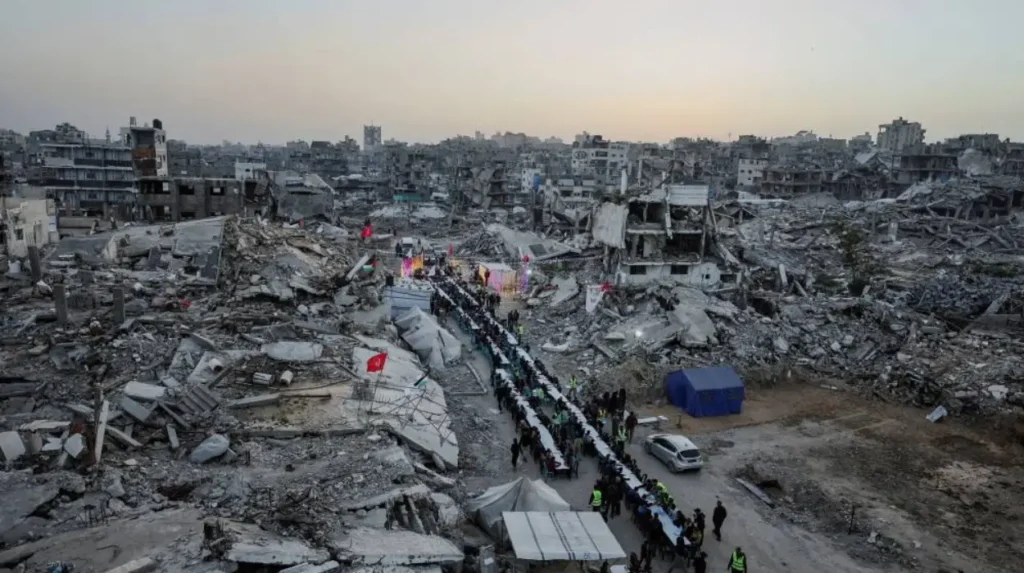
Since the outbreak of the war on October 7, 2023, more than 73,000 Palestinians have been killed, and more than 174,000 people have been injured in Gaza, according to the Gaza Health Ministry, run by Hamas, and Israeli forces have kept on attacking after the ceasefire, leaving at least 1,214 Palestinians dead and 3,977 wounded since October 10, 2025, according to recent reports quoted in news articles. In this context, the prospect of reconstruction becomes not only a hope but also a means to an end. The deal is directly related to major reconstruction processes which cannot start before the necessary security framework is in place and thus provides a strong motivation for Gazans to support demilitarization if they think it will improve their life. At the same time, reconstruction may pose serious political threats to NCAG. Being the key to foreign aid and jobs, NCAG may become the target for those factions which would feel themselves excluded from the process. Slow reconstruction or unequal reconstruction of particular territories or communities may result in growing resentment.