The 2026 FIFA World Cup Final in New York–New Jersey was supposed to showcase football and trilateral cooperation among the United States, Canada and Mexico as co‑hosts. Instead, it became an unexpected backdrop for a sharp political confrontation over climate, cross‑border pollution and economic pressure. At the centre of this clash: the moment “Trump confronts Carney” over thick wildfire smoke drifting from Canada into US cities, and the US president’s choice to escalate the issue into a tariff‑laden dispute rather than a purely environmental emergency.
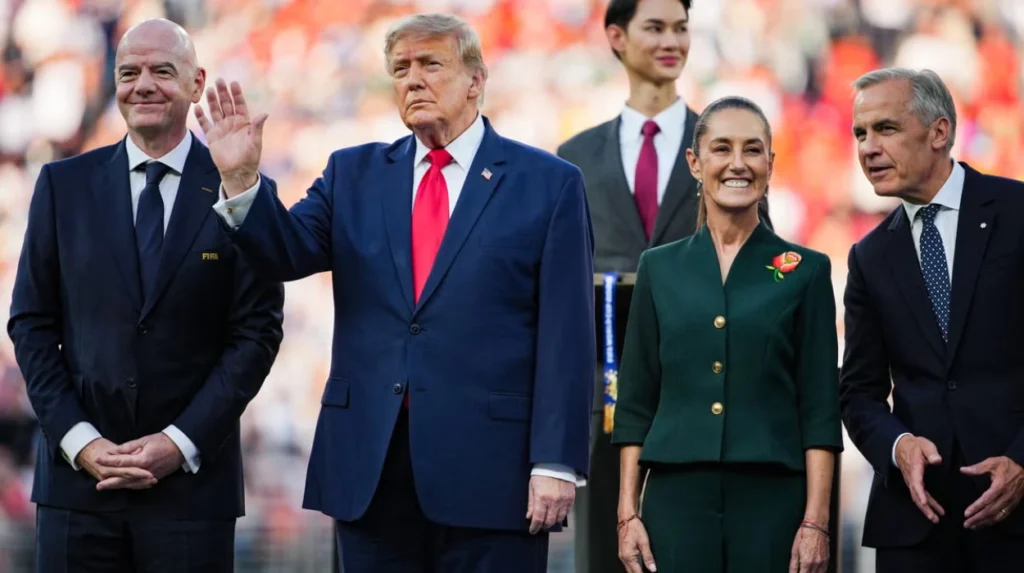
With both Spain and Argentina vying for the cup, US President Donald Trump, Canadian Prime Minister Mark Carney, and Mexican President Claudia Sheinbaum were sitting in the stand during an apparent show of solidarity among the nations. However, the solidarity was not strong. With just a couple of days before the final game took place, smoke pollution due to forest fires in Canada and Northern America had flooded the Northeast, resulting in unhealthy levels of smog, putting into question the feasibility of hosting the match. While the rains and thunderstorms dispersed much of the smog, the political tensions remained high, with the smog being an international issue for Trump.
Trump’s rhetoric: poisoned air and punitive tariffs
Trump seized the moment after returning to Joint Base Andrews, portraying his interaction with Carney as a decisive, almost confrontational intervention. He told reporters that he had directly pressed his Canadian counterpart during the game, framing the smoke in stark, almost apocalyptic language. As he put it,
“I told him you got to stop these fires from coming in and poisoning our air”
– Donald Trump. The choice of words – “poisoning” – was not accidental. It cast the smoke as a hostile intrusion, a kind of contamination that the US should not have to tolerate.
He doubled down on this framing by stating that “Our air has been poisoned” – Donald Trump, turning a meteorological and climate‑driven episode into a narrative of victimhood and external threat. In his account, Canada was failing in basic stewardship, and the United States was paying the price in closed businesses and sickened residents. He claimed that smoke had forced commercial closures across affected areas, arguing that these disruptions had real economic consequences. The economic framing paved the way for the next step in his rhetoric: the suggestion that Canada should compensate the United States or face tariffs.
In the same media encounter, Trump tried to balance criticism with a veneer of personal rapport. He stressed that
“I have a good relationship with Mark Carney, but you know, we got to stop the fires up there”
– Donald Trump. That phrase – “good relationship” – is a familiar device in his diplomatic language, often preceding threats or demands. The real core of his message came when he floated the idea of making Canada pay, either through direct damages or trade measures:
“If we can help them, we’ll help them. But maybe they should pay us some damages or something, or we should do some tariffs”
– Donald Trump. Here, the environmental dispute is reframed as a negotiation over liability and leverage.
On social media and in follow‑up comments, Trump sharpened his accusations, blaming Canada’s forest practices rather than the underlying climatic conditions. He argued that Canada had
“not properly maintaining their Forests, and Brush… Willful Negligence”
– Donald Trump, turning a complex wildfire season into a matter of alleged policy failure. He described the incoming air as
“filthy, polluted, and unhealthy, dangerous, and totally unacceptable”
– Donald Trump, insisting that the smoke had become a recurring, “yearly” problem. Crucially, he claimed the pollution was “costing the United States Billions of Dollars” – Donald Trump and asserted that these costs
“must of necessity be added to the TARIFFS Canada is currently paying”
– Donald Trump.
Taken together, these statements show a consistent stance. Trump is using strong emotive language to mobilise domestic anger about air quality, assigning responsibility squarely to Canada, and tying environmental harm to trade punishment. The episode at the World Cup final becomes one moment in a broader push to formalise cross‑border pollution as a billable offence.
Carney’s response: quiet diplomacy amid an emergency
On the other hand, Mark Carney was much more reserved in his reaction to the game itself. Coverage of the game noted that there were no obvious tensions between the two leaders during the match, even though President Trump characterized it as a “frank discussion.” Carney himself has refrained from making any detailed public statements regarding the conversation in the stadium, preferring an indirect narrative to a more direct one. The conversation at the match is told mostly from Trump’s perspective, which comes as no surprise considering how the news cycle has been dominated by him in recent days.
However, it does not mean that Canada sat back and did nothing. Mark Carney has been quite vocal in communications related to the wildfire problem in general, choosing to talk about the national approach to emergency management rather than mutual finger-pointing. In interviews and in official statements made throughout the course of the wildfire season, he has been grateful to all those who have been on the frontline of fighting the fires.
Carney’s messaging stresses scale and complexity. At different points in the current wildfire season, Canada has reported between roughly 858 and 971 active wildfires nationwide, with about 111 to 239 classified as out of control, and a burned area surpassing 2.4 million hectares, or around 5.9 million acres. These figures underpin his description of an “all‑hands‑on‑deck” approach. Under Carney, the federal government has deployed more than 5,300 firefighting personnel and nearly 300 aircraft, integrated data, drones and advanced thermal imaging into real‑time fire detection, and mobilised the Canadian Armed Forces for air evacuations, especially in heavily threatened regions such as Manitoba.
Where Trump emphasises alleged “willful negligence,” Carney portrays the fires as the product of extreme heat, drought and climate‑driven volatility, layered onto vast, remote forest areas that are difficult to manage even under normal conditions.
He has formed Canada’s Incident Response Group, negotiated with provincial governments and indigenous leadership, and highlighted that national preparedness of Canada has reached its maximum Level 4. According to him, the problem is not that simple of removing the brush because it is an environmental problem at a larger scale that requires coordination, resources and policy adaptation. What Carney has never mentioned in his public statements is Trump’s concept of “damages” or punitive tariffs. The officials and experts from Canada are only talking about joint climate adaptation and emergency planning because the transboundary smoke incidents are regional challenges and not “fault” of a country.
This difference in perspective is going to create long-term conflict where one sees wildfire in terms of global climate and crisis management while others see it in terms of grievance.
The fires behind the feud: data and dynamics
The confrontation at the World Cup final cannot be understood without the underlying fire dynamics. The specific smoke episode that triggered the latest wave of US anger began in early July, after a summer thunderstorm produced more than 1,000 lightning strikes across parts of Canada and northeastern Minnesota, igniting parched woodland. The fires rapidly expanded, with at least 68,956 acres of forest burned in one major wave, and smoke plumes driven south by prevailing winds.
Environmental effects were seen beyond the borders very shortly after. Smoke and haze coming from Canadian fires affected a dozen states in the US, forcing air quality alerts for millions of citizens. In the north of the US, there was “unhealthy” air pollution index, while in some metropolitan areas, “severe” pollution index was established. New York City, which was holding World Cup matches, had particularly polluted air quality. Officials advised sensitive categories of people to remain indoors, and employers to ensure safety for their outdoor employees. Meteorologists expected thunderstorms to blow away most of the smog from New Jersey before the match started – predictions proved to be true, ensuring that the last match would be free from hazy atmosphere. This event, however, demonstrated the increasing belief in the US that Canadian fires are not only Canada’s concern. While for Trump and his associates such an episode serves as a confirmation of rhetoric on “poisonous air”, “billions” of economic losses, and need for trade retaliation, for Carney and other Canadian politicians it proves something different: wildfires become stronger and happen more frequently due to changing climatic conditions, and no effective solutions can be achieved without cross-border climate policy.
US domestic politics: Republicans sharpen the blame
Trump’s remarks at the World Cup final did not emerge in isolation; they fit squarely into a domestic political context where Republicans are increasingly vocal about Canadian wildfire smoke. GOP lawmakers from northern states have criticised Canada’s federal and provincial governments for what they describe as “inaction” on forest management, arguing that repeated smoke episodes show a failure to prevent fires from spreading or to clear flammable undergrowth.
The story fits nicely with Trump’s “willful negligence” and “filthy air” rhetoric, presenting a simple story for his supporters that Canada is mismanaging its forests, American cities are suffering, and Washington should react with economic sanctions. It is politically convenient too. Environmental problems related to climate often push politicians to speak in terms of collective responsibility; in this case, Trump is framing the problem in terms of the externality of the problem created abroad at the expense of Americans, thus promising action. However, the Canadian and some American experts have a different point of view.
They focus on the growing contribution of climate change to the creation of the “megafires,” the sheer size of the northern forests, and the limited effectiveness of traditional clearing of brush as a solution to the problem in difficult conditions. “All-hands-on-deck” approach in Canada, massive mobilization of resources, technology, and military forces shows that this is not a story of lack of action, but the problem of system overload.
Sports, symbolism and foreign policy
The fact that this confrontation unfolded at a World Cup final is more than a colourful detail. Major sports events have long served as platforms for political signalling, and the joint hosting arrangement between the US, Canada and Mexico was meant to highlight North American cooperation. Instead, the final handed Trump a global stage from which to criticise a fellow host over climate and to threaten trade penalties in the same breath as expressing “friendship.”
Visually, the scene was meant to tell a different story: three leaders from three host nations, united behind a global event. Yet behind the optics, Trump’s post‑match narrative suggests a different reality – one in which sport diplomacy provides the pretext for airing grievances and projecting toughness to domestic audiences. By casting his stadium conversation as a moment where he “took Carney to task,” he reinforces his image as a leader willing to confront partners, even at celebratory occasions, when US interests are at stake.
Carney’s quieter posture in public, and the absence of a detailed blow‑by‑blow account from the Canadian side, reflect a contrasting diplomatic style. Where Trump seeks to turn a sporting spectacle into a podium for blame and leverage, Carney appears to see the event as a moment to maintain calm ties amid a spiralling environmental crisis. The gap between these styles is now part of the story of Trump confronts Carney: not just a clash over wildfire smoke, but a clash over how leaders use global stages.
Climate, trade and the future of US–Canada relations
This clash at the World Cup finals highlights the formation of a new rift in US–Canada relations. Rather than being an intermittent irritation, wildfire smoke is now a structural tension in the relationship between the two countries. The fact that Trump has chosen to transform this tension into tariffs and “damages” may point to a possible shift in the manner in which the US will treat its neighbour’s environmental externality problems.
As a matter of policy, using climate-induced pollution to inflict economic sanctions creates many complex issues. These issues pertain to the international legal regime, cross-border environmental cooperation, and the idea of shared responsibility for the impact of climate change on a global scale. On the Canadian side, embracing this view of unilateral responsibility and compensation would create a dangerous precedent that may be applied to all climate-based events.
Against this backdrop, Carney’s emphasis on domestic mobilisation, technological innovation and cooperation with provinces and Indigenous communities points to a different path: one grounded in climate adaptation, risk management and shared regional planning. The challenge for both sides is whether they can reconcile these approaches before the next smoke plume drifts south.
As the smoke clears from the World Cup final, the phrase “Trump confronts Carney” – narrative framing has already entered the political lexicon. It captures not only a conversation in a stadium, but a broader struggle over who pays for climate‑driven disasters, who is blamed for cross‑border pollution, and how global sporting events intersect with high‑stakes diplomacy in an era of environmental upheaval.