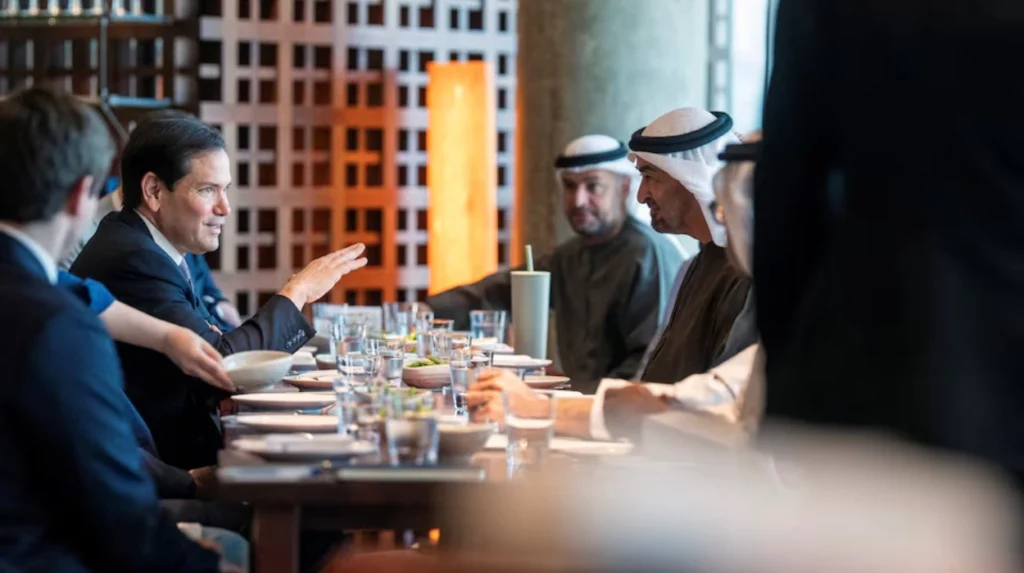
Gulf tour by Marco Rubio takes off amid a climate of high regional anxiety, with Gulf states seeking clarifications on a potential Iran deal that will only make Tehran stronger. This tour, which has started in the UAE and will reportedly take Rubio to Kuwait and Bahrain, has been seen as a major diplomatic challenge for Washington to prove its credentials to partners that are worried about the repercussions of a possible Iran-U.S. deal.
The stakes are especially high as the Gulf states aren’t responding to a dispute taking place far off or just as theory. It is all very much based on reality of past conflict experiences, missile attacks, drone attacks, and the feeling that even after such an agreement is reached, Iran will have more breathing space, more power and influence, and lesser constraints on its military designs. Thus, it is not enough for Rubio to advocate a deal; he needs to ensure his allies that no compromises have been made with respect to their national security interests.
Why Gulf Allies Are Skeptical
The primary issue facing the US government is that there are some Gulf states which seem to feel that the proposed agreement does not sufficiently address the threats that concern them. Such an attitude is fueled by the apprehension that a ceasefire deal, aimed at resolving the war or preventing escalation of the situation, will fail to take into account other capabilities of Iran, such as missiles, proxies, and reconstruction aid.
One major area of worry is that of the purported reconstruction fund attached to the deal. Gulf capitals fear that a fund in the range of $300 billion might eventually be used not only for recovery purposes, but for military restoration or even increasing the power of Iran in the region. In their opinion, a sum like this might inadvertently give Tehran the opportunity to recover faster than expected in the region without actually addressing the security threat. As for the missile problem, it is also very politically charged. For a long time, the Gulf countries have been saying that any viable deal with Iran needs to include the missile program in its direct scope, not as an addition. But the current draft deal is lacking any restrictions regarding this program, thus raising the problem of a gap between the de-escalation rhetoric and the military threat itself.
The Regional Security Calculation
For Gulf officials, this is not just an issue about one deal. Rather, it goes deeper into whether U.S. diplomacy maintains the balance of power in the region or shifts it to the benefit of Iran. Nations like the United Arab Emirates, Kuwait, and Bahrain all have their own security histories, and they are located near vital shipping routes for world energy supplies. An agreement that seems to relieve pressure on Iran but fails to create further restraints may cause instability in both areas.
That is why the language surrounding the trip matters so much. Rubio is not arriving as a distant mediator but as an envoy trying to repair confidence. In this context, even procedural assurances carry political weight. Allies want evidence that the United States is listening, that their objections are being heard before decisions harden, and that Washington is not treating their security concerns as secondary to a broader geopolitical bargain.
The Gulf states also worry about proxy activity. Iran’s relationships with militias and armed groups across the region remain a central part of its influence strategy. If a deal reduces pressure on Tehran but does not constrain those networks, Gulf governments fear the agreement could indirectly strengthen the very instability it is meant to reduce.
Rubio’s Message to Allies
Rubio has been careful to describe the trip as one involving consultation. He has made it clear that the issues of the Gulf will be included in discussions and that America is eager to hear what its regional partners have to say before moving too far into the diplomatic process. This kind of discussion is important because, besides having problems with the content of the agreement, some regional allies felt that they were kept out of the loop.
One of Rubio’s key lines has been that the concerns of allies will be addressed directly in the discussions.
“That most certainly will come up in these discussions,”
Rubio said, underscoring that Washington is aware the Gulf does not view this as a routine diplomatic visit. The statement is important because it acknowledges the political sensitivity of the issue without committing publicly to specific changes in the deal.
Rubio has also emphasized the U.S. position on regional stability and maritime security.
“No nation is permitted to levy tolls or charges on an international waterway,”
Rubio said, reinforcing Washington’s message that freedom of navigation remains a red line. That comment reflects how the Gulf conversation extends beyond Iran alone and into the larger question of how trade routes, oil flows and maritime chokepoints should be protected.
The Deal’s Bigger Political Meaning
What makes this trip especially consequential is that it comes at a moment when the proposed Iran agreement is still politically fluid. That means the Gulf tour is not just about reassurance after the fact. It is also about shaping the political environment around the deal before it becomes fixed. Gulf capitals know this, which is why they are pressing hard now rather than waiting until the text is finalized.
Washington’s dilemma here lies in achieving a balance between two conflicting interests. On the one hand, there is the urge to reach a deal that will help avoid the possibility of future conflict and open the door for negotiations. On the other hand, there is the necessity of maintaining the trust of the allies who have seen Iran use negotiations as an opportunity to strengthen itself.
That is one reason why the lack of senior officials from the U.S. government in any previous interaction has been a part of the story. The regional partners are curious to find out if their opinions matter or not in any decision-making process. They are asking for answers, which might come in the form of this visit, but success is contingent upon the degree of openness of Washington to their views.
What Gulf Leaders Want Explained
The list of questions Gulf governments are likely to raise is substantial. They want to know whether the deal limits Iran’s ability to strengthen its missile arsenal, how any reconstruction money would be monitored, whether proxy networks would be constrained, and what enforcement mechanism would exist if Tehran violated commitments. These are not abstract policy details; they are the issues most directly tied to Gulf national security.
Furthermore, there is also an underlying political aspect to this. Should the deal be presented as a game changer at the international level and should the Gulf fears be portrayed as an afterthought, trust in the security assurances that the United States provides to the Gulf can be eroded. This will matter due to the fact that despite diversifying their strategies in the region, the Gulf states depend on America for both military and diplomatic support.
The tour’s reception will likely depend on whether Rubio can offer more than general assurances. Gulf leaders usually want specifics: how the U.S. plans to prevent a replay of previous agreements that later appeared too permissive, how economic benefits would be controlled, and what the United States is prepared to do if Iran uses any deal to expand its influence. Without those details, reassurance may remain incomplete.
The U.S. Diplomatic Test
At a broader level, this is a test of American credibility. The United States has spent years trying to convince Gulf partners that its regional commitments remain firm despite shifting political priorities and repeated crises. A deal that appears to ignore their core fears could create a fresh credibility problem, especially if it is presented as stabilizing while they see it as empowering an adversary.
At the same time, Rubio’s trip shows that Washington understands the optics of this moment. Visiting Abu Dhabi, Kuwait and Bahrain in sequence sends a message that the administration is not treating the Gulf as a monolith, but as a set of states with distinct concerns and close exposure to Iranian threats. That nuance matters because different allies may prioritize different parts of the deal, from missile restrictions to shipping security to proxy containment.
Nevertheless, the central issue remains unanswered: Can a U.S. – Iran deal be made to work while not making Gulf partners feel insecure? By the looks of his trip, it seems like the White House understands that there is an answer that needs to be given in the open and behind closed doors. How convincing these answers will be will determine both the future of the deal and the mood in U.S. – Gulf relations in the coming months.
The next phase will be defined by how Gulf leaders respond after their meetings with Rubio and whether the administration adjusts its language or negotiating posture in response. If the talks produce clear reassurance, the U.S. may be able to reduce some of the visible friction around the agreement. If they do not, skepticism could harden into open resistance, making the deal harder to sell regionally.
For now, the tour is best understood as an effort to contain doubts before they become diplomatic damage. Rubio is trying to show that the United States still sees Gulf allies as central to Middle East strategy and not as bystanders to an Iran decision. The success of that effort will depend less on ceremony than on whether Washington can prove that any final agreement protects Gulf security as seriously as it seeks to reduce conflict with Iran.