The evolving conflict with Iran has become a defining case for assessing how independent United States foreign policy remains in the Middle East. The joint military actions carried out with Israel in early 2026 have intensified scrutiny over whether Washington is acting from its own strategic calculus or aligning closely with Israeli threat perceptions.
This question has gained urgency because the Iran war is not a limited tactical episode but a broader strategic moment. It combines military escalation, nuclear concerns, and regional realignment, making it an ideal case to observe how influence operates within alliances. Analysts increasingly treat it as a precedent that may shape how future U.S. decisions are interpreted across global theaters.
Strategic overlap and blurred authorship
The alignment between Washington and Jerusalem is not accidental. Both states share concerns about Iran’s nuclear trajectory and regional networks, which creates a natural basis for cooperation. However, the depth of coordination in 2026 has blurred the line between shared interests and policy leadership.
When two allies act in near synchrony, attribution becomes complex. Observers in Europe and the Middle East have noted that the tempo and intensity of operations appear closely aligned with long-standing Israeli priorities, raising questions about whether U.S. strategy is being partially refracted through Israeli security imperatives.
Mechanisms of Israeli influence in Washington
The perception of Israeli influence over U.S. policy does not arise solely from battlefield coordination. It is reinforced by a network of political, institutional, and informational channels that shape how Iran is understood within American decision-making circles.
Political and congressional alignment
Support for Israel within the U.S. political system remains broad and bipartisan. Congressional voting patterns, public statements, and legislative initiatives often reflect strong alignment with Israeli security concerns, particularly regarding Iran.
During 2025, debates around sanctions and military posture toward Iran saw significant overlap between Israeli warnings and U.S. political rhetoric. This alignment contributes to an environment in which Israeli perspectives are not external inputs but integrated elements of domestic policy discourse.
Think tanks and security narratives
Policy debates in Washington are heavily influenced by think tanks and research institutions that frame strategic issues. Many of these institutions emphasize the risks posed by Iran’s missile programs and regional alliances, often echoing assessments long articulated by Israeli officials.
This does not imply uniformity, but it does create a dominant narrative environment. When policymakers repeatedly encounter similar threat assessments, the range of perceived policy options can narrow, making more aggressive approaches appear both logical and necessary.
Leadership diplomacy and direct engagement
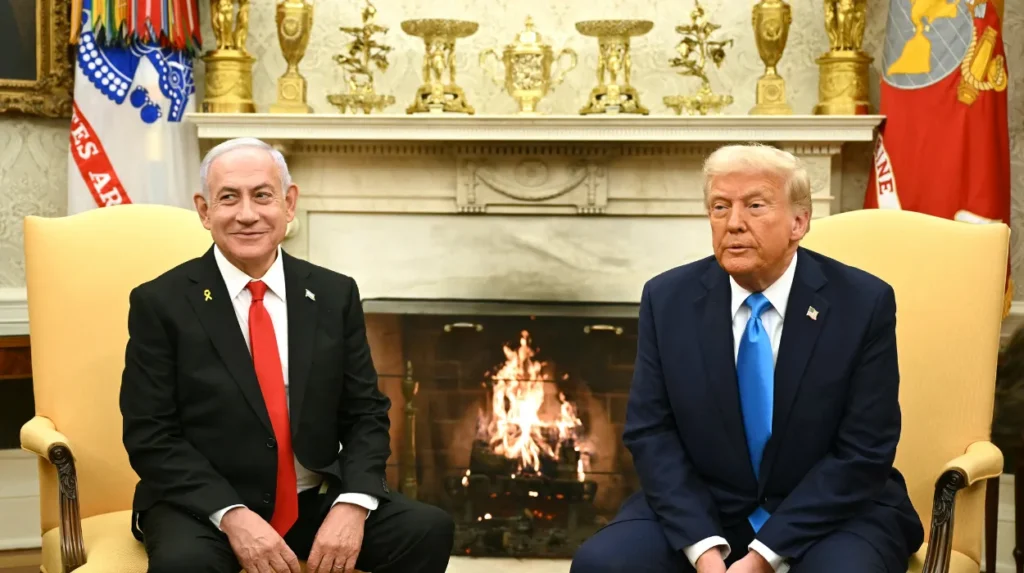
Israeli leadership has historically maintained active engagement with U.S. administrations. High-level diplomacy, intelligence sharing, and coordinated messaging have ensured that Israeli concerns remain visible at critical decision points.
In the 2025–2026 period, this engagement intensified. Frequent consultations and shared intelligence assessments contributed to a sense of urgency around Iran’s capabilities, reinforcing the case for decisive action.
Where U.S. and Israeli interests genuinely converge
Despite concerns about influence, it is important to recognize that convergence between U.S. and Israeli policies is not purely the result of external pressure. There are substantive areas where both countries independently arrive at similar conclusions about Iran.
Nuclear and missile concerns
Both Washington and Jerusalem view Iran’s nuclear ambitions as a central threat. Even when they differ on methods, they agree on the need to prevent Tehran from achieving a credible nuclear weapons capability.
Missile development adds another layer to this concern. Long-range delivery systems increase the perceived urgency of addressing Iran’s military trajectory, reinforcing the rationale for coordinated action.
Regional network containment
Iran’s support for regional actors is another area of shared concern. Both countries see these networks as destabilizing forces that extend Tehran’s influence beyond its borders.
Efforts to disrupt these networks have been a consistent feature of U.S. and Israeli policy, creating a foundation for joint operations that extends beyond immediate crises.
Diverging visions of Iran’s long-term future
The limits of Israeli influence become clearer when examining how Washington and Jerusalem envision the end state of the current conflict. Their long-term objectives, while overlapping in some areas, diverge in important ways.
U.S. preference for managed stability
American policymakers often prioritize stability over transformation. A constrained but functioning Iran is seen as preferable to a collapsed state that could generate broader regional instability.
This approach reflects lessons from past interventions. The risks associated with state failure, including refugee flows and the rise of non-state actors, weigh heavily in U.S. strategic calculations.
Israeli emphasis on structural weakening
Israeli strategy tends to focus on ensuring that Iran cannot reconstitute its capabilities. This often translates into support for sustained pressure designed to erode Tehran’s military and political infrastructure.
While this approach may reduce immediate threats, it introduces uncertainties about long-term regional dynamics. These uncertainties are more acceptable within Israel’s security framework than within the broader U.S. strategic outlook.
The 2025–2026 escalation as a turning point
The events of 2025 and 2026 have brought these dynamics into sharper focus. The escalation cycle, including sanctions, targeted strikes, and coordinated operations, has provided a real-world test of how influence and autonomy interact.
Tactical alignment during conflict
During the peak of military operations, the level of coordination between U.S. and Israeli forces was notable. Intelligence sharing and synchronized targeting reflected a high degree of operational trust.
This alignment reinforced the perception of a unified front against Iran. It also demonstrated the effectiveness of close cooperation in achieving immediate military objectives.
Emerging differences in post-conflict planning
As the conflict evolved, differences in post-conflict planning began to surface. U.S. officials showed interest in preserving diplomatic pathways, even amid ongoing pressure.
Israeli officials, by contrast, emphasized the risks of allowing Iran to retain cohesive structures. This divergence highlights the distinction between short-term coordination and long-term strategic alignment.
Broader implications for U.S. global strategy
The Iran precedent extends beyond the Middle East, raising questions about how alliances shape U.S. decision-making in other regions. It also influences how other global actors interpret American policy autonomy.
Perceptions among international partners
Allies and competitors alike observe how the United States balances its own interests with those of close partners. The Iran case suggests a model in which allied perspectives carry significant weight, particularly in regions of shared concern.
This perception can influence how other countries engage with Washington. Some may see opportunities for alignment, while others may question the independence of U.S. policy choices.
Strategic bandwidth and global priorities
Focusing heavily on the Iran issue also has implications for broader U.S. strategy. Resources and attention devoted to the Middle East can affect the ability to address challenges in other regions.
This dynamic underscores the importance of maintaining flexibility in foreign policy. Overcommitment to a single theater, especially one shaped by alliance dynamics, can constrain broader strategic options.
The evolving balance between influence and autonomy
The Iran precedent does not provide a simple answer to the question of Israeli influence over U.S. policy. Instead, it reveals a complex interaction between shared interests, institutional alignment, and strategic divergence.
Influence operates through multiple channels, from political discourse to intelligence cooperation, but it does not eliminate U.S. agencies. Washington continues to make its own calculations, even when those calculations align closely with Israeli preferences.
What remains uncertain is how this balance will evolve. If the patterns observed during the Iran conflict become entrenched, they may shape not only Middle East policy but also the broader architecture of U.S. alliances. The question is not whether influence exists, but how it is managed and whether future decisions will reflect a recalibrated autonomy or a deepening integration of allied priorities into the core of American foreign policy thinking.