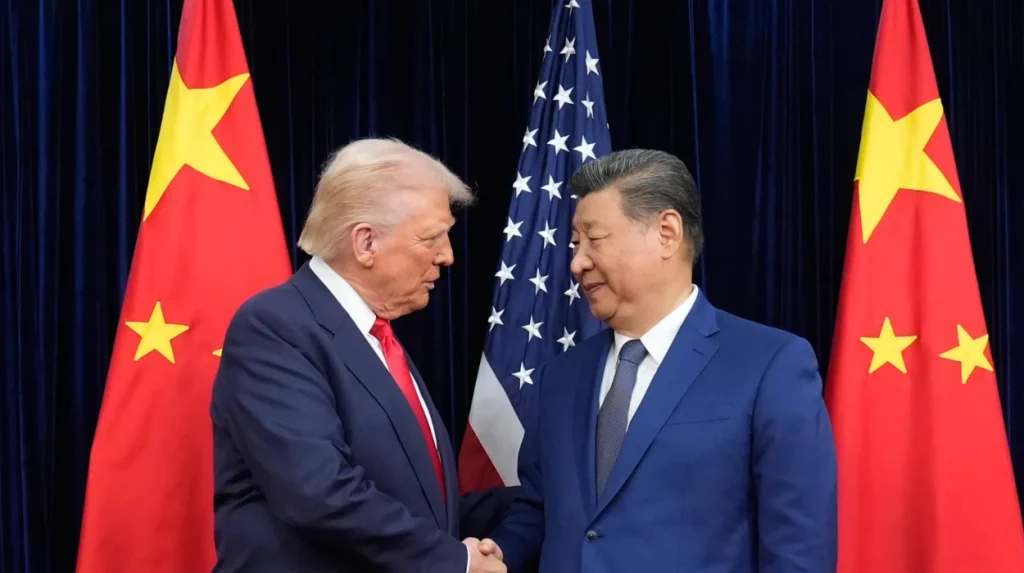
President Donald Trump and Chinese President Xi Jinping had an unusually long phone conversation on Wednesday, lasting almost two hours, during which they covered a wide range of issues, including Iran, the conflict in Ukraine, trade, and agricultural exports such as soybeans, in preparation for Trump’s upcoming visit to China this spring.
However, beneath the surface of Trump’s optimistic public statements, the call included a stern warning from Xi regarding the most contentious issue in U.S.-China relations: Taiwan.
Trump Strikes Optimistic Tone Ahead of China Visit
In a posting on his Truth Social platform, Trump called the conversation “excellent” and “long and thorough,” suggesting that the conversation was largely positive. Trump mentioned Taiwan as one of the issues that were discussed, and said that all of them were positive.
Trump said that the two leaders discussed his upcoming visit to China, which is set to take place in April. This would be a high-level summit that would be intended to calm tensions that have been building between the two countries for several months. The two leaders have been trying to cool tensions that followed an aggressive trade war in the early days of Trump’s second term. Their last face-to-face meeting was in October in South Korea, and it led to a one-year trade truce—but did not include any mention of Taiwan.
“The relationship with China, and my personal relationship with President Xi, is an extremely good one,”
Trump wrote.
“I believe that there will be many positive results achieved over the next three years of my Presidency having to do with President Xi, and the People’s Republic of China!”
Beijing’s Readout Centers Taiwan as a Red Line
The Chinese government’s news agency reported a very different tone in the phone call. According to the Chinese government, Xi stated that
“the Taiwan issue is the most important issue in China-U.S. relations,”
and that
“China will never allow Taiwan to be separated from China.”
Xi also called on the United States to exercise “extreme caution” in the sale of weapons to Taiwan, a clear allusion to the United States’ security guarantees to the island nation. This comes on the heels of a recent U.S. arms sale to Taiwan that exceeded $11 billion.
The contrast suggests that while Trump emphasized warmth and cooperation, Xi used the call to firmly reassert Beijing’s red lines.
Taiwan Responds, Reaffirms Defense Posture
Following the call, Taiwan’s Foreign Ministry said it supports efforts to maintain regional stability but will continue strengthening its defenses. The ministry also underscored that U.S. arms sales to Taiwan remain ongoing, signaling that Taipei does not expect Washington’s policy to shift under pressure from Beijing. A White House official, speaking on condition of anonymity, confirmed that the U.S. position on Taiwan remains unchanged.
One China Policy, Strategic Ambiguity Remains
The United States formally recognizes the government in Beijing under its long-standing “One China” policy. While Washington acknowledges China’s position that Taiwan is part of China, it maintains only informal relations with Taipei and continues to supply Taiwan with defensive weapons under the Taiwan Relations Act.
Xi’s forceful language suggests an effort to set expectations well in advance of Trump’s April visit, both for domestic audiences in China and for Trump personally. The message appears designed to ensure Taiwan dominates the agenda when the two leaders meet face-to-face.
Trump’s Mixed Signals on Sovereignty and Force
Xi’s warning also comes amid growing concern among foreign policy experts over Trump’s rhetoric on sovereignty and the use of force. Trump has openly threatened to invade or take control of sovereign territories in other contexts, raising fears that he may be less inclined to restrain allies—or adversaries—from pursuing similar actions.
At the same time, Trump has demonstrated a willingness to accommodate Beijing on Taiwan to preserve broader diplomatic goals. Last year, his administration blocked Taiwan’s leader from stopping in New York, reportedly to avoid offending China while negotiating a trade deal and arranging a summit with Xi.
Venezuela Comments Raise Eyebrows
In a recent interview with The New York Times, Trump claimed that Xi was “impressed” by a U.S. operation in Venezuela in which American forces captured the country’s leader and seized oil assets. When asked whether Xi might view that operation as a precedent for seizing Taiwan, Trump initially dismissed the comparison, arguing China did not face threats similar to those he attributes to Venezuela.
But when pressed on whether Taiwan could be perceived as a threat to China, Trump acknowledged that the island holds deep symbolic value for Xi.
“He considers it to be a part of China, and that’s up to him,”
Trump said.
“I’ve expressed to him that I would be very unhappy if he did that, and I don’t think he’ll do that. I hope he doesn’t do that.”
Taiwan Likely to Dominate April Summit
Xi’s sharp language during the call suggests that Taiwan will be unavoidable when Trump travels to China. While Trump continues to emphasize personal rapport and deal-making, Beijing appears intent on ensuring that any improvement in ties comes with clear limits—starting with Taiwan.
As both leaders prepare for their April meeting, the gap between Washington’s public optimism and Beijing’s strategic rigidity on Taiwan may prove difficult to bridge.