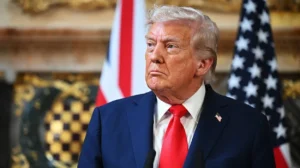
Donald Trump has said Iran is “talking to” the United States and suggested a diplomatic off-ramp may still be possible, even as Washington deploys major military assets to the region and warns Tehran against escalation.
In comments to Fox News, the US president indicated that negotiations were underway but underscored that military options remain on the table.
“They are negotiating,”
Trump said.
“We’ll see if we can do something, otherwise we’ll see what happens … We have a big fleet heading out there.”
Diplomacy Under the Shadow of Force
Trump’s statements are typical of the pattern of coercive diplomacy, in which public suggestions of negotiations are accompanied by strong public military pressure. The US has moved a naval battle group, headed by the aircraft carrier USS Abraham Lincoln, into the area around Iran, which is seen as a threat of military action.
A US carrier strike group normally consists of more than 60 aircraft, guided-missile cruisers, destroyers, and attack submarines, and is one of the most powerful instruments of American military power. Its presence in the area around Iran has sparked concerns of a miscalculation or a quick escalation into conflict.
Trump also said regional allies were not being informed of potential strike plans, citing security concerns. “If I told them the plan, it would be almost as bad as telling you the plan,” he said, an admission likely to unsettle partners who host US bases and would be exposed to any Iranian retaliation.
Uncertainty Over US Intentions
Later, when speaking to the press during a flight to Florida, Trump refused to elaborate on whether he had reached a final decision regarding military strikes. When asked whether pulling back from an attack might lead to Tehran being emboldened, he gave a non-committal answer:
“Some people think that. Some people don’t.”
The uncertainty is only adding to the anxiety of investors and diplomats, especially given the administration’s portrayal of Iran’s nuclear program as a pressing threat and the absence of any information regarding what a “satisfactory” agreement might look like.
Trump reiterated that Iran must negotiate an agreement preventing it from acquiring nuclear weapons, but conceded the outcome was uncertain.
“I don’t know that they will. But they are talking to us. Seriously talking to us,”
he said.
Regional Mediation and Backchannel Efforts
In the midst of the standoff, there has been increased regional diplomacy. Qatar reported that its prime minister, Sheikh Mohammed bin Abdulrahman Al Thani, traveled to Tehran on Saturday to meet with Ali Larijani to “discuss efforts to de-escalate tensions in the region.” This kind of diplomacy is a manifestation of the concern of Gulf states that a conflict between Washington and Tehran would have a devastating effect on the stability of the region.
Risk of Escalation in a Strategic Chokepoint
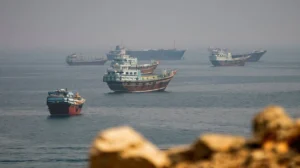
The presence of the USS Abraham Lincoln strike group has increased the threat of a direct confrontation, especially within or around the Strait of Hormuz, which is where about 20 percent of the world’s oil and a substantial portion of the world’s liquefied natural gas pass through.
Iran has stated that it will retaliate against US bases, ships, and allies in the region, especially Israel, with missile attacks if the US launches an attack against it. Iran has one of the largest missile forces in the Middle East, with hundreds of short- to medium-range missiles that can strike targets throughout the Gulf.
Iran Signals Conditional Willingness to Talk
However, Tehran has made it clear that it is ready to talk, but only on certain conditions. Iranian officials have stated that they are ready to talk about their nuclear program but that they will not negotiate regarding their missile power or defense policies, which they consider non-negotiable components of their national security.
Ali Larijani, the head of Iran’s Supreme National Security Council, stated that
“structural arrangements for negotiations are progressing,”
downplaying
“the hype of the contrived media war.”
This came after his meeting with Russian president Vladimir Putin in Moscow, reflecting Iran’s desire to balance US pressure with outreach to other major powers.
Iranian Leadership Warns Against War
Iran’s president, Masoud Pezeshkian, echoed calls for restraint, warning that a wider conflict would be disastrous for both sides.
“The Islamic Republic of Iran has never sought, and in no way seeks, war,”
he said in a call with Egypt’s president, Abdel Fatah al-Sisi.
“A war would be in the interest of neither Iran, nor the United States, nor the region.”
Iran’s army chief, Amir Hatami, adopted a more confrontational tone, saying Iranian forces were at “full defensive and military readiness.” Any attack, he warned, would endanger US security, regional stability, and
“the security of the Zionist regime,”
according to state media.
Hatami also stressed that Iran’s nuclear expertise “cannot be eliminated,” a reference to the resilience of Iran’s scientific infrastructure even under military pressure.
Military Exercises and Rising Tensions
The US Central Command reported that Iran’s Revolutionary Guards were engaged in a live-fire exercise in the Strait of Hormuz, which lasted for two days, issuing warnings against
“unsafe and unprofessional behavior near US forces.”
Iran’s Foreign Minister, Abbas Araghchi, reacted to the statement, accusing the US of trying to dictate how Iranian forces should conduct themselves in the vicinity of their own shores. “Operating off our shores, the US military is now trying to dictate how our Powerful Armed Forces should conduct target practice in their own turf,” he wrote on X.
Iranian authorities also sought to dispel rumors that a series of incidents, including an explosion in the southern port city of Bandar Abbas, were related to sabotage or military action, claiming that the explosion was the result of a gas leak.
Terror Designations Deepen the Rift
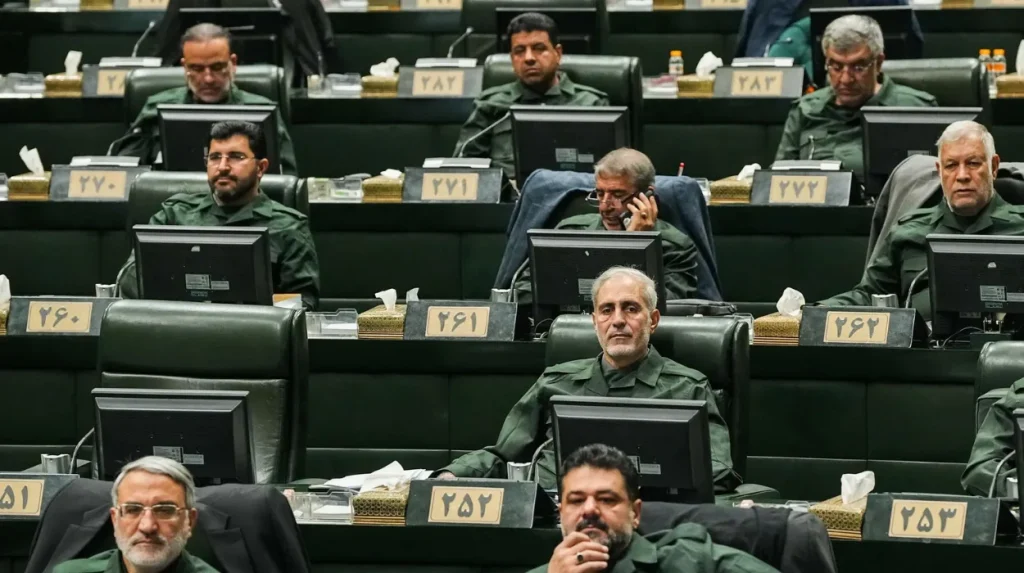
The situation is further complicated by the Iranian Revolutionary Guards being declared a terrorist group by the United States in 2019, a decision that the European Union has followed this week. The Iranian Revolutionary Guards are a crucial part of Iran’s economy, defense, and foreign policy, and Iran has been outraged by the EU’s decision.
This decision has further reduced the diplomatic space and has increased the stakes of any meeting between US and Iranian forces.
A Narrow Diplomatic Window
This implies that Trump’s statements reflect the fact that Washington would rather have a negotiated solution than a military one. However, the fact that a build-up of forces is taking place simultaneously, coupled with the lack of clarity and the mistrust between the two sides, highlights the fact that the diplomatic window is still very fragile.
The fact that the crisis is being defined by a high-risk mix of pressure and uncertainty, where miscalculation could be the determinant of the next move, is a concern.