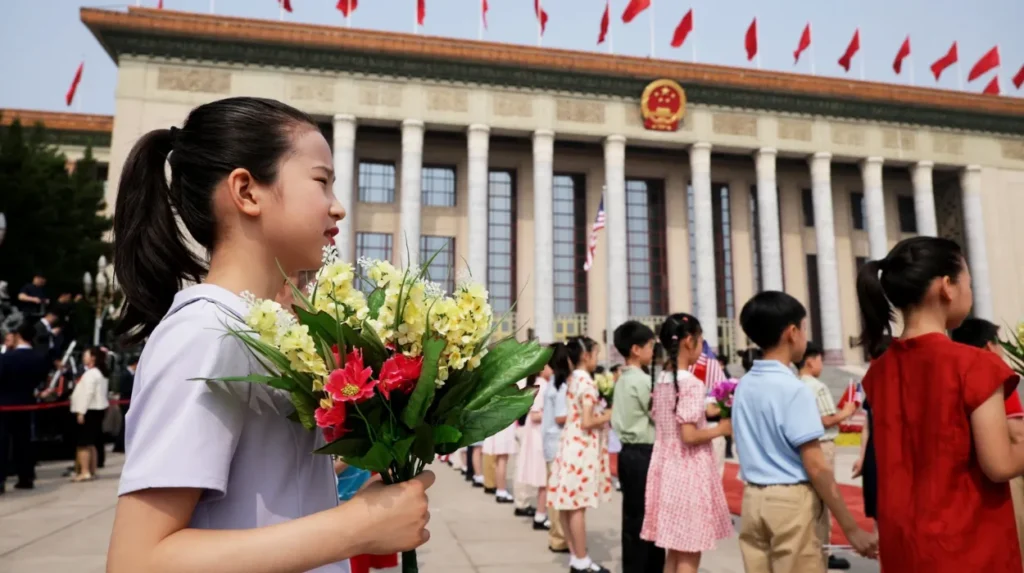
The highly choreographed greeting that China accorded to Putin has attracted a lot of attention simply because it was almost similar to what President Xi had done for Donald Trump before. This is not merely an issue of protocol but it also involves diplomacy since it is a way for the Chinese government to use ritual as well as a way of shaping perception at the global level.
The symbolism of the whole situation should be taken into consideration because the Chinese government would not have acted in such a manner unless it had an agenda. In this case, the Chinese government has demonstrated that it can handle both individuals in the same manner since it sees them as equally important. Nonetheless, the Russians are being given greater attention since China is seeing them as significant strategic partners.
The symbolism of the welcome
What is crucial about the event described above is the likeness in the welcoming receptions for Trump and Putin. Both men received the kind of reception that can only be afforded by a country using statecraft and ceremonialism as its language. This is not just show business; it is Chinese diplomacy.
On the other hand, what made the welcoming ceremonies different from each other is no less important than what made them alike. While the welcoming ceremony for Trump served to highlight China’s capability to awe even an incumbent president of the United States of America, Putin received what he deserved in terms of a more closely aligned geostrategic interest of Beijing to Moscow.
China has long understood that ceremony can be a political tool. The red carpet, the location of meetings, the order of greetings, and the choice of host all communicate hierarchy. In this case, the choreography appears designed to show that Xi is not reacting to Washington or Moscow, but rather setting the terms of engagement himself.
How Trump fits into the context
It is also important to note how Trump’s visit to China prepped for the Putin reception. Sources have described the former as being meticulously choreographed, with great showmanship and pomp being at play. The contrast between the two receptions became obvious when one saw how similar the latter was to the former, although different in content.
The contrast is politically significant. Trump had been advocating closer ties with China, while the Chinese leadership has answered with the respect shown publicly while negotiations were based on pragmatic considerations. While the ceremony can appear friendly, it does not mean that mutual trust is being established here. Rather, the impression is that Beijing sees nothing wrong with flattering someone if it serves its purposes.
It should be noted that Trump is seen by the Chinese leadership not just as a guest from America, but as an embodiment of American power and turmoil. A very high-level reception sends a message to everyone about China’s willingness to deal with this country, which can also apply to Russia if needed.
Putin’s place in Xi’s strategy
Putin’s welcome has significance in itself given the growing proximity between China and Russia in the face of increased tensions with the West. The Sino-Russian relations are generally considered more strategic than ideological in nature; the two nations share common goals such as resisting pressure from Washington and reorganizing the international balance of power. This means that hosting Putin with grandeur cannot be interpreted as mere diplomatic gesture. Rather, it demonstrates solidarity between the two nations.
In view of Beijing’s attempts to portray the Russians as indispensible partners, China’s attitude towards Putin’s visit becomes even more significant considering that Moscow is still experiencing pressure in connection with the Ukrainian crisis and that both countries are working on expanding their freedom of action. Indeed, Xi Jinping’s hospitality can be regarded as both reassurance and a message – China is sticking to its position and will not abandon the Russians.
However, Beijing is not ready to unequivocally support Moscow because of its interests in European and US markets. Thus, Beijing avoids using language that would tie it too closely to Russia.
What the statements indicate
The statements surrounding the broader China-Russia dialogue point to a deliberate attempt to frame the relationship as stable and forward-looking. In previous exchanges, Xi and Putin emphasized continued cooperation, including discussions of security, regional stability, and the long-term direction of ties. The tone is consistently one of continuity, not crisis.
One reported line from the coverage captures the diplomatic posture clearly.
“China and Russia should continue to deepen strategic coordination,”
Xi Jinping said in the context of their broader engagement. That phrasing matters because it places the relationship in the language of durability and strategic purpose rather than short-term convenience.
The messaging toward the United States is more nuanced. Beijing has shown willingness to maintain communication with Trump, but Chinese officials have repeatedly framed the relationship in terms of mutual respect and sovereign equality. In practice, that means China wants room for dialogue without appearing subordinate. It also means the optics of a warm welcome do not necessarily reflect a softer policy line.
The wider diplomatic backdrop
The Putin visit should not be viewed separately from the larger picture, for instance, the reported simultaneous contacts with Trump and Putin, or the near-simultaneous contacts with these leaders. This would suggest that Xi Jinping is working hard to demonstrate his reach, equilibrium and control.
What makes such diplomacy so significant is the fact that China is not reacting to either Washington or Moscow. China is trying to position itself as a pivotal node of global diplomacy, and this is a notable change in its diplomatic strategy. Instead of picking sides in what others have started, China appears to be forming its own diplomatic table.
In this context, the importance of ritual differences becomes quite obvious. Any Chinese diplomatic performance is always about more than a visiting foreign politician – it is all about the image of China itself, confident, organized and indispensable to the global political process.
Why the optics matter
Ultimately, this tale is one of power in style. In Washington, diplomatic warmth may be assessed according to policy statements and joint communiqués. In Beijing, it also has to do with the size of the reception, the venue, and the power structures inherent in every such gathering. Protocol, in other words, becomes a political language.
It becomes particularly important for what it does without altering anything in terms of formal declarations. While a red carpet ceremony can be an expression of respect, it can just as easily be an expression of strength. When done for Trump and Putin alike, equality is thus established right from the outset. This, however, is a kind of equality that has been fabricated.
It suits China in more ways than one. First off, it shows how major powers continue to court Beijing. On another level, it helps to drive home the point that China itself is no longer simply a player in international diplomacy; it is also capable of hosting, shaping, and sizing up world leaders.
The larger political message
The larger political message is that China is managing two relationships at once: one with a rival superpower, and one with a strategic partner. By giving Putin the “Trump treatment,” Xi is not saying the two leaders are identical in policy terms. He is saying China can treat both as important while reserving the right to define the real balance of power.
That is why the story resonates beyond a single visit. It speaks to how the world order is being performed in public. China wants to look stable and central. Russia wants recognition and partnership. Trump wants engagement and leverage. Xi’s answer is to offer ceremony to all three while keeping the real advantage with Beijing.
The result is a diplomatic performance that reveals more than it conceals. It shows China’s confidence, its caution, and its desire to avoid being forced into a binary choice between Moscow and Washington. In that sense, the welcome given to Putin was never only about Putin. It was about Xi showing that China decides who gets which treatment, and why.