The US Department of Defense is rethinking America’s traditional military presence in Europe with plans to downsize the American troop deployment and decrease the number of forces that are ready to come to the assistance of NATO member states in case of any major conflict. This represents the biggest realignment of American military forces on the continent since the massive influx of reinforcements after Russia’s 2022 attack on Ukraine. It is seen as the Pentagon’s attempt to rebalance the global force posture and to make European allies do more to secure themselves, but some members of NATO remain concerned.
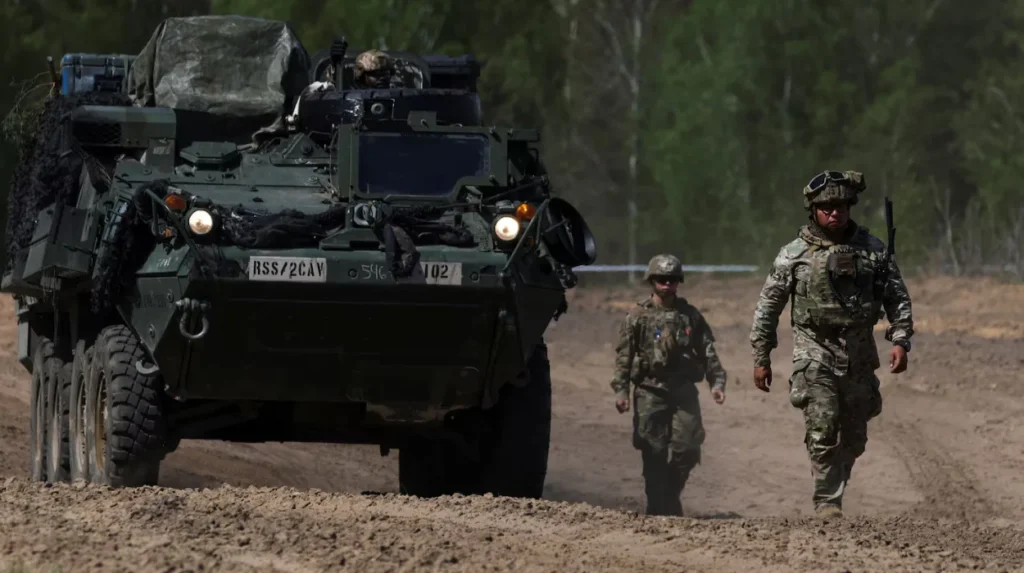
In terms of the revised strategy, the U.S. Army will decrease its presence in Europe by reducing the BCTs currently based there from four to three, resulting in downsizing one heavy armored brigade, ranging between 4,000 and 4,700 troops, yet ensuring that the total number of U.S. forces on the continent is above the congressionally mandated level of about 76,000 troops. Moreover, the Department of Defense has revealed its intention to withdraw up to 5,000 troops from Germany within the next six to 12 months, making it one of the biggest reductions for a single country in recent years.
What the troop cuts mean for NATO
Not only does the scope of the new Pentagon strategy involve just a numerical change in the presence of troops, but also a reduction in the number of U.S. forces associated with NATO’s crisis response mechanism. The concept known as the NATO Force Model implies the commitment by member nations to place specific units within a “crisis force pool” which is ready for activation in case of any major aggression against one of the allies. The United States has made it clear to the alliance that it intends to make its capabilities for this purpose much smaller in numbers.
This move is seen as an effort to induce Europe to increase its efforts in enhancing its capability for NATO’s crisis-response force posture. The officials at the Pentagon and in the administration believe that the Europeans have to step up and contribute more towards their own defense in view of the fact that the military expenditures of many of the NATO countries now exceed 2 percent of their GDP. Nevertheless, several defense ministers and NATO diplomats from the European nations have confided privately that the move might undermine deterrence, especially if the Europeans do not improve quickly.
As one NATO official told defense‑focused outlets,
“Fewer U.S. forces in the pool mean fewer American capabilities automatically available when the phones ring in a crisis.”
That sentiment underscores the delicate balance NATO faces between fiscal pressure, political will, and military credibility.
Numbers, deployments, and strategic context
Before this latest news, the US had kept around 85,000 troops deployed in Europe with most of them in Germany, Italy, and eastern Europe in countries like Poland and the Baltic nations. These troops acted both as a deterrent and as a force that could help with exercises and reinforcements. By announcing the reduction of 5,000 troops from Germany and an armor BCT from Europe, it can be concluded that there would be an overall reduction of around 8,000 to 10,000 troops of readiness in the European land forces.
The third critical factor pertains to the delayed deployment of a previously planned armored brigade combat team in Poland. In its initial planning stages, this decision was understood as a clear indication of America’s determination for staying committed to Eastern Europe for years to come. By delaying the implementation of this plan, however, the Pentagon creates confusion as to whether the Americans are ready to leave enough steel forward-based in Europe or whether they should expect their troops to be deployed only from the continental United States in times of crisis. Within the Pentagon itself, officials argue that the United States continues to have a “strong” forward posture in Europe and that those troops remaining will be highly-ready and interoperable with NATO.
As Pentagon spokesperson Sean Parnell put it in recent remarks,
“Our posture in Europe is being recalibrated, but our commitment to the alliance remains firm.”
Yet, for many European capitals, the word “recalibrated” feels uncomfortably close to “downgraded.”
Political drivers behind the decision
The timing and content of the announcement made by the Pentagon are directly associated with the overall strategy of the Trump Administration in terms of its foreign policy and military agenda, where the main emphasis is on “America First,” which implies a focus on the Indo-Pacific region in terms of strategic rivalry. The president has been constantly stressing that his European allies had not been doing anything to protect themselves and that NATO members needed to spend more money on their defense, provide more soldiers, and get involved in America’s endeavors beyond Europe and into the Middle East.
In this regard, German politicians have specifically understood the reduction of 5,000 troops from Germany to be a symbolic move associated with burdensharing debates between America and Europe. The Germans have suggested that further reductions may come if Europe does not meet the U.S. demand to form alliances, or else raise defense spending in certain concrete ways. On the other hand, U.S. authorities have attempted to dispel any notion of a split, reiterating their commitment to maintaining a large number of U.S. troops in Europe, and that the force structure is being altered “with the full understanding of our allies.”
As one senior defense official told reporters,
“We are not retreating from Europe; we are rebalancing our forces so that Europe and the Indo‑Pacific are both properly resourced.”
The reality, of course, is that for many European leaders, a rebalancing that involves fewer American troops on their soil feels like a weakening of the security guarantee.
Reactions from NATO and European capitals
In the case of NATO, the reaction to the plan by the Pentagon has consisted of diplomacy coupled with a sense of alarm. NATO Secretary General, among others, has said that the organization is cooperating with the US in regard to getting a grasp of the situation in connection with the reduction in number of troops from Germany and its effect on NATO-Force-Model thinking. However, some of the European defense ministers have expressed their concerns about how the reduction of American involvement in the crisis-force force might affect the situation if Russia chooses to escalate.
“If the U.S. reduces its pledged forces, others will need to step up immediately,”
one European diplomat told reporters, adding that the onus is now on European members to demonstrate they can credibly fill the gap.
The Germans too have been equally vocal, with the reduction in 5,000 troops being taken as a signal of the political ramifications of transatlantic defense relationships. Berlin believes that any additional reductions will be perceived as a test of American commitment towards the defense of Europe, especially given Russia’s continued threats to its eastern frontier. On the other hand, there are some German policy makers who see the reduction as more symbolic rather than a catastrophe. This is because, the additional reinforcements from the Continental U.S. can still pour through in an emergency situation.
“Forward‑based troops are vitally important for deterrence, but they are not the only way the United States can defend Europe,”
one German defense adviser said. Nonetheless, the psychological effect of seeing thousands of U.S. troops leave cannot be dismissed, particularly for countries that have grown accustomed to a dense American military presence.
Military and strategic implications
On the face of it, according to the Pentagon, the residual American forces left behind in Europe would still be very competent and well suited to modern strategic needs. The rationale behind the three-brigade model was the need to sustain the presence of an effective land force while at the same time allowing space for operations in other strategic locations such as the Indo-Pacific area. In addition, the Pentagon has been keen to emphasize that the US will continue rotating its forces in Europe.
“Our posture is about readiness, not just numbers,”
a senior U.S. Army official said, underscoring that modern warfare depends on rapid deployment, advanced systems, and interoperability as much as on static troop levels.
However, opponents, both within the Pentagon and beyond, argue that the withdrawal of such a large contingent of troops, including even an entire armored brigade, will complicate any contingency plans. Indeed, an armored brigade combat team is one of the most effective types of ground force formations available in the American arsenal, able to conduct both offensive and defensive high-end missions. Consequently, a reduction in such brigades will make it necessary for NATO, should the Russians escalate, to rely much more on reinforcement from the USA, which can take some time.
Some European analysts argue that while the United States can still project power across the Atlantic, forward‑based troops are critical for maintaining a credible deterrent and preventing crises from escalating in the first place.
“Deterrence is not only about what you can do, but about what the adversary believes you can do quickly,”
noted a European defense expert in a recent briefing.
Long‑term outlook for U.S. strategy in Europe
Looking ahead, the Pentagon’s troop cuts in Europe are likely to become a central feature of the broader debate over America’s role in NATO and its global military posture. On one side, the Trump administration and its supporters argue that Europe is now capable of shouldering more of its own defense and that the United States must prioritize great‑power competition with China. On the other side, many European allies and some U.S. defense experts warn that any visible reduction in the U.S. footprint could embolden adversaries and erode the credibility of the NATO security guarantee.
For the time being, the Pentagon insists that the changes are carefully calibrated and that the United States will remain a “strong, reliable” partner in Europe. Senior officials repeatedly emphasize that the decision to cut thousands of troops and shrink the forces available to NATO during crises is not a retreat, but a recalibration meant to align U.S. capabilities with evolving strategic priorities. As Pentagon spokesperson Sean Parnell stated,
“We are not abandoning our commitments; we are re‑shaping how we meet them.”
Whether European allies will accept that reassurance—or see the Pentagon’s troop cuts in Europe as a turning point in the post–Cold War security order—will likely shape transatlantic relations for years to come.