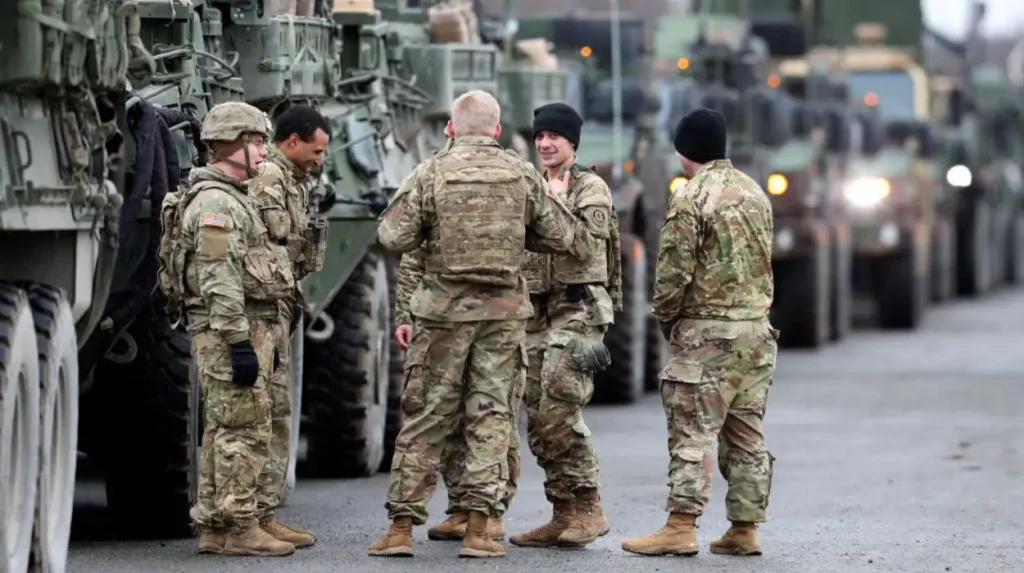
The Germany Troop Cut announced by Donald Trump is a pivotal moment in transatlantic defense relations, marking the end of decades of fairly stable US military presence in Europe. The proposed exit of about 5,000 soldiers within a six to twelve-month time frame, is a manifestation of the strategic re-tuning and the political strife, especially after the ensuing public differences with the German leadership on issues of foreign policy.
Germany has long served as a central base of US military operations in Europe, accommodating tens of thousands of military personnel in key installations. Bases like Ramstein, Landstuhl have served not only to deter NATO but also to support global logistics, medical services and the rapid deployment capability. The idea of cutting down on the number of troops in this scenario is not just a symbolic move; it has operational implications as far as the alliance preparedness and the coordination is concerned.
Political friction driving military decisions
The short term background to the withdrawal includes the tensions between Washington and Berlin, and the criticism of German Chancellor Friedrich Merz that the US was not properly handling the Iran conflict. The administration is reported to have construed these statements as criticism of the US leadership, a pattern that has seen political disagreements translated into changing the direction of the defence policy.
This connection between diplomatic conflicts and military stance poses some doubts with regard to predictability in alliance management. When the movement of troops starts to respond to political feeling, the allies can start to perceive the guarantee of security to be more of a conditional than a structural guarantee.
Pentagon review and force posture adjustments
US defense officials have put the reduction of the troops as part of a larger assessment of the force posture in Europe. Although some of the capabilities are likely to be preserved (such as the ability to provide medical support at Landstuhl), the fact that some combat units are being redistributed, means that there will be a shift towards more flexible and potentially rotational deployments.
These changes reflect a broader shift in US military planning which places a greater emphasis on mobility and responsiveness in lieu of permanent basing. The transition however, also brings an element of uncertainty in the speed at which forces can be formed in case of a crisis.
2025 precedents reveal continuity in burden-sharing pressure
The 2026 announcement is based on the preceding developments in 2025 that underscored a rising US dissatisfaction with the burden-sharing arrangements by NATO. At that time the administration was indicating possible cuts of up to 12,000 Germans troops by linking defense commitments to allied levels of expenditures.
The threats that went before that set a precedent where military presence is used as a bargaining tool to entice more allies to spend more on defense. As of 2024, few NATO members had contributed to the alliance at the 2 percent GDP spending limit, further provoking the US anxieties about contributing disproportionately.
NATO spending imbalances and US contributions
Statistics of current years help to visualize the extent of imbalance in NATO. As of 2021, the United States has consistently allocated a large majority of the total amount of alliance defense spending, contributing about 69 percent of the total amount of defense spending on alliance defense in 2021. European allies, such as Germany, on the other hand, have been persistently criticised on underinvestment.
This situation is very delicate especially considering the German economic contribution to Europe. Although Germany has been raising its budgets in defense, Berlin has been the center of US pressure because of its inability to meet the NATO standards.
Historical reliance on US security umbrella
US military capabilities since the termination of the Cold War have been important in European security. The involvement of Germany as a host country has been the key to this set-up, offering infrastructures and strategic depth to US operations.
The Germany Troop Cut calls this old time model into question by adding the fact that US protection is no longer unconditional. This change forces European states to reconsider their respective defence capacities and strategic independence.
Cost dynamics reshape expectations of alliance commitments
Financial factors are of great concern in the explanation of the rationale of the Germany Troop Cut. The cost of maintaining overseas military bases is very high and in recent years, the amount spent by the US on global basing has been estimated to be more than 24 billion a year.
The management has insisted severally that host countries have to contribute a larger part of such expenses. The demands placed on such countries as Japan and South Korea, reflect a more comprehensive approach of renegotiating defense agreements to decrease US financial liabilities.
Host nation support and comparative models
Host countries in Asia are found to be making a huge contribution towards the cost of US troop deployments. An example is Japan and South Korea which contribute billions annually of subsidies which replace the cost of operation. In comparison, European schemes have traditionally entailed lesser degrees of direct fiscal input.
This imbalance has led to arguments among the policy circles in the US that European allies enjoy an unfair advantage of American security guarantees. The Germany Troop Cut can thus be regarded as a part of a bigger initiative to make European input correspond with that of other regions.
Economic leverage as strategic tool
When one uses the deployment of troops as leverage, a transactional aspect is introduced into the relationship of the alliances. By making the presence of the military to be linked to the financial commitment, the United States sends a message that the security guarantees can be negotiated.
Although this strategy could have more contributions in the short term, the risk also exists that this strategy may also weaken trust within the alliance. Allies might doubt the effectiveness of the promises that might seem to be dependent on the cost-sharing agreement.
European responses highlight shifting security priorities
The responses of the Europeans to the Germany Troop Cut simply shows that the continent should be ready to take more responsibility in terms of self-defense. Boris Pistorius, the German Defense Minister has underscored the need to enhance European capabilities as has been discussed in more detail within the European Union in respect of strategic autonomy.
These changes are accompanied by a greater outlay in the defense procurement and collaborative efforts by the member states of the EU. The aim is to decrease the dependence on the external actors and strengthen collective security measures.
Strategic autonomy and defense integration
The process of developing European defense capacity has been accelerating over the last few years, especially after the 2022 conflict in Ukraine and the ensuing security issues. The Germany Troop Cut provides some urgency to these efforts by pointing out that there may be gaps in the transatlantic coordination.
Nonetheless, to attain meaningful autonomy, it is necessary to overcome major barriers, such as lack of coherence in procurement systems, differences in perception of threats, and political restrictions among member states.
NATO cohesion under pressure
The downsizing of the troops also puts a strain on the unity of NATO. Although the alliance has continued to be a stronghold of European security, conflicting interests between the United States and its allies may make the decision-making processes cumbersome.
NATO officials have so far adopted a cautious stance, emphasizing continuity and adaptability. Yet the underlying tension between collective defense principles and national interests remains a defining challenge.
Global implications extend beyond the European theater
The Germany Troop Cut resonates beyond Europe, signaling a broader shift in US global military strategy. Allies in other regions, including Asia, are closely monitoring the situation for indications of how US commitments might evolve.
In Japan, where over 50,000 US troops are stationed, past negotiations over cost-sharing have already tested alliance dynamics. While no immediate reductions have been announced, the precedent set in Europe may influence future discussions.
Redistribution of forces and strategic priorities
US officials have indicated that some forces withdrawn from Germany may be redeployed to Eastern Europe, including Poland and Romania. This reflects an effort to maintain deterrence against emerging threats while adjusting the geographic distribution of military assets.
Such redistribution underscores the adaptability of US strategy but also highlights the complexity of balancing regional priorities. Shifting forces can address specific threats but may create vulnerabilities elsewhere.
Long-term recalibration of alliances
The broader implication of the Germany Troop Cut is a gradual transition toward a more conditional and flexible alliance system. Rather than fixed commitments, partnerships may increasingly be defined by shared interests, financial contributions, and strategic alignment.
This evolution aligns with trends observed in other areas of US foreign policy, where transactional approaches have gained prominence. While this model offers greater flexibility, it also introduces new uncertainties into international security arrangements.
The unfolding dynamics suggest that the Germany Troop Cut is not an isolated decision but part of a larger transformation in how the United States defines its role within global alliances, leaving open the question of whether future security frameworks will lean toward deeper cooperation or more fragmented, negotiated arrangements shaped by shifting national priorities.