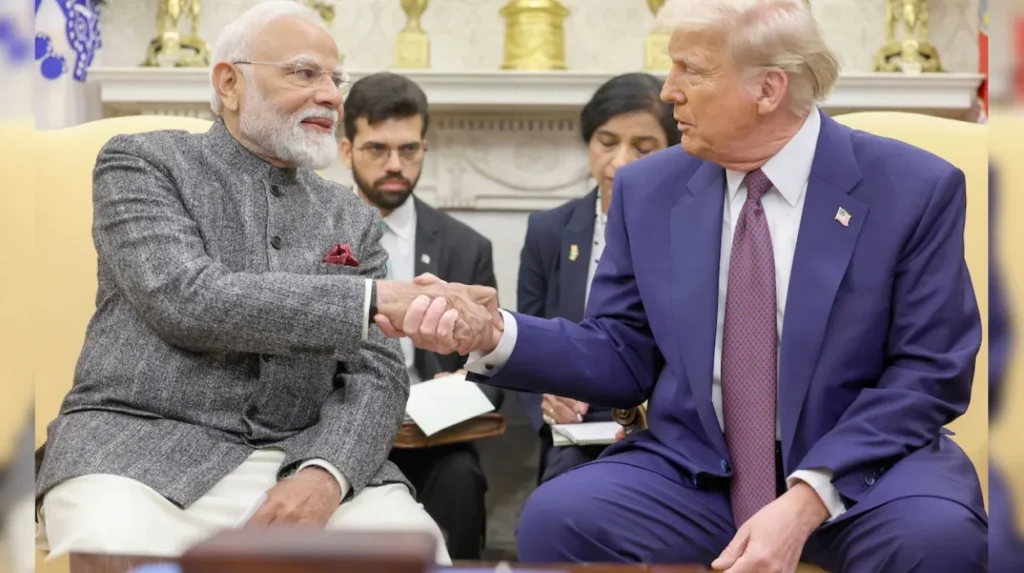
The rebalance of the U.S.–India trade agreements has emerged as one of the most tactically laden economic stories of 20252026, influenced by the way Washington had tried to redefine its global trade philosophy in the prism of its experience with China. What used to be introduced as open-market convergence is now more and more pronounced in terms of conditional engagement, when the entry is conditional on the exchange of access.
The China mistake warning which has been mentioned severally by the U.S. authorities has become a historical criticism and a policy limitation which looks into the future, it determines the way Washington deals with new partners like India.
China Lesson Framing And U.S. Strategic Recalibration
The basis of the present U.S. policy towards U.S. Indian trade agreements is a new understanding of the previous phase of globalization, especially the economic involvement of Washington in Beijing. The move does not merely represent a change in rhetoric; it implies the structural reevaluation of the interaction between trade openness and industrial policy, as well as geopolitical competition and the economic sustainability in the long term.
From WTO optimism to strategic skepticism
In the early WTO-era growth of the 2000s, U.S. policymakers were mostly optimistic that the incorporation of large emerging economies into world trade regimes would bring about convergence to liberal market standards. The emergence of China upset that assumption. According to U.S. trade strategists, increasingly by 2025 this will be described as a time when market access was conferred at a faster rate than regulatory reciprocity could be achieved.
As a result of the rise in Chinese industrial strength, officials now contend that China, with the aid of domestic protection, specifically targeted subsidies, and state-directed integration of supply chains, exposed vulnerabilities within the U.S. industrial systems. Such interpretation has proved to be the basis of Washington in assessing all its future trade alliances, such as the one it has with India.
India as the next calibrated partner
In this new worldview, India is not seen as a duplication of the Chinese model but as a similar experiment of a way of engagement that is fixed. The U.S. officials stress that the U.S. trade agreements with India should be organized in a way that they have more defined points with equal terms at the start and not corrections at the end.
This logic, with constant reference to preventing asymmetry before it comes into existence, is echoed in statements made by U.S. diplomats in 2025 and early 2026. It is not about the crippling of Indian development but making sure that the U.S. companies will not be at a structural disadvantage in the long term as they happened in the case of China.
Reciprocity As The Core Of U.S.–India Trade Deals
The concept of reciprocity has taken on the architecture of the U.S. India trade agreements determining the tariff negotiations, regulatory expectations, and access structures. In comparison to the previous stages of trade, where strategic alignment tended to unify the economies in conflicts, the contemporary strategy incorporates trade into a transactional reasoning that links concessions with quantifiable results.
Tariff alignment and market access negotiations
One of the major areas of conflict is tariff disparity. The United States still emphasizes relatively high average tariffs of India in the areas of agriculture, dairy and some manufactured products. India in its turn has retaliated on the basis of developmental demands and sensitivity of domestic jobs.
This was seen in 2025 with negotiations signaling a gradual shift to conditional convergence, which entails cutting tariffs linked to progressive market openings as opposed to liberalization. This has resulted in the ad hoc arrangements which offer some relief in the form of tariffs to the U.S. exporters but at the expense of India being able to have protective buffers in politically sensitive areas.
Sectoral pressure points in 2025-2026
U.S.–India trade transactions have shifted to focus on pharmaceuticals, semiconductors, and digital services. Washington is paying growing attention to guaranteeing supply chain integration of key technologies, whereas New Delhi attempts to maintain regulatory independence in data regulation and computer taxation.
The outcome is a broken-up system of negotiations, with development taking a lopsided form in various sectors. Certain pacts are moving fast as the parties are interdependent, whereas some are stagnant because of the regulatory divergence. Such an imbalance is representative of the bigger issue of harmonizing two economies that are in different levels of industrial maturity.
Geopolitical Conditioning Of Trade Policy
The United States-India trade is no longer considered only through the economic prism. Rather it is becoming geopoliticalized, especially in the areas of energy policy, defense alignment, and regional stability in the Indo-Pacific.
Russia energy and compliance signaling
India has been recognized to have one of the most sensitive aspects of the U.S. trade agreements in 2025 regarding its energy ties with Russia. Washington has also made it clear that tariff relief and trade concessions are pegged on the decrease in Russian oil imports by India, and this is a subset of a larger sanctions-compliance ecosystem.
This linkage can be seen in the February 2026 interim tariff adjustment actively discussed in policy circles in 2025 negotiations. U.S. officials termed it a behavior-based trade re-calibration, indicating that economic gains are no longer wholly dependent on the commercial interests but rather on the aspects of geopolitical affiliation.
Indo-Pacific supply chain restructuring
In addition to energy, the U.S. is also working hard to open up India to Indo-Pacific supply chain systems aimed at lessening reliance on China. This involves cooperation in semiconductor assembly, rare earth processing and advanced manufacturing corridors.
Nevertheless, the attitude of India is cautious. Although it is open to investment and transfer of technology, it opposes any commitments that would hamper its strategic independence. This conflict is indicative of a larger structural fact: U.S.India trade agreements are developing in a geopolitical ecosystem as opposed to an economic one.
Risks Of Asymmetric Expectations
Although there is an increasingly close collaboration, the changing form of U.S. India trade arrangements is fraught with risks especially when expectations of the two parties go amiss in the long run. This focus on reciprocity, though politically attractive in Washington, creates tensions as it is implemented in other economies whose priorities in development are different.
India’s domestic constraints and political economy
The natural limits to rapid liberalization in India are in its internal economic structure. The rate at which the external trade commitments can be absorbed is limited by agricultural employment, small-scale industries, as well as price-sensitive consumer markets.
Consequently, Indian policymakers also tend to interpret U.S. demands as those that need a gradual change and not instant adjustment. This poses a structural imbalance between the expectation of Washington to see quicker concessions and the New Delhi desire to make reform gradual, slackening the pace of U.S. trade deals with India even in times of political goodwill.
U.S. enforcement credibility and market volatility
From the American perspective, the challenge lies in maintaining credibility while balancing enforcement with partnership-building. Overuse of tariff leverage risks introducing volatility into bilateral economic planning, potentially discouraging long-term investment from both sides.
Business analysts in 2025 have noted that unpredictable policy signaling can undermine the very supply chain diversification that U.S. strategy seeks to promote. If firms perceive trade conditions as overly politicized, they may delay relocation or expansion decisions, weakening the structural objectives behind the U.S.–India trade framework.
The trajectory of the U.S.–India trade deals now reflects a broader transformation in how major economies interpret globalization itself. What was once a system driven by expansion and convergence is increasingly being redefined through strategic caution, reciprocal calibration, and geopolitical conditioning. As negotiations continue into 2026, the central question is whether this recalibrated model can sustain trust while enforcing discipline, or whether the very logic of reciprocity will introduce new layers of friction into an already complex partnership. The answer may ultimately depend on whether both sides can treat trade not as a zero-sum correction of past mistakes, but as an evolving architecture capable of absorbing disagreement without destabilizing the broader strategic alignment they both claim to value.