Cuban, Venezuelan, and Iranian Americans have long carried political influence that exceeds their demographic size in the United States. Their concentration in competitive states such as Florida and California has allowed them to shape electoral strategies, campaign messaging, and foreign-policy positioning across multiple administrations. In recent election cycles, both major parties have increasingly treated these diasporas as strategic constituencies whose views on sanctions, immigration enforcement, and regime change abroad carry measurable electoral consequences.
Polling conducted by Florida International University during the 2024 election cycle indicated a strong shift among Cuban American voters toward president Donald Trump. Surveys suggested that more than two-thirds of likely Cuban American voters in Miami-Dade County supported Trump’s candidacy, representing one of the highest levels recorded since the institution began tracking the community in the early 1990s. Venezuelan American voters showed a similar movement, although their support appeared less consolidated and more dependent on immigration status and economic integration.
Electoral leverage in Florida and California
Diaspora communities often function as bridges between domestic electoral politics and foreign-policy debates. Cuban Americans have historically influenced Washington’s stance on Havana, while Venezuelan and Iranian Americans have increasingly shaped discussions about sanctions, democracy promotion, and humanitarian policies.
The visibility of these communities has also made them sensitive to shifts in immigration enforcement. When federal policy tightens or expands, the effects are quickly felt in neighborhoods where mixed-status families, asylum seekers, and long-term residents coexist within the same social networks.
Generational divides within diaspora politics
Generational differences are becoming more pronounced. Younger Cuban Americans and more recently arrived Venezuelan Americans often prioritize economic stability and legal protections over ideological alignment with foreign-policy positions. This dynamic has begun to fragment what once appeared to be cohesive voting blocs.
Among Iranian Americans, political influence has traditionally flowed through professional associations, advocacy organizations, and campaign financing rather than concentrated voting districts. That structure provides visibility in policymaking circles but can also expose the community to scrutiny during periods of geopolitical tension.
Cuban Americans and the costs of allegiance
The relationship between Cuban American political support and federal immigration enforcement has grown more complicated in the past two years. Many voters who backed a hard-line stance toward Cuba did so expecting a consistent approach to Cuban migration, yet enforcement policies introduced after 2024 have altered those expectations.
A 2024 FIU Cuba Poll highlighted a generational and nativity split within the Cuban American electorate. While strong opposition to the Cuban government remains widespread, many foreign-born Cuban Americans are not registered Republicans and show more fluid political preferences.
Deportation routes and uncertainty
Recent enforcement cases have drawn attention because some migrants with Cuban connections were reportedly deported to third-country destinations rather than returned to Cuba. These developments unsettled families who had long assumed a more predictable legal pathway due to decades of unique U.S. migration policies toward Cubans.
Community advocates argue that these deportations demonstrate how broader immigration priorities can override earlier political expectations. Analysts interviewed by outlets such as Reuters noted that enforcement decisions increasingly follow operational considerations rather than the historical diplomatic context that once shaped Cuban migration outcomes.
Healthcare and economic pressure
Economic and healthcare policies have also entered the conversation. Miami-Dade County and nearby Hialeah have some of the highest participation rates in Affordable Care Act marketplaces among Cuban American households. Adjustments to healthcare subsidies and insurance coverage have therefore carried immediate consequences for communities already navigating immigration enforcement anxiety.
Observers suggest that these combined pressures have begun to reshape political attitudes, producing a gradual shift from bloc-style voting behavior to a more fragmented landscape.
Venezuelan Americans between hope and precarity
The Venezuelan American population has expanded rapidly over the past decade as economic collapse and political repression drove migration from Venezuela. Many arrived under temporary humanitarian pathways, which has created a delicate balance between optimism about U.S. political support for democratic change and concern about legal stability at home.
Polling released in 2025 indicated that about half of Venezuelan American voters who supported Trump in the 2024 election remained satisfied with their decision. Satisfaction appeared highest among individuals who had lived in the United States longer and had achieved stable employment or permanent residency.
Temporary protected status and family security
Temporary Protected Status and humanitarian parole programs remain central to the community’s political outlook. Families with relatives relying on TPS protections are particularly sensitive to any policy adjustments that could alter eligibility or renewal timelines.
Political analysts note that immigration status often becomes a determining factor in future voting behavior. Those with secure legal footing tend to prioritize foreign-policy outcomes in Venezuela, while those still navigating temporary protections focus on domestic immigration stability.
The geopolitical ripple of Venezuela’s crisis
The geopolitical situation surrounding Venezuela has also shaped diaspora perceptions. Developments in 2025 involving the detention of Venezuelan president Nicolás Maduro and subsequent negotiations over energy production and regional security changed expectations among Venezuelan Americans.
Some families viewed these events as a turning point toward democratic transition. Others expressed concern that human-rights issues and migration pathways might receive less immediate attention if geopolitical priorities shifted toward energy cooperation and regional stability.
Iranian Americans as leverage and vulnerability
Iranian Americans represent a smaller but highly visible diaspora within U.S. political and economic life. Estimates from 2024 place the population at roughly 740,000 people, with a large concentration in Southern California, particularly around Los Angeles County. The community’s influence has historically emerged through business leadership, academic networks, and policy advocacy rather than electoral density.
Periods of heightened tension between Washington and Tehran tend to place Iranian Americans in a dual position. On one hand, many support stronger international pressure on Iran’s political leadership. On the other, expanded surveillance and visa restrictions can affect families with cross-border ties.
Public demonstrations and diaspora activism
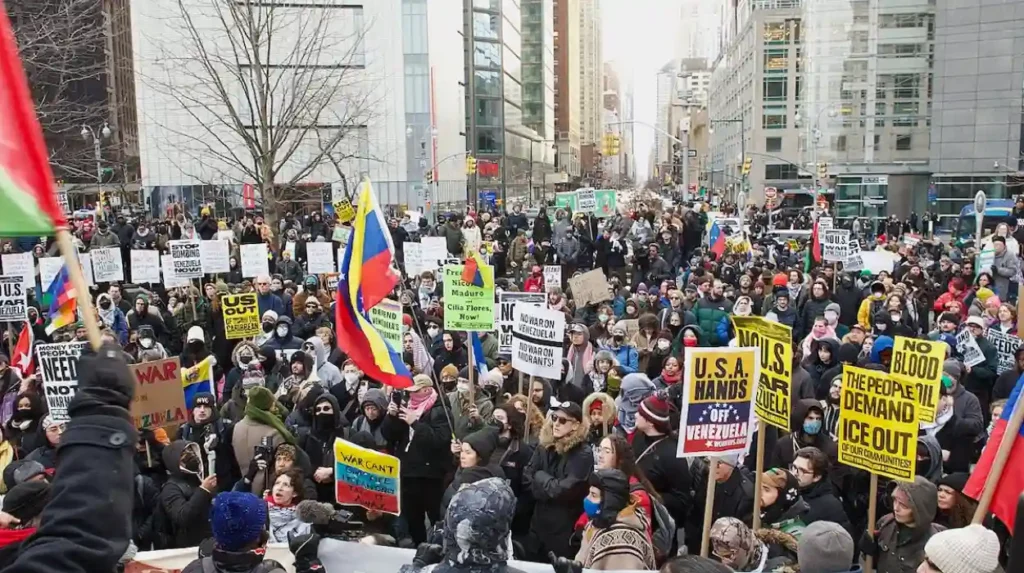
During the 2025–2026 period of intensified geopolitical friction with Iran, Iranian American groups organized demonstrations calling for political reform in Tehran. Several rallies publicly supported opposition figure Reza Pahlavi, reflecting a segment of the diaspora that favors systemic political change in Iran.
These demonstrations highlighted the community’s complex identity as both participants in American civic life and stakeholders in Iran’s political future. Analysts observed that diaspora activism often becomes more visible during international crises, which in turn draws greater attention from policymakers and security agencies.
Immigration oversight and professional communities
At the same time, expanded visa scrutiny and travel restrictions introduced during security reviews have affected students, researchers, and dual-national professionals. Universities and technology firms in California reported concerns about delays in academic collaboration and travel approvals.
Coverage by organizations such as Al Jazeera noted that diaspora communities frequently experience indirect consequences when geopolitical rivalry intensifies, even when their role in domestic politics is primarily civic and economic.
Immigration enforcement and diaspora fracture
Across all three communities, immigration enforcement policies have produced a shared sense of unpredictability. Federal authorities have emphasized declining net migration numbers and stronger border enforcement metrics, yet those statistics often obscure how enforcement unfolds within neighborhoods where diaspora networks are deeply embedded.
Travel restrictions affecting dozens of countries have increased visa processing uncertainty and delayed family reunification for many Iranian and Venezuelan American households. These administrative challenges rarely dominate political speeches but remain central to everyday life within diaspora communities.
The portrayal of detained migrants on official social media channels has also shaped public perceptions. Government messaging frequently emphasizes alleged criminal histories, describing some detainees as serious offenders. Local analyses conducted in several states have indicated that many individuals highlighted in these campaigns face minor charges or unresolved legal cases, which community advocates argue can amplify stigma and fear within immigrant neighborhoods.
Local resistance and policy adaptation
Cities with large diaspora populations have begun adapting to these pressures through local initiatives and legal challenges. Some municipal governments have limited cooperation with federal immigration enforcement operations, arguing that community trust and public safety benefit from clearer separation between local policing and immigration authority.
Civil-society organizations have also expanded legal aid services, informational workshops, and rapid-response networks designed to support families facing detention or status uncertainty. These efforts reflect a broader recognition that immigration policy often operates unevenly across regions and communities.
Political researchers observing the 2025–2026 period note that Cuban Americans, Venezuelan Americans, and Iranian Americans are reassessing how closely their electoral preferences align with the evolving blend of immigration enforcement and foreign-policy strategy emerging in Washington. Cuban American voters appear increasingly divided along generational lines, Venezuelan Americans continue balancing optimism about political change abroad with concerns over legal stability, and Iranian Americans remain attentive to how geopolitical tension may shape domestic scrutiny. The trajectory of these debates suggests that diaspora politics in the United States is entering a phase where foreign policy, immigration enforcement, and community identity intersect more visibly than in previous electoral cycles, leaving open questions about how these communities will position themselves as the next round of national political contests approaches.