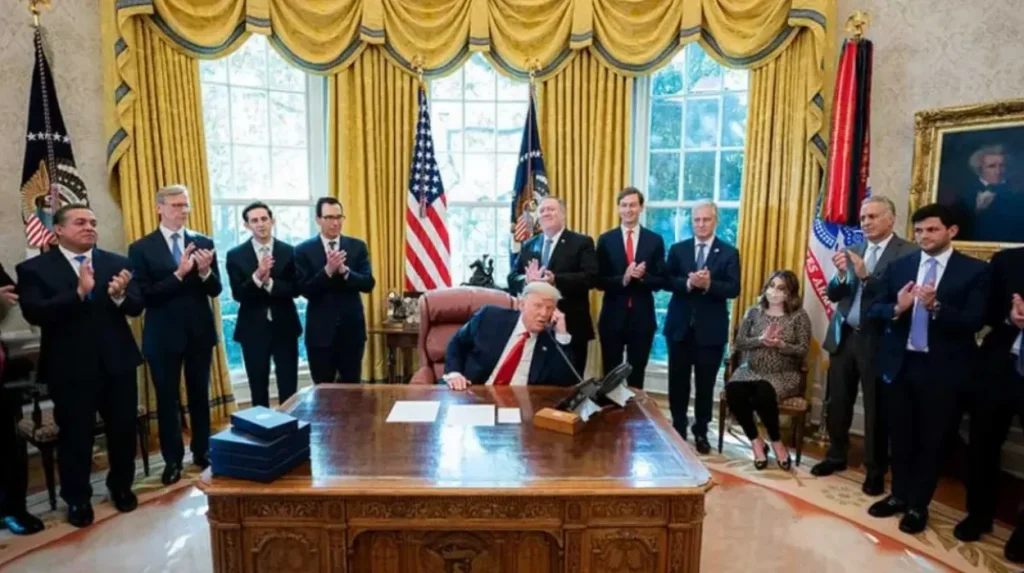
Family Envoys of Trump resurfaced as key players in the design of U.S. involvement in the Middle East in 2026 under a model whereby the United States focuses on insiders rather than classic diplomatic relationships. In the vanguard are Jared Kushner and Steve Witkoff who are working with the explicit presidential support and a mandate that is a combination of negotiation with political signaling.
President Donald Trump has heavily relied on his personal relationship that had been developed in his first term especially in the Abraham Accords. The present system makes it less dependent on the State Department and passes decisions through a small group of advisers. According to officials conversant with the set up, it represents an attempt to streamline diplomacy where bureaucratic friction is reduced.
This has attracted questioning in Washington but has found welcome in certain sections of the Gulf where personal liking is more frequently seen as a strategic asset. Reactivation of Trump Family Envoys indicates a consistency of approach as the regional crisis changes.
Gaza Ceasefire Negotiations as Proof of Concept
The most evident exercise of this model was the October 2025 ceasefire framework Gaza was negotiable at Sharm el-Sheikh. Kushner, who had served several years in the diplomatic service a few years earlier, having been employed in the interim in the field of private investment ventures, collaborated with Witkoff to negotiate staged de-escalation.
Phase One Implementation
The first stage revolved around hostage frees and partial pulls out by Israeli troops. The process was characterized by the regional mediators as intensive but unusually direct in Egypt and Qatar. Kushner has been reported to insist on an agreement in principle prior to ironing out technical annexes, a strategy that he has justified in the past as being a pragmatic sequencing.
Israeli officials publicly attributed the access of the envoys to President Trump as improving decisions. Most of the hostages were released on supervised exchanges by December 2025 and humanitarian corridors were closed due to multinational oversight.
It was not a full-fledged arrangement but served to change the situation in the battlefield enough to stabilize the conditions to the extent of enabling wider negotiations.
Transition to Reconstruction and Governance
By January 2026 the focus had changed to attention to governance structures and financing of reconstruction. Witkoff proposed a technocratic Palestinian administrative institution financed by the Gulf and controlled by international observers. There were consultations on supervisory measures that would be used to avoid aid misappropriation.
Saudi and Emirati interlocutors conditionally supported each other, conditional on reconstruction commitments on demilitarization standards. The incremental approach was a combination between transactional bargaining and political risk-sharing.
Those who criticized that there was no profound institutional coordination, proponents pointed out that centralized control enabled quick switching of military and civilian priorities.
Parallel Track: Iran Nuclear Diplomacy
At the same time, Trump Family Envoys have been the most vocal in indirect negotiation with Iran in Geneva. These consultations come after an unstable 2025 where Iranian nuclear infrastructure has been targeted by strikes and the International Atomic Energy Agency has seemed to scrutinize it more intensely.
Geneva Negotiations and Zero-Enrichment Demands
The meetings that were conducted on February 17 and 26, 2026, were aimed at limiting the enrichment efforts undertaken by Iran and the issue of stockpile transparency. The United States negotiators allegedly demanded the dismantling or international custody of some of the high-tech centrifuges, as well as the reinstatement of intrusive monitoring.
Iranian representatives do not accept the provisions of zero-enrichment, but expressed readiness to negotiate the dilution of higher-grade uranium. Omani mediators presented offers between delegations, trying to reconcile as much as possible between maximalist positions.
The negotiating style proposed by Kushner and Witkoff focused on conditional incentives. Sanctions relief was conceived as progressionary and result based as opposed to being front loaded.
Military Posture as Diplomatic Leverage
The diplomatic drive is made with a backdrop of increased U.S deployments in the Gulf. The advisories of the embassy and troop augmentation on rotational basis stresses on the deterrent aspect of negotiations.
Privately Witkoff has claimed that credible force increases bargaining leverage. The stance of the envoys is a reflection of the overall position of President Trump: apparent willingness and blatant desire to reach an agreement.
It is very sensitive to strike a balance between coercion and compromise. According to regional observers, Tehran can push limits as negotiations continue especially via proxy.
Institutional Bypass and Centralized Authority
The Family Envoys Trump works under an alternate form of governance that marginalizes the conventional policy committees. Issues of strategic decisions are supposed to be made within a small circle of the president and it is reported that there is analytical support given by the National Security Council staff.
Loyalty and Cohesion Over Bureaucratic Consensus
The advocates argue that small teams minimize mixed messaging. According to one of the senior officials, the setup was seen as having one voice in the room. This unity is perceived in-house to serve as a remedy against the interagency wrangles that made the previous diplomatic undertakings difficult.
Opponents claim that bypassing career diplomats will lead to underestimation of technical challenges especially in nuclear verification and post conflict governance. However, the white house holds that expertise is not being added at the expense of command.
The model corresponds to the long-standing tendency in Trump to participate in negotiations personally and by means of direct control.
Financial and Regional Interconnections
Affinity Partners, an investment firm run by Kushner, has raised capital among Gulf sovereign funds since 2021, which forms a strange intersection between financial and diplomatic contacts. Witkoff also has a business history that overlaps with the Middle Eastern investing communities.
Authority agents claim that such connections promote credibility and access and not conflicts. However, ethics observers in Washington have requested more explicit firewalls to avoid any case of perceived blending of the public and the personal interests.
Personal business familiarity in the regional capitals, however, is usually perceived as enabling trust and not compromising it.
Regional Reactions and Strategic Calculations
Leadership of Israel has embraced direct exposure of the envoys especially due the relationship that had existed between Kushner and Israel before the normalization process. Gulf states are also reserved, but seem to be at ease with the personalized format.
European allies have had ambivalent opinions. In particular, some diplomats subconsciously like institutional predictability, especially when it comes to multi-layered nuclear talks. Some people admit that the ability of focused power makes the decision-making process faster during crisis situations.
Iran and partners in the region are still tuning the responses. The statements of Tehran focus on sovereignty and allow technical compromise. Being keen to notice that the successful U.S.-brokered stabilization may change the regional alignments, Moscow and Beijing are looking on.
Long-Term Diplomatic Sustainability
The envoy-based approach has proved to be short-term effective in spurring motion where there were stalemates. However, longevity is a factor of carrying capacity. Gaza reconstruction structures and Iran verification systems need long-term administration control that is not based on top-level deals.
The question of domestic politics is also present. With the United States heading to mid term elections, concrete diplomatic success could support the administration in terms of its overall message of decisive leadership. On the contrary, failures may increase the criticism on the concentration of power.
Family Envoy Trump has packed complicated regional portfolios into hastened negotiation procedures delivering quantifiable results in stabilizing ceasefire and reopening nuclear dialogue. The success of such gains developing into long term architectures will be determined by the effectiveness of personal diplomacy to merge with institutional follow through. In a country used to great deals and great turnarounds, the permanence of this model could have not as much to do with access to power, but rather the purity of the agreements made therein.