The curve recorded in From 125% Tariffs to NDAA Threats: Fracturing Points Ahead is that of a turbulent stage of 2016 in the US-China economic relationship that is intensified until 2025. The tariff rates between the two countries shot up momentarily to 125 percent in a cycle of escalation in the spring, which was one of the most significant increases in bilateral trade disagreement since the initial trade war rounds in the first half of the decade.
The growth was precipitated by the executive actions against fentanyl precursors, strategic technologies and old trade imbalances. Beijing retaliated with counter-measures of American farm products and industrial products. These tit-for-tat actions, acting very quickly, shook commodity markets and reinforced the belief among all world investors that structural decoupling was accelerating.
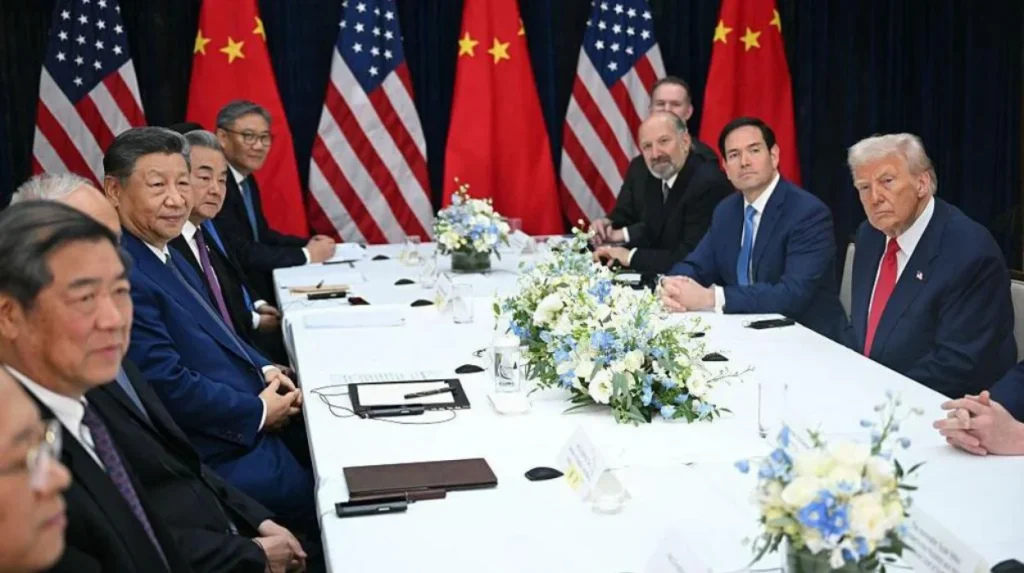
There was a diplomatic freeze that occurred after the top level talks between Donald Trump and Xi Jinping. Geneva discussions and further consultation on the margins of multilateral conferences had yielded a temporary cut of mutual tariffs to 10 percent over a 90 day phase which was subsequently prolonged to 2026. The White House described the move as a way to keep on building upon the progress made and solving the remaining issues which indicated that managed competition was a better alternative to direct confrontation.
Trade Data Reflect Structural Realignment
With uncertainty left behind, even after the headline tariffs had dropped to their highest levels, trade flows were left with the stamp of doubt. Year-end importation statistics revealed that Chinese electronics exports into the United States have significantly declined to its lowest level since the late 2000s. Southeast Asia and Mexico became the new sources of diversity in sourcing by US importers to speed up reconfiguration of the supply chain that already began to be reconfigured by the pandemic.
Sector-Specific Disruptions
Section 301 tariffs which were maintained at 25-100 were particularly effective on electronics, batteries, and solar components. Such responsibilities were still maintained even though the larger de-escalation took place, and this indicated that strategic sectors would not be subjected to diplomatic resets.
By mid-2025, steel and aluminum tariffs increased to 50 percent, making life more difficult on the automotive supply chains which already have an overlay of a 25 percent import duty. It was not merely an increase in prices but a change in the investment decisions. Chambers of commerce survey reports by both the US and foreign showed that more than a quarter of the companies with operations in China reported bilateral uncertainty as a significant reason to cut or shift the capital expenditure.
GDP and Growth Implications
There was a subtle picture of macroeconomic indicators. The US economy continued to grow up to the year 2025 and the growth rate of the Chinese economy had a slight drag due partly to trade frictions. Analysts have estimated that a rise in tariffs has removed half to two percentage points of the expected growth in China, depending on the exposure of each industry.
Nevertheless, the numbers of aggregate GDP masked underlying structural issues. It is evident that both economies showed resilience, but the partial decoupling pattern indicated that stabilization of the economies at lowering tariff levels was not equivalent to regained confidence. Rather it was a recalibration phase in a wider competitive framework.
Legislative Crosscurrents and the NDAA Factor
Executive diplomacy bought some breathing room whereas Congress came up with a parallel path. Some of the proposals included in the 2026 National Defense Authorization Act were to limit federal involvement with selected Chinese biotechnology and technology companies. The interventions that were associated with the BIOSECure and the FIGHT China programs were indicative of the bipartisan concord regarding exposure to strategic vulnerabilities.
This policy push brought a dualistic policy setting. On one side, the executive branch tried to take a course of moderation of tariffs and negotiation. On one more, the Congress progressed structural limitations focusing on the supply chains, research partnerships, and federal procurement. In the case of Beijing, this two-pronged strategy made the evaluation of the US will harder.
Section 301 Reviews and Escalation Risks
In 2025, the office of the United States trade representative ended 4 years of section 301 review by confirming increased duties on electric vehicle batteries, ship to shore cranes, and graphite. They are the main areas of clean energy transitions and infrastructure modernization, and both sides are politically sensitive as a result.
The possible reactionary measures adopted by China are mutual technology restraint, exportation of vital minerals, or increased investment filtering. All these actions have a risk of enhancing fragmentation of global trade governance. Regulatory tightening can have similar economic impacts even without tariff spikes being made on heads.
Defense Framing and Strategic Competition
The incorporation of economic indicators in defense law is an indication of a repackaged trade policy as a national security approach. Legislatures believe that relying on adversarial supply chains causes systemic risk. Opponents warn that blanket restrictions can provoke retaliatory actions of multinational companies and research institutions.
The antagonism of the industrial policy based on security and the integration into the world is the core of the present moment. The provisions of the NDAA emphasize the fact that the stabilization of tariffs is not equal to strategic detente.
Persistent Imbalances and Investment Reorientation
The bilateral trade deficit remained high in 2025 despite the presence of tariff cycles. The net surplus trade of China in the entire world was at an all time high and the deficit of the US in China had been on historic scales. These statistics support stories on both ends of structural imbalance.
Corporate Strategy Adjustments
The reaction of corporations has been practical and not ideological. Several US companies embraced China plus one sourcing model whereby they operated in China and were increasing capacity elsewhere. Around a fifth of the surveyed companies claimed to be actively moving production segments, especially electronics and the supply chain in the electric vehicles.
The Chinese companies also increased diversification into the emerging markets faster. The export volumes to Southeast Asia and the Middle East were high enough to partially offset the shrinking of the US market. What is achieved is not complete decoupling but increased regionally fragmented trade architecture.
Financial Market Sensitivity
The reaction of financial markets to tariff headlines in 2025 was financial markets reacting sharply, but then the volatility decreased in the de-escalation stage. Investors seem to draw a line between symbolic bells and ringing and long-term policy changes. With the emergence of NDAA-associated restrictions, however, the issue of a more profound institutional division was reawakened.
Rating agencies and multilateral institutions are alarmed that this kind of fragmentation that continued would hinder global growth prospects. Although neither party has given indications of breaking their links with each other on an economic front, the rising build-up of restrictions in layers would gradually solidify the borders.
Geopolitical Overlay and Strategic Signaling
There are overlaps between economic and geopolitical flashpoints, including in and around Taiwan and in the South China Sea. In 2025, naval accidents increased the concern about credibility of signaling and deterrence. Trade concessions in such a situation can be seen as gestures of goodwill or pauses in battle.
Think tanks such as the Center of Strategic and International Studies indicated that the relationship is seen as a contestive one rather than a cooperative one, by the experts. Such a state of affairs is not described by many analysts as China as a strategic partner, which highlights a sustainable level of rivalry.
It was further complicated with the overlay of world tariffs declared under Section 122 authority at the beginning of 2026. Though used widely, their interaction with China specific measures makes it difficult to compute multinational corporations as well as the allied governments.
Navigating a Managed Rivalry
From 125% Tariffs to NDAA Threats: Fracturing Points Ahead encapsulates a relationship oscillating between stabilization and structural confrontation. The tariff truce demonstrated that executive-level engagement can temporarily lower economic barriers. Yet congressional initiatives and sector-specific restrictions reveal that competition is institutionalizing rather than dissipating.
The immediate question is whether legislative action will trigger reciprocal escalation or coexist alongside limited economic engagement. The broader issue concerns how two intertwined economies recalibrate expectations in a period defined less by integration and more by guarded interdependence.
As 2026 advances, policymakers on both sides face a narrowing window to define guardrails that prevent episodic disputes from cascading into systemic rupture. Whether the interplay of executive diplomacy and legislative assertiveness yields durable equilibrium or renewed confrontation may determine not only bilateral trade flows but the architecture of global commerce in the decade ahead.