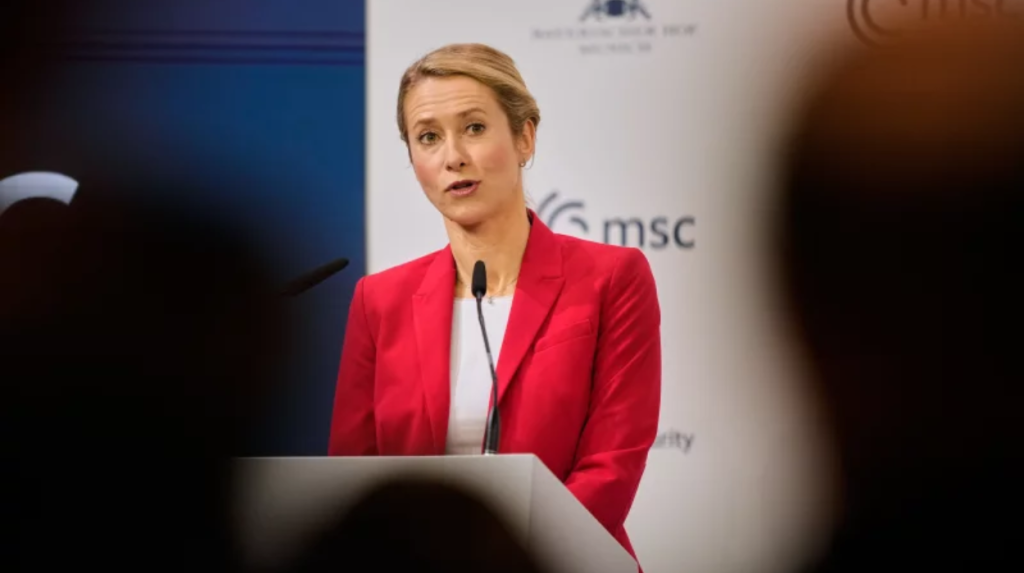
The European Union’s foreign policy chief has strongly rejected U.S. claims that Europe is undergoing a “civilisational erasure,” denouncing what she described as increasingly trendy “euro-bashing” rhetoric from Washington.
Kaja Kallas also argued that the United States was learning it could not resolve the war in Ukraine without Europe’s participation and approval, underscoring the continent’s continued geopolitical relevance.
Her comments concluded a tense three-day Munich Security Conference, where global leaders and security officials debated the future of the transatlantic alliance, proposals for a stronger European role within NATO, and prospects for peace negotiations in Ukraine.
Rubio’s Conditional Partnership Offer and Washington’s Demands
In his speech on Saturday, U.S. Secretary of State Marco Rubio adopted a more diplomatic tone but delivered a clear message: Washington would cooperate with Europe only if the continent adjusted its policies on migration, trade, and defence spending to align with U.S. leadership priorities.
Kallas suggested that parts of Rubio’s remarks were aimed at domestic political audiences in the United States rather than European partners.
She criticized the growing trend of “euro-bashing,” arguing that Europe continues to offer strong values admired globally. She said that many countries around the world still look to the EU as a model, and noted that in Canada, more than 40 percent of respondents had expressed interest in joining the EU.
Challenging U.S. Criticism on Democracy and Media Freedom
Kallas dismissed U.S. criticism of European media freedom, highlighting that Estonia ranks second in the global press freedom index, while the United States ranks 58th.
She also defended Europe’s human rights record, arguing that the EU continues to advance global human rights and prosperity, and said she found U.S. accusations difficult to accept given Europe’s track record.
A vocal critic of Russia, Kallas acknowledged that the EU was not yet prepared to set a concrete timeline for Ukraine’s membership, calling the prospect of accession as early as 2027 unrealistic.
Rubio’s Vision of a New World Order and Transatlantic Destiny
The day before Kallas’s remarks, Rubio made a highly anticipated speech presenting a conditional vision of renewed partnership, describing the United States as culturally rooted in Europe and emphasizing shared history.
He said the U.S. aimed to shape a new global order and stressed that while Washington was prepared to act independently, it preferred to do so alongside European allies. Rubio acknowledged that U.S. rhetoric might seem blunt and urgent, attributing this tone to concerns about Europe’s future and the belief that American and European destinies remain deeply connected.
Intelligence Disputes and Navalny Poisoning Report
After the conference, Rubio travelled to Bratislava, where he avoided explaining why U.S. intelligence agencies did not participate in a European intelligence report that concluded Russian opposition leader Alexei Navalny had been poisoned.
The report, compiled by five European intelligence agencies including the UK’s, alleged that Navalny was poisoned with a toxin derived from South American dart frogs and accused the Russian state of responsibility.
When questioned, Rubio said the report was coordinated independently by those countries, adding that the U.S. did not necessarily disagree with the findings but had not participated in the process. UK Prime Minister Keir Starmer said that intelligence cooperation between London and Washington was closer than ever.
Trump Administration Strategy Warns of Europe’s “Civilisational Erasure”
The controversy stems from a major U.S. National Security Strategy document released by the Trump administration, which warned that Europe could face “civilisational erasure” and might eventually cease to be a reliable U.S. ally.
The document criticized the European Union as anti-democratic and said the U.S. should help Europe correct its trajectory. It accused European governments of undermining democratic processes, particularly in relation to the war in Ukraine.
The strategy also suggested that demographic changes could transform some NATO countries into majority non-European societies within decades, questioning whether such nations would maintain the same global outlook or commitment to the U.S.-led alliance.
European leaders largely avoided public comment, with officials cautious about provoking President Donald Trump.
Ideological Alignment With Europe’s Far Right
The strategy outlined broader concerns about the EU and transnational institutions, migration policies, free speech restrictions, declining birthrates, and perceived erosion of national identities. These themes closely align with the agendas of Europe’s far-right political movements.
The document indicated a clear ideological convergence between Trump’s MAGA movement and nationalist parties in Europe. It also suggested that the U.S. administration, which has developed closer ties with far-right groups in countries such as Germany and Spain, could support ideologically aligned European political forces.
“America encourages its political allies in Europe to promote this revival of spirit,”
the strategy stated, describing the rise of patriotic European parties as a positive development.
A Blueprint for Trump’s Foreign Policy Worldview
The National Security Strategy provides a rare formal articulation of Trump’s foreign policy outlook and is intended to guide U.S. policy priorities and budget allocations. In an introductory note, Trump described the document as a roadmap to ensure American dominance and global leadership.
While the strategy acknowledges that Europe remains strategically and culturally important to the United States, its tone reflects the administration’s broader skepticism toward the EU. Vice President JD Vance had already shocked European leaders at the Munich Security Conference earlier in the year by attacking Europe over migration and free speech.