The idea sounds appealing at first glance: a coalition of nations dedicated to promoting global peace. But instead of strengthening existing multilateral institutions, a newly formed entity known as the “Board of Peace” has raised eyebrows across the world. Despite being established through a UN Security Council resolution last year, the board has failed to attract broad international support—particularly from democratic countries.
The reason is simple: many leaders and observers see the board less as a multilateral peace initiative and more as a vehicle for Donald Trump’s personal geopolitical ambitions.
Western Democracies Keep Their Distance
The first meeting of the Trump-led Board of Peace is set to take place later this month, although many major Western democracies are set to boycott it. Key United States allies, including France, Germany, the United Kingdom, and Canada, are said to have made up their minds not to take part.
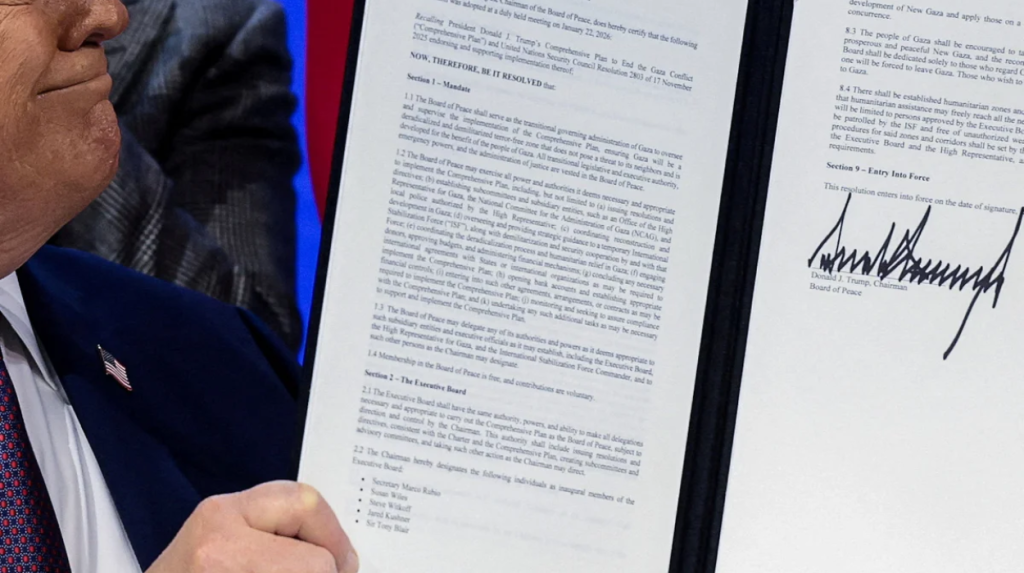
Such trends are highlighted in the board’s charter, which critics argue affords Trump significant control of its operations and financial management. The document is said to accord Trump almost total control of all aspects of the board’s activities. The president is said to act as the administrator, the financier, and the ultimate arbiter of the board.
Trump’s Expansive Vision and Bold Claims
Trump has touted the commission as a historic entity with vast potential power. In a speech this January, Trump said it had the potential to be “one of the most consequential bodies ever created,” also bragging about US military strikes and foreign policy successes in Iran, Nigeria and Venezuela.
Yet such rhetoric has fueled apprehensions that the board could be employed as an extension of U.S. unilateral power instead of a neutral peace mechanism.
Limited Membership and Democratic Deficit
When Trump launched the initiative, roughly 60 countries were invited to join. So far, only about 20 have confirmed participation. The list includes Albania, Argentina, Armenia, Azerbaijan, Bahrain, Belarus, Bulgaria, Egypt, Hungary, Indonesia, Israel, Jordan, Kazakhstan, Kosovo, Mongolia, Morocco, Pakistan, Paraguay, Qatar, Saudi Arabia, Turkey, the UAE, Uzbekistan, and Vietnam.
Notably, few of these countries are established liberal democracies—a point highlighted by Reuters and other observers. This has reinforced perceptions that the board lacks democratic legitimacy and global credibility.
From Gaza Plan to Global Power Platform
Originally, the Board of Peace was created to implement Trump’s 20-point Gaza peace plan. But the board’s scope has rapidly expanded. The charter does not even mention Gaza, signaling a shift from a focused transitional mechanism to a broader geopolitical instrument.
Trump himself has openly discussed using the board for initiatives far beyond Gaza, stating that once fully formed, it could pursue “numerous other things” and effectively act wherever he sees fit.
Chair for Life? Structural Concerns and Accountability Issues
One of the most controversial aspects of the board is its governance structure. According to its charter, the chair—currently Trump—can only be replaced through voluntary resignation or unanimous executive board agreement. However, the executive board is composed of Trump-appointed figures, including his deputy national security adviser, cabinet members, and his son-in-law.
This arrangement makes meaningful oversight or leadership change highly unlikely. Even if Trump resigns, he alone would select his successor, further entrenching personal control.
A Potential Rival to the United Nations
The board’s charter explicitly calls for a “more nimble and effective international peace-building body,” a phrase widely interpreted as a critique of the United Nations. Membership reportedly costs $1 billion, raising questions about whether the initiative is designed to compete with or undermine existing multilateral frameworks.
France has publicly stated it will not join, citing concerns about conflict with the UN’s mandate. Trump responded with characteristic bravado, threatening tariffs on French wines and champagnes in a rhetorical jab at President Emmanuel Macron.
Risks of Concentrated Power in an Unpredictable Leader
Many governments and analysts worry about giving such extensive authority to a single leader known for impulsive and confrontational foreign policy behavior. As chair-for-life, Trump can convene meetings, veto decisions, and remove executive board members at will.
Recent episodes—such as his threat to block a U.S.-Canada bridge amid a personal dispute with Canada’s prime minister—have underscored fears that the board could be used as a geopolitical weapon rather than a peace instrument.
Peace Initiative or Power Play?
Ultimately, the reluctance of democracies to participate reflects a broader concern: whether the Board of Peace is genuinely about conflict resolution or primarily about consolidating Trump’s global influence. For countries considering membership, the question remains whether investing $1 billion in such a structure would promote peace—or simply fund a personalized parallel world order under Trump’s control.