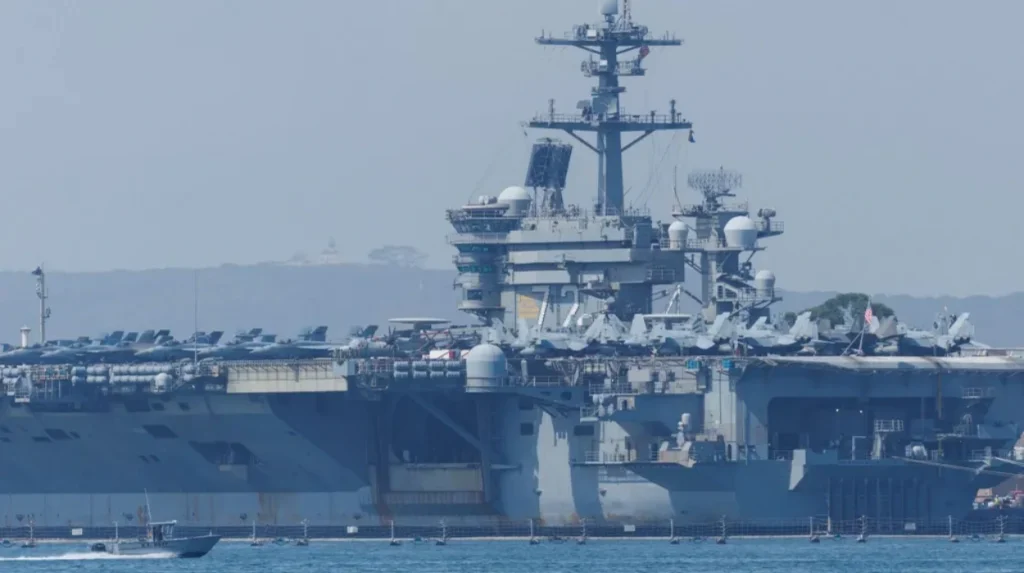
The presence of the USS Abraham Lincoln carrier strike group within the area of responsibility of the US Central Command, near Iranian waters, has heightened fears that a larger-scale confrontation is being prepared. This has come at a time of utmost vulnerability within Iran and has heightened the perception that the US and Iran are now poised for a direct military confrontation than at any time in recent years.
This action comes at a time when the Iranian government is experiencing the most brutal crackdown on protests in decades. The Iranian government is now being squeezed from two sides: the Iranian protest movement, which is no longer demanding reform but the overthrow of the regime, and a US president whose intentions are intentionally unclear. This lack of clarity is causing concern not only in Iran but throughout the volatile Middle East.
Why might Iran abandon its familiar pattern of calibrated retaliation?
Iran’s response to a potential US military strike may not follow the carefully managed, symbolic playbook seen in earlier confrontations. President Donald Trump’s recent threats, made against the backdrop of Iran’s violent suppression of domestic unrest, come at a moment of exceptional internal strain for the Islamic Republic.
This means that any attack by the US now has a much higher likelihood of escalation, both in the region and inside Iran. The Iranian strategy of waiting before striking, which has been the norm in the past, may not be politically or strategically viable anymore.
How has Iran managed escalation in past crises with the United States?
In recent years, Tehran has shown a preference for limited and belated retaliation. Following US strikes on Iranian nuclear facilities on 21-22 June 2025, Iran retaliated the next day with a missile strike on the US-controlled Al Udeid Air Base in Qatar.
As President Trump reported, Iran gave advance notice of the attack, which allowed air defenses to intercept most of the missiles. There were no reported casualties. This incident was seen as an attempt by Tehran to save face without escalating the conflict.
A similar trend was seen in January 2020, during Trump’s first term as president. In response to the US assassination of Quds Force commander Qassem Soleimani near the Baghdad airport on 3 January, Iran launched missiles at the US Ain al-Asad airbase in Iraq five days later. In this incident as well, prior warning was provided. Although there were no casualties among US personnel, dozens of them later tested positive for traumatic brain injuries.
How has domestic unrest fundamentally changed Iran’s calculations?
The current situation is very different. Iran is currently coming out from one of the most serious periods of internal unrest since the founding of the Islamic Republic in 1979. The protests that broke out in late December and early January were followed by a crackdown that was exceptionally brutal.
Human rights groups and medical personnel within Iran have reported that thousands of people have been killed, with many more wounded or arrested. The exact numbers are impossible to determine because of a near-total blackout of the internet that has now lasted for over two weeks.
Iranian authorities have denied responsibility for the deaths, instead blaming what they describe as “terrorist groups” and accusing Israel of fomenting unrest. That narrative has been echoed at the highest levels of the state. Iran’s secretary of the Supreme National Security Council recently framed the protests as a continuation of last summer’s 12-day war with Israel, offering insight into the regime’s security-first mindset and helping justify the scale and intensity of the crackdown.
Has the regime truly regained control, or merely imposed calm?
Although the scale of street protests has diminished, they have not ended. The underlying grievances remain unresolved, and the divide between large segments of Iranian society and the ruling system has rarely appeared so wide.
On 8 and 9 January, security forces reportedly lost control of parts of several towns and neighbourhoods in major cities before reasserting authority through overwhelming force. That brief loss of control appears to have deeply unsettled the authorities. The relative calm that followed has been imposed rather than negotiated, leaving the situation highly combustible and vulnerable to renewed unrest.
Could a limited US strike strengthen repression inside Iran?
Against this backdrop, the nature of any US military strike becomes critical. A limited attack might allow Washington to claim military success while avoiding immediate regional war. Yet it could also hand Iranian authorities a powerful pretext for another round of internal repression.
Such a scenario risks fresh crackdowns, mass arrests and a new wave of harsh sentences—including death penalties—for protesters already in detention. External pressure, rather than weakening hardliners, could reinforce the regime’s security narrative and justify even more brutal measures against dissent.
Are both sides misreading each other’s red lines?
Both Washington and Tehran are acutely aware of the broader strategic picture. Trump knows Iran is militarily weaker than it was before last summer’s 12-day war, while Iranian leaders understand that the US president has little appetite for a prolonged, open-ended conflict.
That mutual awareness may offer some reassurance, but it also creates the conditions for dangerous miscalculation. Each side may overestimate its leverage or misread the other’s tolerance for risk.
For Trump, the challenge is to engineer an outcome he can present as a victory without pushing Iran into either renewed repression or outright collapse. For Iran’s leadership, the danger lies in timing and perception. The previous model of delayed, symbolic retaliation may no longer suffice if leaders believe rapid action is necessary to reassert deterrence abroad and control at home after the shock of recent unrest.
Is the region approaching a tipping point?
A faster, more forceful Iranian response would significantly increase the risk of miscalculation, potentially drawing regional actors into a conflict few can afford. With both sides under intense pressure and limited room to manoeuvre, a prolonged game of brinkmanship may be entering its most dangerous phase.
The cost of getting that balance wrong would not be borne solely by governments or military planners, but by millions of ordinary Iranians—and by a region already stretched to the brink by war, instability and humanitarian crisis.