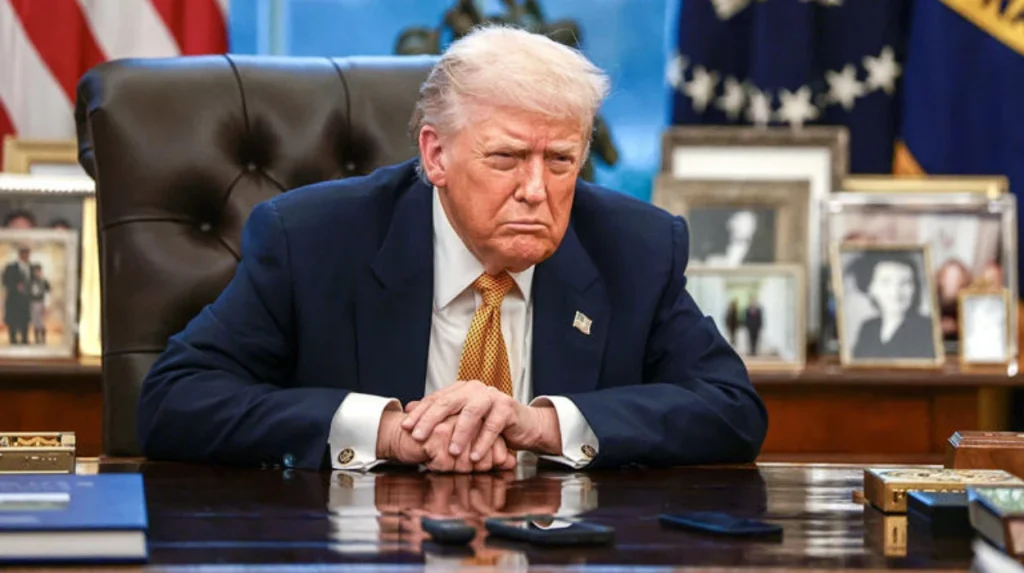
President Donald Trump said on Saturday that the United States will impose sweeping new tariffs on several European countries unless an agreement is reached for the purchase of Greenland, dramatically escalating his long-running campaign for US control of the Arctic territory governed by Denmark.
According to Trump, the United States will impose a 10% tariff on “any and all goods” from Denmark, Norway, Sweden, France, Germany, the United Kingdom, the Netherlands, and Finland starting February 1, with the tariff rising to 25% on June 1 if no agreement is reached. The tariffs would remain in place until European governments, particularly Denmark, agree to negotiations over Greenland.
In a post on his Truth Social platform, Trump framed the tariffs as overdue compensation.
“We have subsidized Denmark, and all of the Countries of the European Union, and others, for many years by not charging them Tariffs, or any other forms of remuneration,”
Trump wrote.
“Now, after Centuries, it is time for Denmark to give back — World Peace is at stake!”
Trump did not clarify whether the threatened tariffs would be applied on top of existing duties or replace them. Nor did he specify whether the tariffs would vary by sector or apply uniformly across all imports. CNN has reached out to the White House for clarification.
Why Is Greenland Central to Trump’s Strategy?
Trump also reiterated that the United States has sought to acquire Greenland for more than 150 years, arguing that modern military realities have made the Arctic territory strategically indispensable. He cited advanced weapons systems, missile defense initiatives, and projects such as the proposed “Golden Dome” as reasons why US control of Greenland is now a national security priority.
Greenland, while part of the Kingdom of Denmark, is an autonomous territory with broad self-government and the internationally recognized right to self-determination. Trump’s repeated statements have significantly strained diplomatic relations between Washington and Copenhagen, while also triggering alarm across NATO’s European members.
Are European Troops in Greenland a Security Threat?
In the same social media post, Trump warned that recent European military deployments to Greenland represent what he called
“a very dangerous situation for the Safety, Security, and Survival of our Planet.”
While NATO allies have long conducted joint military exercises in Greenland, the timing of these deployments has taken on new political significance. European governments view the deployments as a show of support for Denmark amid Trump’s escalating rhetoric, while Washington appears to interpret them as a challenge to US strategic dominance in the Arctic.
Danish Foreign Minister Lars Løkke Rasmussen rejected Trump’s framing, emphasizing transparency and alliance coordination.
“We agree with the US that we need to do more since the Arctic is no longer a low tension area,”
Rasmussen said.
“That’s exactly why we and NATO partners are stepping up in full transparency with our American allies.”
How Could Trump Legally Impose These Tariffs?
Trump’s proposed tariffs would most likely be imposed under the International Emergency Economic Powers Act (IEEPA)—the same law cited in previous executive orders that allowed the administration to use tariffs as leverage against foreign governments.
However, the legal foundation for such a move is far from settled. The US Supreme Court is expected to rule in the coming weeks on whether the IEEPA can legally be used to impose tariffs at all. Several justices have expressed skepticism, noting that the law does not explicitly authorize tariffs.
If the court rules against Trump, alternative trade laws remain available, but they are generally more limited in scope and duration. That could significantly weaken the effectiveness of tariffs as a coercive tool—particularly for pressuring Denmark to relinquish Greenland.
Adding to the complexity, the European countries Trump threatened are already subject to tariffs of at least 10%, and it remains unclear whether preexisting trade agreements with the European Union and the United Kingdom, reached last year, would override the new measures. Those agreements include numerous carve-outs and exemptions for specific industries.
How Are European Leaders Responding?
European leaders reacted swiftly and forcefully to Trump’s threats.
French President Emmanuel Macron called the proposed tariffs “unacceptable” and warned that Europe would respond collectively if the measures are confirmed.
British Prime Minister Keir Starmer echoed that criticism, stating:
“Applying tariffs on allies for pursuing the collective security of NATO allies is completely wrong.”
Norwegian Prime Minister Jonas Gahr Støre said threats have no place among allies, while Finnish President Alexander Stubb stressed that disputes between partners should be resolved through dialogue, not economic pressure.
Is the European Union Preparing Retaliation?
European Council President António Costa confirmed that he is coordinating a joint response among the EU’s 27 member states. Speaking from Paraguay after the European Union and South America’s Mercosur bloc signed a free trade agreement, Costa argued that Trump’s approach runs counter to global economic stability.
“If we want prosperity, we must open markets, not close them,”
Costa said. European Commission President Ursula von der Leyen also warned that the threatened tariffs undermine transatlantic relations and “risk a dangerous downward spiral.”
Within the European Parliament, criticism was particularly sharp. Bernd Lange, chair of the Parliament’s trade committee, said “a new line has been crossed” and called for work on the EU-US trade deal finalized in Scotland to be halted until Washington withdraws its threats.
Manfred Weber, leader of the European People’s Party—the largest voting bloc in the Parliament—said that while he supports closer EU-US trade ties, approval of the deal is now “impossible at this stage.”
An emergency meeting of EU ambassadors was called to address Trump’s Greenland threats, according to an EU diplomat with direct knowledge of the matter. The meeting is scheduled for Sunday afternoon in Brussels.
Why Are Protesters Mobilizing in Greenland and Denmark?
Public opposition has surged in both Greenland and Denmark.
In Denmark, thousands of protesters gathered in Copenhagen, Aarhus, Aalborg, and Odense in solidarity with the Greenlandic population. In Greenland’s capital, Nuuk, an estimated 5,000 people—nearly one-tenth of the island’s total population of 56,000—took part in demonstrations.
Protesters waved banners reading “Yankee go home” and “Greenland is already great.”
“We are demonstrating against American statements and ambitions to annex Greenland,”
said Camilla Siezing, chair of the Joint Association Inuit.
“We demand respect for the Danish Realm and for Greenland’s right to self-determination.”
Asked what message she would send to Trump, one unnamed protester in Nuuk told CNN:
“We are not for sale.” Another protester, Patricia, accused Trump of abusing power:
“We have seen what he does in Venezuela and Iran. He doesn’t respect anything. He just takes what he thinks is his.”
Are US Lawmakers United Behind Trump?
Amid the escalating dispute, a bipartisan US congressional delegation traveled to Copenhagen to meet Danish and Greenlandic leaders.
Democratic Senator Chris Coons, who led the delegation, criticized the administration’s approach, saying the “tempo of statements” about acquiring Greenland was not constructive. He also emphasized respect for Greenland’s Indigenous population and culture.
“The population of Greenland has managed to carve out, from an exceptionally difficult environment, a culture and an approach to living that is worthy of deep respect,”
Coons said.
Senate Minority Leader Chuck Schumer announced that Democrats will introduce legislation to block the tariffs, warning they would cause further damage to both the US economy and relations with European allies.
Opposition has also emerged within Trump’s own party. Republican Representative Don Bacon of Nebraska called the threats “shameful,” noting that Greenland’s inclusion under NATO’s security umbrella already allows the US to expand its military presence without coercion.
Does the American Public Support Taking Greenland?
Public opinion appears firmly against Trump’s ambitions. According to a recent CNN poll conducted by SSRS, three-quarters of Americans oppose any attempt by the United States to take control of Greenland—suggesting that Trump’s strategy faces not only international resistance, but significant domestic opposition as well.