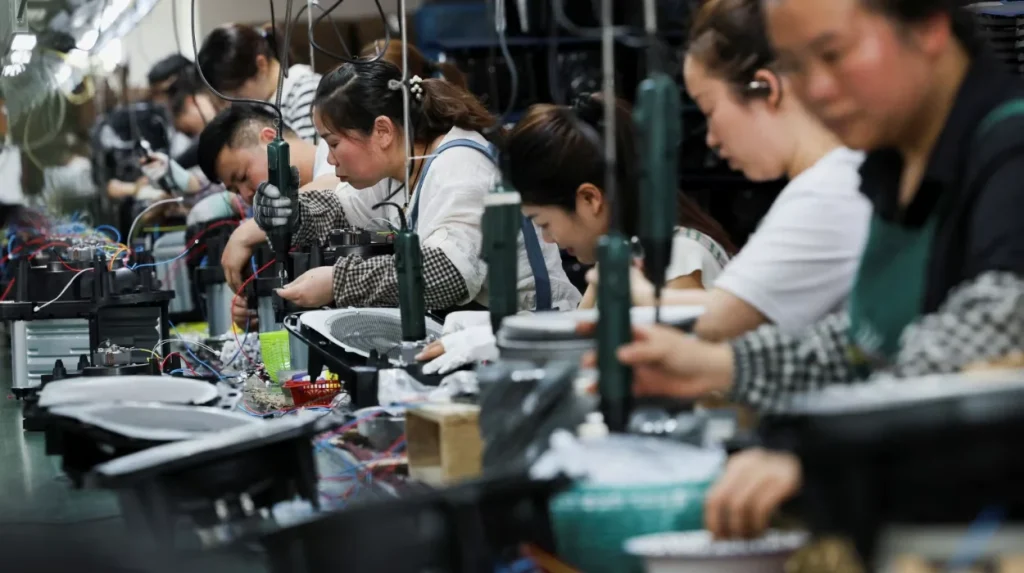
China finished 2025 with the highest ever trade surplus, reaching an unprecedented level of $1.2 trillion, representing a 20% increase from 2024. Even as it has an economic hardiness message relative to US trade pressure, it’s important for analysis of this level and structure of a China surplus – and indeed global trade and industry-related issues – to question further.
In a world where international demand is still imbalanced and a resurgence of protectionism is underway, the growing footprint of Chinese/exporting economies is increasingly regarded less as a stabilizing element and more as a source of friction within international trade—particularly among developing economies as well as developed economies working to protect their home manufacturing industries.
Pivoting away from the US: diversification or displacement?
The relationship between China and the United States, a historic main trading partner for Chinese exports, continued to worsen in 2025. Chinese shipments to the United States were lower by 16.9% through the first 11 months of the year, reflecting the lasting effects of tariffs, supply chain decoupling, and the efforts of the current American administration to reverse the offshore processing trend by resrouting strategic sectors back within the United States.
But, paradoxically, this represented no slow-down in overall exports. Rather, Chinese producers sought to raise exports to South East Asia, Africa, Latin America, and various regions of the Middle East, in which price sensitivity is prominent and government restrictions are minimal. Exports to ASEAN nations registered double-digit growth, while those to Africa registered growth at a rate not seen in over a decade, as per customs statistics.
Critics argue this shift represents displacement rather than diversification. By flooding alternative markets with low-cost goods—often supported by state subsidies—China risks replicating the same trade tensions it previously faced with the US, but on a broader global scale.
High-tech exports surge amid accusations of industrial overcapacity
Beijing has pointed to the shift in its export structure as proof that China is moving up its value chain. In 2025, China’s exports of high tech products, including “industrial robots,” “progressed by 13% year on year,” while exports of so-called “new three products”: “electrical vehicles,” “lithium batteries,” and “photovoltaic products,” “grew 27%.”
However, it has been observed that the governments of Western countries and developing nations have expressed similar concerns regarding these advances being fuelled by innovation and being more about excess capacity and government support. According to the International Monetary Fund, China’s manufacturing production has been increasing at a faster rate than global demand, particularly in electric vehicles and clean-energy equipment.
The European Union has already launched anti-subsidy investigations into Chinese electric vehicles, while countries such as Brazil, India, and Indonesia are considering safeguard measures to shield local industries from import surges. What Beijing presents as competitiveness, others increasingly see as market distortion.
Trade surplus vs domestic weakness: an unbalanced growth model
The Chinese boom in exporters also speaks to the fact that there have been fundamental problems within the Chinese economy. The fact is that consumer spending in the Chinese economy continues to be low because of declining real-estate prices and high unemployment among the young and less-skilled segments of the population. The real-estate sector, which contributed a full one-fourth of the economy’s activities, continues to serve as the biggest drag on economic performance.
Despite commitments to “rebalance” the economy to focus on consumption-driven growth, consumer spending in the country as a share of nominal GDP remains substantially lower compared to other developed nations. It is foreseen, however, that to compensate for the stagnant domestic market, the country faces growing risks in facing international trade barriers.
French President Emmanuel Macron’s recent warning that Europe’s growing trade imbalance with China is “unsustainable” reflects a wider international consensus: China cannot export its way out of structural economic problems indefinitely.
Trade truce with the US: fragile stability amid rising geopolitical risks
China’s strong export performance emboldened Beijing during months-long trade negotiations with Washington, culminating in an October meeting between President Xi Jinping and US President Donald Trump. The resulting truce reduced new tariffs on Chinese goods to 20%, down from peaks of 145% earlier in the year.
Yet the ceasefire remains fragile. Trump’s latest threat to impose a 25% tariff on countries doing business with Iran could directly affect China, Tehran’s most important economic partner. At the same time, Washington continues to prioritise supply-chain security and domestic manufacturing, signalling that strategic decoupling—not reconciliation—remains US policy.
Exporters on both sides are bracing for renewed volatility, while smaller economies fear becoming collateral damage in an increasingly fragmented global trade system.
A surplus that fuels strength—and suspicion
China’s $1.2 trillion trade surplus may be celebrated domestically as a triumph over external pressure, but internationally it is viewed with growing alarm. As more countries confront factory closures, job losses, and widening deficits linked to Chinese imports, calls for tariffs, quotas, and industrial policy are likely to intensify.
The central question is no longer whether China can sell more to the world—but how long the world will tolerate the imbalance. Without a meaningful shift toward boosting domestic demand and addressing overcapacity, Beijing’s export success risks deepening global trade conflicts rather than securing long-term economic stability.