For Europe, Donald Trump’s return to the White House has burned away long-held assumptions about alliances, deterrence, and collective security. His administration’s renewed threat to annex Greenland — an autonomous territory of Denmark — has pushed NATO into uncharted territory: an alliance built on the promise that members will defend one another now faces the possibility that one ally could turn its military power against another.
.@VP on Greenland: “But I guess my advice to European leaders and anybody else would be to take the President of the United States seriously … So what we’re asking our European friends to do is to take the security of that landmass more seriously, because if they’re not, the… pic.twitter.com/KWifFOOyaZ
— Department of State (@StateDept) January 9, 2026
The White House confirmed this week that Trump is “discussing a range of options” to acquire Greenland, pointedly refusing to rule out the use of force. In blunt terms, the administration appears to be embracing a worldview in which raw power overrides law, diplomacy, and alliance norms. Trump’s deputy chief of staff, Stephen Miller, captured that posture succinctly on CNN:
“We’re a superpower, and … we’re going to conduct ourselves as a superpower.”
Could NATO survive a US threat against one of its own members?
Denmark’s Prime Minister Mette Frederiksen has responded with rare directness. While US Secretary of State Marco Rubio has attempted to soften the rhetoric by suggesting Washington prefers a purchase over a military takeover, Frederiksen warned that an attack on Greenland would shatter NATO’s foundations.
“If the US chooses to attack another NATO country militarily,”
she said,
“then everything stops — including NATO and thus the security that has been established since the end of the Second World War.”
Her warning underscores the existential stakes: NATO’s credibility depends on the assumption that no member would ever contemplate coercion against another. Trump’s posture places that assumption in doubt.
Why are European leaders avoiding public confrontation with Washington?
Despite the severity of the threat, most European leaders have been conspicuously restrained. The reason is deeply uncomfortable: even if the US is becoming a less reliable ally, Europe cannot yet afford to alienate it.
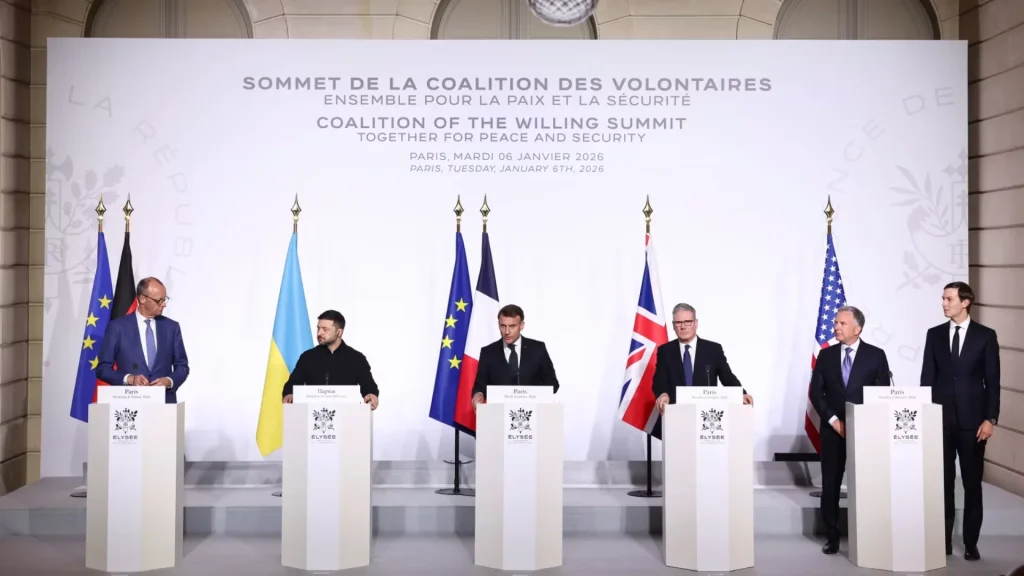
This tension was on full display in Paris this week, where officials from 35 countries — including the US — gathered to discuss post-war security guarantees for Ukraine. The meetings produced tangible commitments, but the atmosphere shifted when journalists raised the Greenland issue.
Asked how credible US security guarantees could be on a day when Washington was openly discussing seizing NATO territory, British Prime Minister Keir Starmer sidestepped the question, referring instead to an earlier statement of solidarity with Denmark. French President Emmanuel Macron offered a similar evasion. Standing alongside Trump’s special envoy Steve Witkoff and son-in-law Jared Kushner, neither leader appeared willing to risk antagonizing Washington at a moment when US engagement in Ukraine remains critical.
Is Europe sacrificing principle to keep the US engaged in Ukraine?
Over the past year, Europe has repeatedly absorbed political and economic blows to keep the US aligned with its strategic priorities. European leaders have been publicly berated by Vice President JD Vance, targeted online by Elon Musk, and accused in the Trump administration’s National Security Strategy of undermining democracy by marginalizing “patriotic” parties favored by Washington.
The European Union has also accepted a 15% tariff on trade with the US — a concession that would have been unthinkable under previous administrations.
According to Mujtaba Rahman of the Eurasia Group, Europe’s caution reflects structural weakness rather than diplomatic cowardice.
“Many European leaders want to talk tough to America,”
he said,
“but they’re simply not in a position to do so, because for a very long time they’ve outsourced their security to America.”
How dependent is Europe on US military power?
That dependence is particularly acute in Ukraine. Since the Trump administration has not sought congressional approval for new military aid packages, Europe has effectively shouldered the financial burden of Ukraine’s defense for more than a year. Yet even as it pays, Europe remains reliant on US-made weapons systems and logistics.
Rahman argues that Europe’s overriding priority in 2026 is to keep Washington engaged in Ukraine at almost any cost — even if that means pressuring Copenhagen to find a “face-saving accommodation” with the US over Greenland. Rearming Europe, he notes, will take at least three to five years.
Does Europe have more leverage than it admits?
Some analysts contend that Europe underestimates its own bargaining power. Daniel Fried, a former US assistant secretary of state, argues that European defense industries remain globally competitive.
“There are plenty of areas in which European defense suppliers are competitive with the Americans,”
Fried said.
“We’re not the only ones who make fighter aircraft.”
He suggested that Europe could withhold access to cutting-edge drone technologies if US pressure escalates.
Such measures would mark a shift from quiet accommodation toward strategic pushback — though few leaders appear ready to take that step.
Should Europe respond with military or political countermeasures?
Calls for a tougher response are growing. French MEP Raphael Glucksmann has urged the EU to establish a permanent military base in Greenland, arguing it would undermine Washington’s claim that only the US can guarantee the island’s security.
Others urge caution. Majda Ruge of the European Council on Foreign Relations warns against turning the crisis into a military standoff with the US. Instead, she advocates raising the political, economic, and alliance costs of unilateral American action early and visibly.
“The goal is not escalation,” she said,
“but to make sure Trump cannot act in a political vacuum.”
Forcing the US president to openly confront allied opposition would significantly increase domestic and international costs.
Does Trump face resistance at home over Greenland?
Public opinion in the US suggests limited appetite for military adventurism in Greenland. A YouGov poll conducted last August found that just 7% of Americans supported using force to annex the territory, while 72% were opposed.
Trump’s political rise was fueled in part by his criticism of the Iraq war and other “forever wars.” Yet his recent comments to The New York Times — suggesting US oversight of Venezuela could last for years following the removal of Nicolás Maduro — indicate a growing comfort with prolonged foreign entanglements.
Is Europe simply buying time until it can defend itself?
European officials privately fear that Trump’s interest in Greenland may not fade as it did during his first term.
“He is deadly serious about this,”
one British lawmaker told CNN.
Rahman is blunt about the strategic reality.
“The Americans know the Europeans are weak,”
he said.
“Predators prey on the weak — that’s what the Trump administration is doing.”
For now, Europe’s strategy appears to be one of delay rather than resistance — buying time to rebuild its defenses while navigating an alliance increasingly defined by power rather than principle.