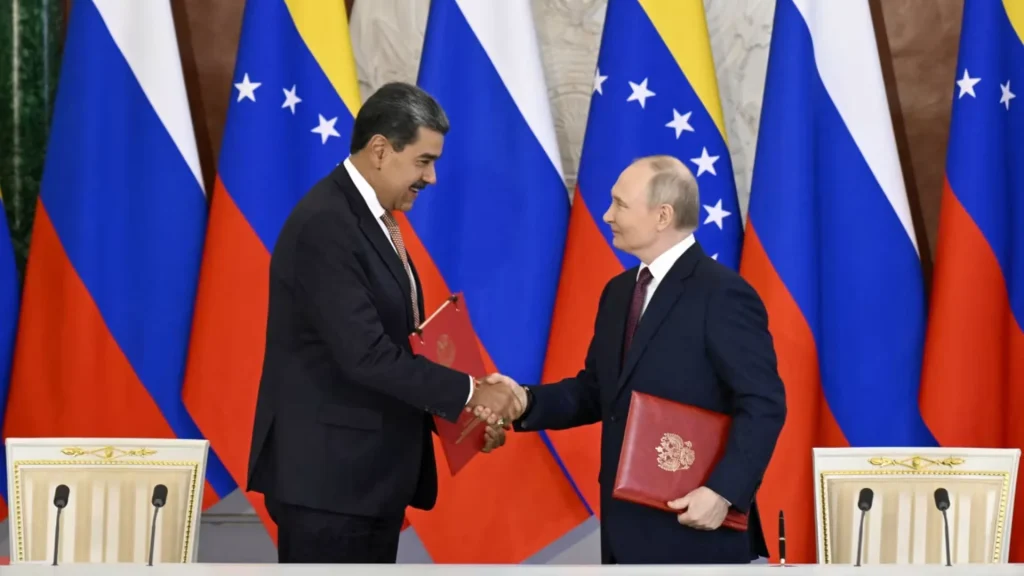
In May last year, Russian President Vladimir Putin welcomed Venezuelan leader Nicolás Maduro to the Grand Kremlin Palace, days before Moscow’s lavish celebrations marking the 80th anniversary of the Soviet victory over Nazi Germany. The choreography was deliberate and symbolic. Standing beside Foreign Minister Sergey Lavrov, Putin praised the deepening ties between Moscow and Caracas, crediting their progress largely to Maduro’s “personal attention.”
The visit culminated in the signing of a treaty on strategic partnership and cooperation, projecting Russia’s most significant alliance in the Western Hemisphere. Yet the dramatic US-led military operation that captured Maduro has since cast serious doubt on how deep—or how reliable—that partnership ever was.
How did Washington’s raid expose the limits of Russia’s influence?
The seizure of Maduro, ordered by US President Donald Trump, marked a decisive assertion of American power in Latin America. Despite Russia’s prior pledges of solidarity and strategic cooperation, Moscow offered no concrete response to stop or counter the operation.
Instead, the episode exposed the hard limits of Russian power far from its immediate sphere of influence, revealing that symbolic alliances do not necessarily translate into military deterrence when confronted by US force.
Why did Russia’s response remain largely rhetorical?
Russian condemnation came swiftly—but only at the diplomatic level. Lavrov told Venezuela’s interim president, Delcy Rodríguez, that Moscow stood in “strong solidarity” with the Venezuelan people against “armed aggression.” At the UN Security Council, Ambassador Vasily Nebenzya accused Washington of fueling “neocolonialism and imperialism.”
Conspicuously absent, however, was Putin himself. Unlike Chinese President Xi Jinping—who publicly denounced Washington’s actions as “unilateral bullying”—Putin made no immediate statement. His silence stood in stark contrast to the gravity of the moment and reinforced perceptions of Russian restraint, or reluctance, in confronting the United States directly.
What message did Putin’s silence send to allies and adversaries?
In Russian politics, Putin’s voice is decisive. His failure to publicly address Maduro’s capture—or even the US seizure of a Russian-flagged vessel days later—sent a clear signal: Moscow was unwilling to escalate.
For allies, this raised uncomfortable questions about the credibility of Russian security guarantees. For Washington, it suggested that US military adventurism in Latin America could proceed with minimal risk of Russian retaliation.
Is Maduro’s downfall part of a broader pattern of Russian setbacks?
Maduro’s removal fits into a wider sequence of geopolitical disappointments for the Kremlin. In December 2024, Syrian President Bashar al-Assad—another longtime Russian client—fled to Moscow after his regime collapsed. Months later, US strikes on Iranian nuclear facilities underscored Russia’s unwillingness or inability to defend yet another strategic partner.
In each case, Moscow emphasized that its “strategic partnerships” did not require direct military intervention. The Venezuela episode reinforced the perception that these agreements are politically symbolic rather than operationally binding.
Did Russian weapons fail Venezuela at a critical moment?
The US raid was also a public embarrassment for Russia’s military-industrial complex. Under Hugo Chávez and later Maduro, Venezuela invested heavily in Russian-made air defense systems, including S-300s, Buk missiles, and Pechora platforms. Maduro had even claimed that thousands of Russian short-range missiles were deployed to protect key sites.
Yet none of these systems prevented US special forces from carrying out their mission. US Defense Secretary Pete Hegseth openly mocked their performance, highlighting reputational damage for Russia’s defense exports.
Could US “gunboat diplomacy” actually benefit Putin strategically?
Despite the setbacks, the crisis may offer Putin unexpected strategic advantages. Trump’s unapologetic assertion of a US sphere of influence in Latin America—reviving what critics label a modern “Monroe Doctrine”—provides rhetorical cover for Russia’s own imperial ambitions.
If Washington claims the right to use force in its backyard, the Kremlin can more easily justify its actions in Ukraine and the former Soviet space as great-power politics rather than aggression.
How does Greenland fit into the Kremlin’s worldview?
Trump’s repeated signals that Greenland could be seized by force have not gone unnoticed in Moscow. For the Kremlin, such rhetoric reinforces a worldview in which power, not international law, determines outcomes. This logic aligns neatly with Putin’s long-standing claim that Russia has special rights in its so-called “near abroad”—the independent states that emerged after the Soviet Union’s collapse.
Is Putin openly embracing a doctrine where might makes right?
Putin has made little effort to conceal his belief in imperial restoration. Since launching the full-scale invasion of Ukraine in February 2022, he has framed the war as a historic mission to reclaim lost territory and status.
That worldview mirrors comments made by Trump adviser Stephen Miller after the Venezuela raid, when he bluntly stated that the world is governed by “strength… force… power.” For the Kremlin, such statements validate Russia’s own rejection of a rules-based international order.
Why does Ukraine remain the real measure of Putin’s power?
The image of Maduro being led into a New York courthouse inevitably draws comparisons with Ukraine, where Putin has failed to impose regime change despite years of war. The contrast is stark: Washington achieved in days what Moscow has not managed in years.
Yet Putin continues to signal defiance. Appearing with soldiers and their families during Orthodox Christmas services, he framed Russia’s war in near-messianic terms, portraying the military as divinely tasked with defending the “Fatherland.”
What does the Venezuela episode reveal about today’s global order?
Maduro’s capture underscores a harsh reality of contemporary geopolitics: alliances are conditional, power is uneven, and international law is increasingly subordinate to force. While Russia condemns US actions as imperialist, it simultaneously draws lessons that may embolden its own ambitions.
In this global game of power, Putin appears determined to demonstrate that—even after setbacks—might still makes right.