United States forces have boarded and commandeered a Russian-flagged oil tanker ship in the Atlantic Ocean after a pursuit spanning weeks, which has increased tensions with Russia.
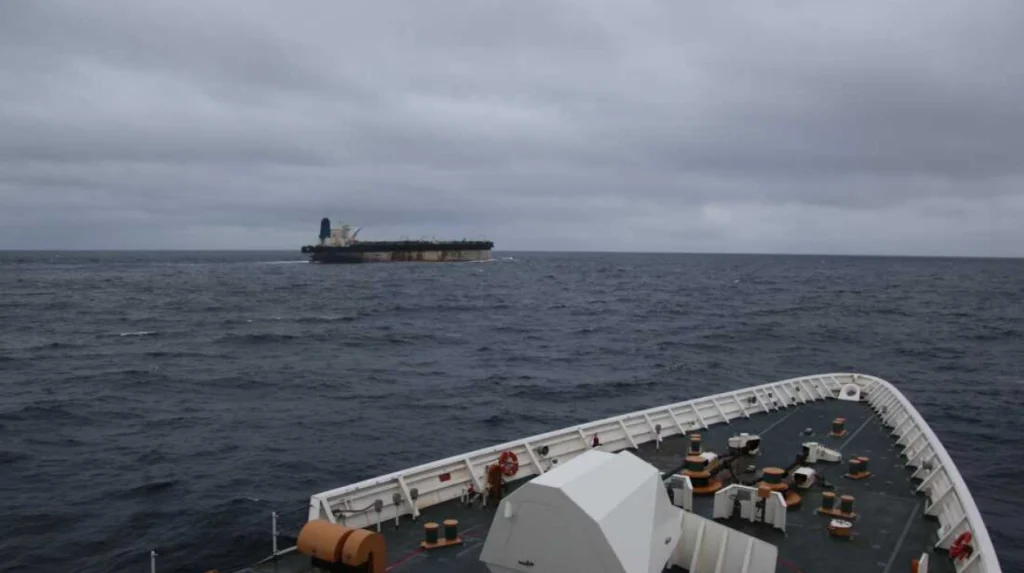
The ship—a rusting tanker dating from a bygone era and originally called the Bella 1—had been blacklisted by Washington in 2024 for operating in what was dubbed a “shadow fleet” network dedicated to smuggling oil on behalf of Iran, Venezuela, and Russia in contravention of US sanctions.
The @TheJusticeDept & @DHSgov, in coordination with the @DeptofWar today announced the seizure of
— U.S. European Command (@US_EUCOM) January 7, 2026
the M/V Bella 1 for violations of U.S. sanctions. The vessel was seized in the North Atlantic pursuant to a warrant issued by a U.S. federal court after being tracked by USCGC Munro. pic.twitter.com/bm5KcCK30X
The dramatic seizure marked one of the most aggressive maritime enforcement actions undertaken by the US in recent years.
What triggered the high-seas chase?
The confrontation began last month when the US Coast Guard attempted to board the tanker as it sailed toward Venezuela to load oil. At the time, the ship was operating under the flag of Guyana. The crew refused to comply, abruptly changing course and steering into the open Atlantic — a move US officials interpreted as deliberate evasion.
Soon after, the vessel’s operators escalated matters further.
Why did the tanker suddenly become “Russian”?
Following the failed boarding attempt, the crew reportedly painted a Russian flag on the ship’s hull. The tanker then appeared in a Russian shipping registry under a new name: Marinera.
US officials say the reflagging was an attempt to shield the ship from seizure by invoking Russian jurisdiction — a move that sharply raised the stakes.
According to US intelligence, Moscow responded by dispatching a submarine to escort the vessel as it sailed toward Europe, raising fears of a direct confrontation between the US and Russia.
How did Washington justify the seizure?
US Defense Secretary Pete Hegseth underscored the administration’s position in a blunt social media post:
“The blockade of sanctioned and illicit Venezuelan oil remains in FULL EFFECT – anywhere in the world.”
The blockade of sanctioned and illicit Venezuelan oil remains in FULL EFFECT — anywhere in the world. https://t.co/iTPUWqrFiB
— Pete Hegseth (@PeteHegseth) January 7, 2026
American officials say the Marinera was part of a “dark” or “shadow” fleet used to move sanctioned oil through deceptive practices such as false flags, name changes, and disabled tracking systems.
How and where was the tanker finally seized?
The seizure occurred Wednesday roughly 190 miles south of Iceland in the North Atlantic, according to ship-tracking data from MarineTraffic, which shows the tanker making a sharp turn around the time of the operation.
CNN reported that the US repositioned military assets to the United Kingdom ahead of the boarding. V-22 Osprey aircraft were observed flying out of RAF Fairford, while two AC-130 gunships arrived at RAF Mildenhall days earlier. Russia’s Transport Ministry confirmed it lost contact with the vessel at around 7 a.m. ET, shortly after US forces boarded.
Which forces carried out the operation?
According to sources briefed on the mission, US Navy SEALs boarded the tanker after being inserted by helicopters operated by the US Army’s 160th Special Operations Aviation Regiment — known as the “Night Stalkers.” The UK Ministry of Defence confirmed it provided assistance “following a US request,” underscoring the multinational dimension of the operation.
The US has not released official footage, though Russian state broadcaster RT aired grainy video appearing to show a ship shadowing the tanker in foggy conditions prior to the seizure.
Did Russia attempt to protect the vessel?
US officials say Russia had begun repositioning naval assets — including a submarine — to protect the tanker. However, it remains unclear how close those assets were at the time US forces moved in. The uncertainty underscores how close the incident may have come to triggering a direct military standoff.
How has Moscow responded to the seizure?
Russia condemned the action, with its Transport Ministry arguing that under the 1982 UN Convention on the Law of the Sea, no state has the right to use force against a vessel properly registered under another country’s jurisdiction.
Moscow also demanded the return of Russian citizens aboard the ship. Russian lawmaker Leonid Slutsky described the seizure as “21st-century piracy.” President Vladimir Putin has not publicly commented.
The White House, however, downplayed the risk of escalation. Press Secretary Karoline Leavitt said President Donald Trump’s relationship with Putin would help prevent confrontation.
Was the tanker carrying oil at the time?
According to analytics firm Kpler, the Bella 1 was not carrying oil when it was seized — unlike two other tankers, Skipper and Centuries, intercepted in recent weeks and piloted to Texas with their cargoes intact. Kpler data also showed the tanker had twice switched off its Automatic Identification System (AIS) for 99-day periods — a common tactic among vessels transporting sanctioned Iranian and Venezuelan crude.
Were other tankers seized as well?
Yes. In a separate operation on Wednesday, US authorities seized another tanker, the Sophia, in international waters near the Caribbean. US Southern Command described the Sophia as a “stateless, sanctioned” vessel engaged in illicit activity. Kpler estimates it was carrying roughly 2 million barrels of crude oil loaded from Venezuela.
Is this part of a broader maritime crackdown?
US officials insist the seizures are part of a sustained pressure campaign targeting sanctioned oil flows. White House officials have pledged to continue intercepting vessels linked to Venezuela’s “dark fleet,” even as analysts warn of rising tensions with Russia and China — both of which have economic stakes in Venezuelan oil.
How many ships remain at risk?
Kpler data indicates at least 16 vessels loaded crude or fuel oil in Venezuela between October 2025 and January 2026. Ten of those ships switched off their AIS transmitters and may already have departed Venezuelan waters. The remaining six — with a combined capacity of nearly 9 million barrels — either remain docked or have disabled tracking systems.
Is the US pushing maritime enforcement to a breaking point?
The seizure of the Bella 1 highlights how sanctions enforcement has expanded beyond diplomacy into direct military action at sea.
While Washington argues it is upholding international norms, critics warn that aggressive interdictions — particularly involving nuclear-armed states — carry serious risks of miscalculation. As global energy routes become increasingly militarised, the question remains whether enforcing sanctions at gunpoint will deter illicit trade — or push great-power rivalry into even more dangerous waters.