President Trump ordered an attack on facilities inside Venezuela, military installations among them, as his administration began early Saturday its campaign against Venezuelan President Nicolas Maduro. This comes after a long period of increased US military strength in Latin America.
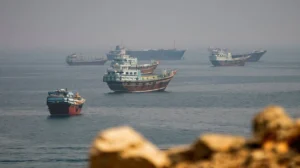
The U.S. had been mobilizing for months with its military presence in the Caribbean, which included its USS Gerald R. Ford aircraft carrier as well as other war ships. This was prior to their early Saturday attacks on military and strategic locations around Venezuela.
What explosions were reported in Caracas and other areas?
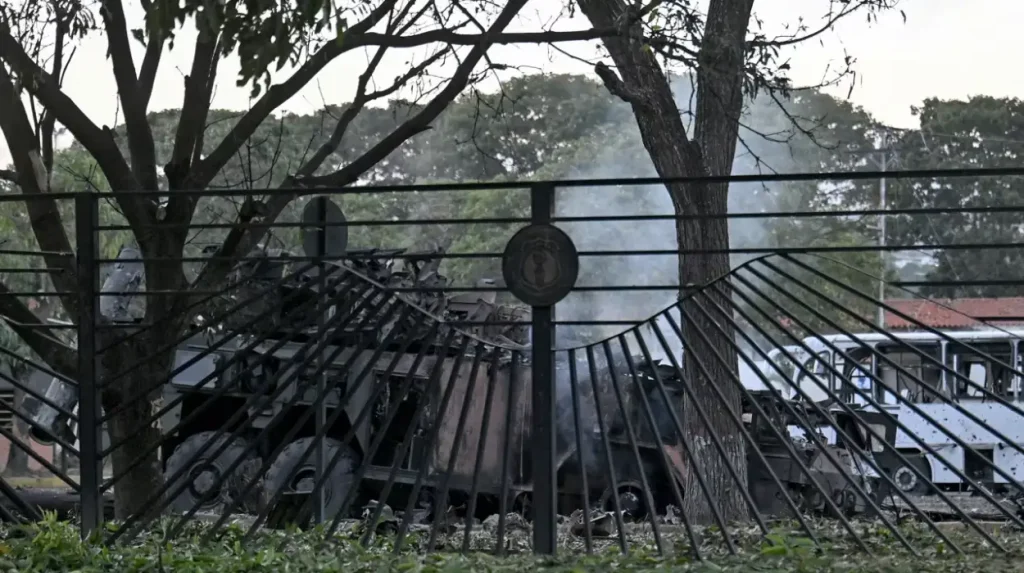
According to sources, several explosions hit the city of Caracas, and some parts of the capital faced an electricity shortage. The first blast was documented at about 1:50 a.m. local time on Saturday, or 0:50 a.m. EST. The government of Venezuela blamed the U.S. for the continuous attacks-not only in Caracas but also in the states of Miranda, Aragua, and La Guaira. In response, President Nicolás Maduro signed a state of emergency.
Did President Trump claim Maduro had been captured?
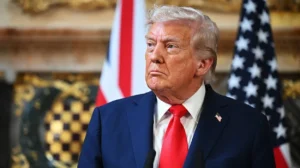
President Trump wrote on Truth Social early Saturday morning that Venezuelan President Nicolás Maduro and his wife were “captured and flown out of the country,” confirming U.S. military strikes in Venezuela.
“The United States of America has successfully carried out a large-scale strike against Venezuela and its leader,”
Trump wrote. He also mentioned that U.S. law enforcement was involved, though he did not specify which agencies.
How is the U.S. protecting its citizens in Venezuela?
The State Department issued an early Saturday message to Americans in Venezuela urging them to shelter in place.
“The U.S. Embassy in Bogota, Colombia, has learned of reports regarding explosions in and around Caracas, Venezuela,”
the State Department stated in a message on its website.
The US has in the past warned its citizens against travelling to Venezuela due to problems such as random arrests, torture, terrorism, kidnappings, summary trials for violations of local law, crime, civil unrest, and poor health care.
How did U.S. senators react to the attacks?
Reactions among U.S. lawmakers were mixed. Democratic Sen. Ruben Gallego of Arizona, a U.S. Marine Corps veteran who served in Iraq, posted on X that “this war is illegal” and called it the “second unjustified war in my lifetime.”
Second unjustified war in my life time.
— Ruben Gallego (@RubenGallego) January 3, 2026
This war is illegal, it’s embarrassing that we went from the world cop to the world bully in less than one year.
There is no reason for us to be at war with Venezuela.
Republican Sen. Mike Lee of Utah expressed skepticism, posting on X: “I look forward to learning what, if anything, might constitutionally justify this action in the absence of a declaration of war or authorization for the use of military force.”
I look forward to learning what, if anything, might constitutionally justify this action in the absence of a declaration of war or authorization for the use of military force https://t.co/f5ackJn5Mi
— Mike Lee (@BasedMikeLee) January 3, 2026
Senator Brian Schatz, a member of the Senate Foreign Relations Committee, also warned against U.S. military involvement, stating on X that the United States has “no vital national interests in Venezuela to justify war.”
We have no vital national interests in Venezuela to justify war. We should have learned not to stumble into another stupid adventure by now. And he’s not even bothering to tell the American public what the hell is going on.
— Brian Schatz (@brianschatz) January 3, 2026
How did the Venezuelan government respond to the strikes?
Venezuela’s government called on its supporters to take to the streets following the U.S. strikes.
“People to the streets! The Bolivarian Government calls on all social and political forces in the country to activate mobilization plans and repudiate this imperialist attack,”
the statement said.
According to Venezuelan Defense Minister Vladimir Padrino López, the US attack on Saturday affected Venezuelan cities with the firing of missiles and rockets from US combat helicopters.
He said Venezuela is still seeking information on the numbers that were killed or wounded, but confirmed the country’s military base named Fort Tiuna in Caracas was attacked.
The government criticized the “very serious grave military aggression” carried out by the U.S. against various parts of the country, including the capital, Caracas, early on Saturday morning. President Nicolas Maduro signed a declaration of a state of emergency and decreed that all national defense plans were to be carried out at the relevant time and in the appropriate circumstances.
The President has also declared a state of external disturbance and has ordered all national defense plans to be activated. This state of emergency will enable him to guarantee the rights, freedom, and liberties of Venezuelans, in accordance with Article 342 of the Constitution, which attributes such powers.
The Venezuelan government has also indicated that it will “complain before the United Nations Security Council, before the Secretary-General, before international institutions, demanding a condemnation” of actions taken by the United States.
How are Colombia and Cuba reacting to the situation in Venezuela?
The presidents of Colombia and Cuba have expressed concern and condemnation over the situation in Venezuela.
Colombian President Gustavo Petro wrote on X:
“The Colombian Government rejects any unilateral military action that could aggravate the situation or put the civilian population at risk.”
He added that Colombia is monitoring the situation in neighboring Venezuela with “deep concern” and urged all parties to refrain from escalatory actions, without directly mentioning the U.S.
El Gobierno de la República de Colombia observa con profunda preocupación los reportes sobre explosiones y actividad aérea inusual registrados en las últimas horas en la República Bolivariana de Venezuela, así como la consecuente escalada de tensión en la región.
— Gustavo Petro (@petrogustavo) January 3, 2026
Colombia…
Cuban President Miguel Díaz-Canel condemned what he described as a “criminal” attack by the U.S., posting:
“Cuba denounces and urgently demands the reaction of the international community against the criminal attack by the US on Venezuela. Our zone of peace is being brutally assaulted.”
#Cuba denuncia y demanda URGENTE reacción de la comunidad internacional contra criminal ataque de E.U a #Venezuela. Nuestra #ZonaDePaz está siendo brutalmente asaltada. Terrorismo de Estado contra el bravo pueblo venezolano y contra Nuestra América.
— Miguel Díaz-Canel Bermúdez (@DiazCanelB) January 3, 2026
Patria o Muerte ¡Venceremos!
Which Venezuelan opposition leaders support Trump’s strategy?
Venezuelan opposition leader María Corina Machado told CBS News in mid-December that she was “absolutely” supportive of President Trump’s strategy in the country.
“We, the Venezuelan people, are very grateful to him and to his administration, because I believe he is a champion of freedom in this hemisphere,”
Machado said on Face the Nation with Margaret Brennan.
At that time, Trump’s strategy had been limited to attacks on suspected drug boats, the seizure of an oil tanker, and economic and diplomatic pressure, but it had not included land strikes. Asked if she would welcome U.S. military action in Venezuela, Machado said she would
“welcome more and more pressure so that Maduro understands that he has to go.”