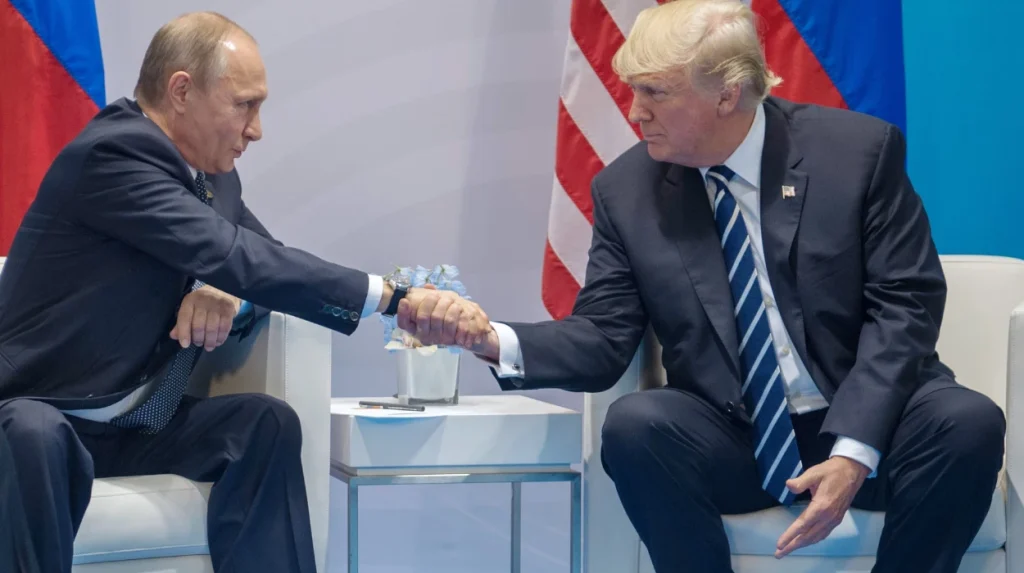
The US-Russia Thaw presented in the 2025 National Security Strategy is a shift in approach compared to the adversarial approach inherent in previous frameworks. Thus, in the 2017 strategy, Moscow is a revisionist power, together with China, but the new strategy shuns assumptions of threats and emphasizes coordination opportunities to achieve strategic stability. This change is in line with a transactional attitude where emphasis is made on specified interests and not on ideological framing.
Kremlin spokesman Dmitry Peskov said that the document is compatible with that position of Russia to a large extent as its tone is based on cooperation, not on categorical hostility. His reaction highlights the fact that Moscow favors a form of dialogue that does not involve a lot of confrontation and provides avenues of focused negotiations. U.S. strategic priorities, as manifested in the recalibration, are also informed by frozen efforts at peace in Ukraine and changing burden-sharing controversies in Europe over the course of 2025.
Washington can de-emphasize Russia as an immediate military competitor to indicate the desire to explore the possibilities of de-escalation in the field of arms control, the rules of cyber space, and the stability of the energy market. It is not that the repositioning eliminates competition, but puts it in a friendly framework where diplomatic bargaining is at the fore.
Core elements driving momentum behind the US-Russia Thaw
The plan envisions European partners taking up a higher burden of regional and conventional defense as the United States will provide nuclear deterrence and other selective strategic missions. This recalibration leaves implicitly space to have a direct U.S.-Russia interaction without the deep-operative involvement in Ukraine.
Europe has seven articulated priorities, which are resilience, border management, and economic self-reliance. Such instructions re-align the transatlantic expectations and buy diplomatic space to negotiate with Moscow. The 2025 military posture of Russia- adaptive and constrained by resource constraints further persuade Washington to focus more on dialogue instead of long-term containment.
U.S. evaluations are growing to state that Russia is regionally strong but globally weak. This framing allows the NSS to treat Moscow as a negotiable competitor rather than an all-encompassing threat. Paraphrased Russian commentary suggests mutual recognition of limits, which could serve as a basis for wider strategic stabilization.
Strategic stability and arms control channels reopening
Reviving arms control occupies a central place in the emerging thaw. The NSS promotes collaboration on nuclear risk reduction at a moment when New START approaches expiration in 2026. Where earlier policies leaned on multilateral frameworks, the current strategy emphasizes personalized diplomacy to shape bilateral guardrails.
Emerging communication channels in late 2025 point to preliminary technical exchanges covering hypersonic weapons, missile defense configurations, and transparency protocols. These talks suggest Washington’s willingness to acknowledge Russia as a co-manager of global nuclear risks. Any sustained progress may depend on reciprocal moderation in Russia’s activities across Europe, including influence operations and targeted military deployments.
European and international ramifications of U.S. recalibration
The U.S.-Russia Thaw has unsettled European capitals already grappling with political cohesion challenges in 2025. Sharp passages in the NSS criticizing immigration policies, regulatory measures, and media oversight drew immediate concern. EU Council President Antonio Costa and senior German figures characterized the strategy as signaling a “changed relationship,” reflecting unease that Washington’s pivot deprioritizes longstanding security guarantees.
Analysts at the EU Institute for Security Studies observed that the NSS portrays Europeans as having contributed to Russian threat perceptions through misjudgment or internal fragmentation. This interpretation deepens debates around strategic autonomy and fuels calls for accelerated defense investment across Paris, Berlin, and Warsaw. Yet dependency on the U.S. nuclear umbrella limits Europe’s ability to achieve full independence, preserving friction within the alliance.
Implications for global power balances and China’s strategic positioning
The U.S.-Russia Thaw indirectly affects Indo-Pacific dynamics. The NSS reframes China primarily as an economic rival rather than a military counterpart, signaling a partial decoupling of Russia policy from China containment strategies. However, Washington’s limited alignment against Beijing risks reinforcing a Eurasian partnership between Russia and China, especially given their trilateral naval drills and energy agreements in mid-2025.
Experts from Brookings have described the NSS as a “nativist vision” that reorients U.S. global commitments around domestic-centered interests while embedding Russia in a peripheral but negotiable position. Foreign Policy’s reviews highlight consistency in prioritizing room for bilateral deals, even as European nationalists interpret the document as tacit support for political movements challenging Brussels.
Domestic and operational underpinnings shaping the US-Russia Thaw
The NSS incorporates what policy observers term a “Trump corollary” to the Monroe Doctrine. This corollary extends deal-making logic beyond the Western Hemisphere, applying it to Russia through issue-specific incentives tied to migration, counternarcotics, cyber norms, and Arctic resource management.
Washington’s significant defense buildup reinforces the confidence behind this approach. The introduction of the Golden Dome air and space defense system is presented in the NSS as a guarantee that no adversary can credibly threaten U.S. territory. This expanded defense posture allows Washington to negotiate from a position of perceived strength, minimizing fear of escalation while engaging Russia on selective interests.
Operationally, 2025 has seen quiet envoy exchanges between Washington and Moscow focused on Arctic navigation rights, cybersecurity baselines, and energy transit norms. These efforts represent early implementation steps of the thaw, translating political intent into discreet diplomatic mechanisms.
Volatility and implementation risks
Execution remains sensitive. Analysts from the Atlantic Council warn that the reordering of strategic priorities exposes Eastern European states to uncertainty, particularly nations relying on U.S. forward presence. Al Jazeera’s assessments emphasize the NSS’s departure from multilateralism, observing that reliance on bilateral pacts heightens vulnerability to rapid policy swings.
National Defense Magazine describes the strategy as a “major departure” from institutionalized deterrence frameworks. Congressional oversight, fluctuating interagency support, and domestic political shifts could alter the durability of the thaw, especially as election cycles heighten scrutiny of Russia policy.
The NSS also incorporates optimism for “patriotic European parties,” positioning them as potential stabilizers. This framing raises concerns about the possibility of Washington leveraging Moscow’s influence networks in ways that reshape European political landscapes, adding another layer of uncertainty to the evolving thaw.
The unfolding geopolitical landscape surrounding the US-Russia Thaw
As 2025 progresses, the U.S.-Russia Thaw embedded within the National Security Strategy continues to redraw geopolitical boundaries across Europe, Eurasia, and the Indo-Pacific. The balance between strategic stability engagements and evolving regional anxieties underscores the complexity of transforming rivalry into managed competition. Arms control discussions, Ukraine negotiations, and shifting European defense postures all sit at the intersection of this recalibrated approach.
Whether transactional diplomacy can deliver lasting strategic predictability or whether entrenched historic distrust will resurface as fissures widen remains an open question. The coming cycles of negotiations will determine whether the thaw can produce sustainable outcomes or if a return to hardened confrontation awaits just beyond the horizon.