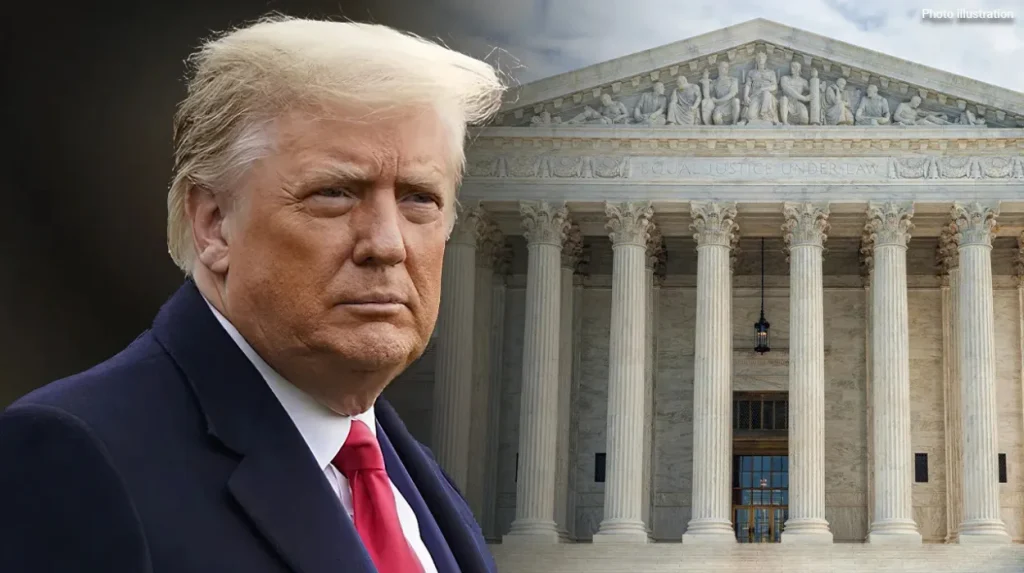
The Supreme Court’s November 2025 hearing has become one of the most consequential legal showdowns over executive authority in recent decades. The case centers on whether President Donald Trump exceeded his constitutional and statutory powers when invoking the International Emergency Economic Powers Act (IEEPA) to impose sweeping tariffs on over 100 countries.
Since early 2025, the administration has leveraged these tariffs, some exceeding 145% as instruments of foreign policy and national security. Trump justified the measures under IEEPA, citing threats such as fentanyl trafficking, cyber espionage, and imbalanced trade deficits as “national emergencies.” Yet federal courts in Washington, D.C., and New York ruled that these actions infringed upon Congress’s constitutional prerogative to regulate commerce and impose taxes. The justices now face the delicate task of defining the limits of presidential discretion in the realm of trade and emergency powers.
The legal argument under IEEPA
The government’s defense, led by Solicitor General D. John Sauer, maintains that the tariffs were “regulatory instruments” rather than fiscal measures. Sauer argued that extraordinary threats to the U.S. economy justified emergency executive action, comparing the policy to earlier sanctions programs targeting adversarial regimes. However, opponents contend that tariffs constitute revenue-raising mechanisms squarely within Congress’s legislative domain and that the administration’s invocation of IEEPA lacks a legitimate national security basis.
This distinction lies at the heart of the case. Should the Court find that Trump’s use of IEEPA was improperly extended, it would mark a significant judicial constraint on the modern presidency’s capacity to act unilaterally in economic affairs.
Judicial perspectives during oral arguments
Chief Justice John Roberts highlighted the “constitutional hazard” of allowing presidents to substitute emergency authority for legislative will.
Justices Neil Gorsuch and Amy Coney Barrett raised the issue of establishing a precedent which might permanently undermine the ability of Congress to tax and regulate. Their inquiries showed a potential political alliance along ideological boundaries to protect institutional checks and balances.
Justice Samuel Alito, in his turn, commented on the history of executive freedom in the sphere of foreign policy by stating that frequently diplomacy and national security might demand some decisive and instantaneous tools. Such a tension highlighted the main dilemma, namely the need to balance the constitutional confines with the realities of global trade diplomacy.
Economic And Political Ramifications
Ever since its implementation, the tariffs by Trump have significantly influenced the domestic and global markets. The manufacturers of consumer goods like toy manufacturers, textile manufacturers and electronics importers in America are recording increasing cost and decreasing competitiveness. Counteractions by China, Canada and the European Union were additional actions that tightened the belt of exporters in both the agricultural and industrial sectors.
A group of the businesses affected submitted amicus briefs claiming that unparalleled economic turmoil and massive layoffs were caused by the tariffs. Treasury Secretary Scott Bessent acknowledged the strain during an October 2025 Senate hearing, noting that “the administration is evaluating parallel trade mechanisms” to mitigate harm should the Court overturn the tariffs.
Potential fiscal consequences of reversal
If the Supreme Court rules against the administration, the federal government could be compelled to refund up to $90 billion in collected tariffs. Economists warn that such a reversal would not only disrupt fiscal planning but also strain Treasury operations managing international settlements. Legal experts describe the case as “unmatched in its potential for retroactive economic impact,” given the scale of transactions tied to the disputed tariffs.
Broader market and diplomatic uncertainty
Financial markets have already reflected the uncertainty. The Dow Jones Industrial Average fluctuated sharply in late October 2025 as investors anticipated judicial outcomes that could reshape global trade alignments. U.S. allies in Asia and Europe have adopted a “wait-and-see” stance on new trade negotiations, with some signaling a preference for multilateral frameworks if U.S. tariff policy is curtailed.
Impact On Foreign Policy And Executive Power
For Trump, tariffs have long represented what he calls his “international weapon of first resort.” They served as bargaining chips in trade disputes with China, immigration negotiations with Mexico, and security talks with NATO partners. By framing tariffs as tools of national defense, the administration blurred traditional boundaries between commerce and foreign policy.
This approach marked a continuation but also a radical expansion of trends seen during Trump’s first term. However, legal scholars argue that turning economic coercion into routine diplomacy risks undermining both congressional authority and the predictability of U.S. foreign relations. The Supreme Court’s judgment will determine whether such tactics remain constitutionally sustainable.
Judicial restraint and the major questions doctrine
During oral arguments, several justices invoked the major questions doctrine, a legal principle requiring explicit congressional authorization for actions of “vast economic or political significance.” This doctrine has increasingly limited administrative agencies’ discretion, and its extension to presidential powers could further tighten constraints on unilateral economic measures.
If applied, it would represent one of the most significant recalibrations of executive power since the post-Watergate era, effectively narrowing the scope of “emergency authority” under IEEPA and similar statutes.
The constitutional balance of trade powers
The case also revives a historic debate over the Constitution’s Commerce Clause, which assigns Congress, not the president, the power to regulate international trade. For decades, successive administrations have stretched this boundary through trade sanctions and tariffs tied to national emergencies. A decision against Trump could restore a more traditional interpretation, reaffirming congressional supremacy in economic governance.
The Political Crossfire And Future Outlook
The case has drawn bipartisan attention. While Republican lawmakers remain divided—some defending Trump’s assertive trade posture, others wary of executive excess—Democrats have largely emphasized institutional integrity. Senate Minority Leader Chuck Schumer stated that the Court’s review “offers a long-overdue opportunity to restore constitutional discipline in trade policy.”
Meanwhile, Trump and his advisors have portrayed the case as a test of America’s sovereignty, warning that a judicial rollback would “handcuff future presidents” in defending national interests. The president’s social media posts throughout November 2025 characterized the lawsuit as “an attack on American independence by globalist judges.”
Anticipated judicial outcome
The Court’s conservative majority faces a delicate balancing act. Upholding Trump’s actions would preserve a broad interpretation of executive flexibility but risk institutionalizing emergency powers as a standard policy mechanism. Striking them down, however, would impose limits on future presidents, including potential Republican successors, curbing rapid responses in crises.
Legal analysts expect a decision by mid-2026, though preliminary observations suggest the justices may favor a narrow ruling curtailing tariff powers without entirely dismantling the executive’s use of IEEPA in non-trade contexts. Such a decision could leave the door open for future administrations to test the boundaries again under different circumstances.
A Judicial Crossroads For Trade, Power, And Policy
The Supreme Court’s examination of Trump’s tariff diplomacy represents a pivotal test for the United States’ constitutional architecture and economic governance. The outcome of the case will show either how a president may exercise an emergency power of the economy to achieve geopolitical goals or the power should be returned to the solid control of Congress.
This confrontation raises an underlying question about this contemporary democracy: the degree of agility that a president should have in reacting to global demands, and at what price to legislative checks and balances? The resolution, which was molded in this battle in the courtroom, is a question that will reverberate in the world markets, global network and domestic political discussions over the coming years.
The success or failure of Trump-trade tariff diplomacy, however, will determine the changing relationship between expediency and constitutional protection, which holds accountability, which will remain to challenge the limits of economic insecurity and international realignment in American politics.