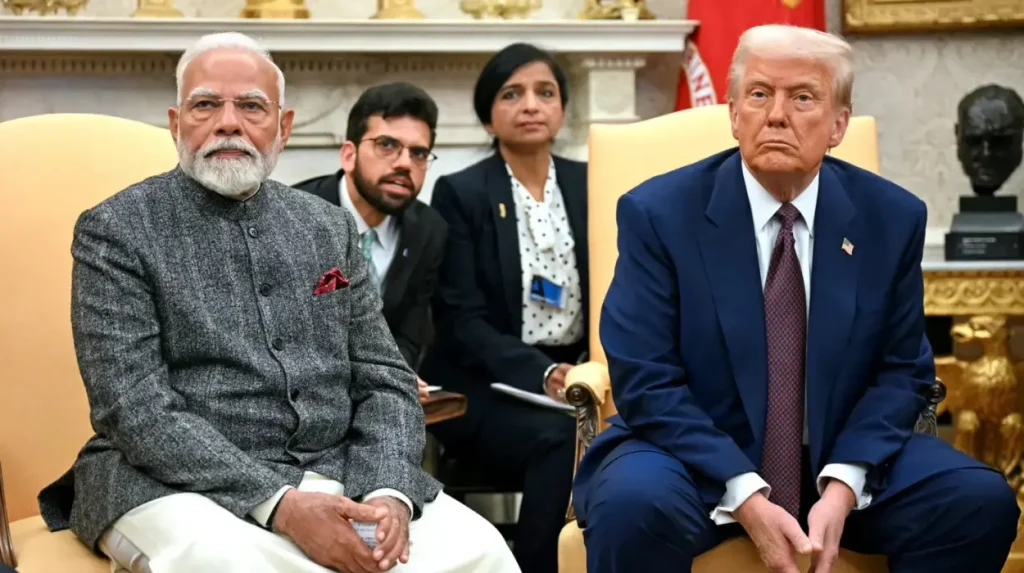
The escalating US tariffs in India have turned what was previously among the most talked of strategic relationships in Washington into a crumbling one. In 2025, the United States slapped a blanket 50 percent tariff on the majority of Indian imports, contributing to the pressure of trade and indicating a re-evaluation of the geopolitical agenda.
Bilateral cooperation was based on strategic convergence in the Indo-Pacific and mutual democratic standpoints for almost twenty years. But tariff increase is a step toward economic pressuring as an instrument of policy and it changes the history of US-India relations and begs the question of the long term sustainability of alignment with transactional policymaking.
Tariff Escalation And Commercial Fallout
The tariff actions, to be implemented between April and end of August 2025, raised the taxation on Indian goods to 25 and finally 50 percent from 10%. Over 50 per cent of the annual export of the Indian goods to the U.S. which amounts to $87 billion is influenced by textiles and leather goods as well as machinery, auto parts and gems.
Pharmaceuticals, semiconductors and critical minerals were excluded, a recognition of the interdependence of supply chains of strategic industries. The scale of trade disruption is an indication of a policy change, despite the exemptions, that values leverage of tariffs more than a historically strategic perspective.
Decline In Export Competitiveness
The exports of India to the United States were hit significantly as May through September 2025 became more than a third lower. The most affected ones are smartphones, gems and pharmaceutical intermediates.
In the present state of the U.S tariff rate is higher than those levied on Chinese goods and this has given Vietnam, Mexico and Thailand a competitive edge since their export tariffs are lower. The reform questions the export-based sectors of India and places some new challenges to the economic growth trend of the country.
Geoeconomic Interests And Policy Signaling
Over the greater part of the last decade, Washington has been making India an important democratic counterweight to China in the Indo-Pacific. The tariff hike is an indication that it is leaving that method behind and adopting a policy preference of economic leverage.
Analysts observe that there is now a dominant presence of a transactional framework, a sign of strategic realignment, and an indication that both the Biden and Trump administrations, despite their political contrasts, have been using the tools and instruments of the trade to gain geopolitical power. The existing policy, however, puts more pressure on using tariffs as a diplomatic tool.
Influence Over Foreign Policy Choices
The U.S. has severally shown apprehensions regarding how India has remained active in buying Russian oil and its involvement in multilateral formations like the BRICS. The pressure of trade is broadly understood as the effort to move New Delhi more in the direction of the Western economic and security requirements.
Prime minister Narendra Modi stressed the need to remain sovereign economically on the national scale and within India, the response was based more on long-term strategic autonomy, and not compromise in the face of external economic pressure.
Domestic Consequences And Response
The industries that are dependent on U.S. markets have pressured the government to implement off-setting policies, such as expedited export rebate payments and helping to diversify their supply chains. The export councils warn that the labor-intensive industries might lose their jobs unless they are exposed to the tariffs.
New Delhi has not taken any direct retaliatory responsibilities but has sought diplomatic solutions and possible recourse in the World Trade Organization, which indicates the tendency to resolve the issue by the rule rather than war.
Consumer Effects In The United States
The U.S. consumers are expected to experience price increases in household goods, textiles and consumer electronics and some of the estimates went as high as price increases of over one third in certain categories.
According to independent economists, the household costs caused by tariffs are projected to rise to levels of more than 2,000 annually by the close of the 2025 which would be the highest consumer burden, a result of trade duties in decades. The policy also embodies more economic nationalism, focusing more on domestic manufacturing cues, rather than immediate consumer affordability.
Trade Tensions Amid Strategic Military Cooperation
Even in the light of the tariff dispute, there has not been a loss of defense cooperation. In 2025, in the India Major Defense Partnership agreement, the shared security priorities in the Indo-Pacific were reaffirmed, notably, technology sharing and maritime coordination.
This tension of trade and cooperation in defense indicates a complex relationship where national interest develops and is not easily generalized with predictions of long-term orientation.
Competing Strategic Imperatives
Protectionist policies in the economy conflict clumsily with Indo-Pacific strategic policies. In case of continued tariffs, India can enhance its diversification to Europe, Southeast Asia, and domestic production growth, and maintain its strategic independence.
The United States is to lose a pillar partnership when regional competition with China is one of the primary foreign-policy goals.
Industry Reaction And Political Messaging
The tariff issue is presented by the Indian policymakers as a chance towards faster self-sufficiency of industries and re-alignment of exports. The government message is based on confidence in the strength of its domestic markets to support the innovation and localization of supply chains as well as economic resilience.
U.S. Policy Outlook
The actions are justified by U.S. officials because it is necessary to save domestic industry and decrease dependence on foreign suppliers. The policy fits into a larger, bipartisan trend that has focused more on re-shoring of industries, at the cost of strategic trade alliances.
Reflection On A Transforming Partnership
The U.S. tariffs being increased by India highlights a critical re-definition of one of the most significant bilateral relations of the century. With tariffs reshaping both trade flows and economic confidence, both countries face conflicting demands: security cooperation, energy needs and internal political forces.
It depends if the strategic trust can be restored through the diplomatic engagement without economic interests being sacrificed which will determine the longevity of the partnership.
Now, observers are keen to find out whether the present trade divide will be transformed into structural decoupling, or whether new impetus in diplomacy can be used to reestablish the collaborative path that characterized U.S.-India relations over the past twenty years. With the intensification of economic competition in the world, the striking ratio of national sovereignty and strategic orientation can spell out the difference between the partnering adjusting to the changing geopolitical environment and their radical transformation.