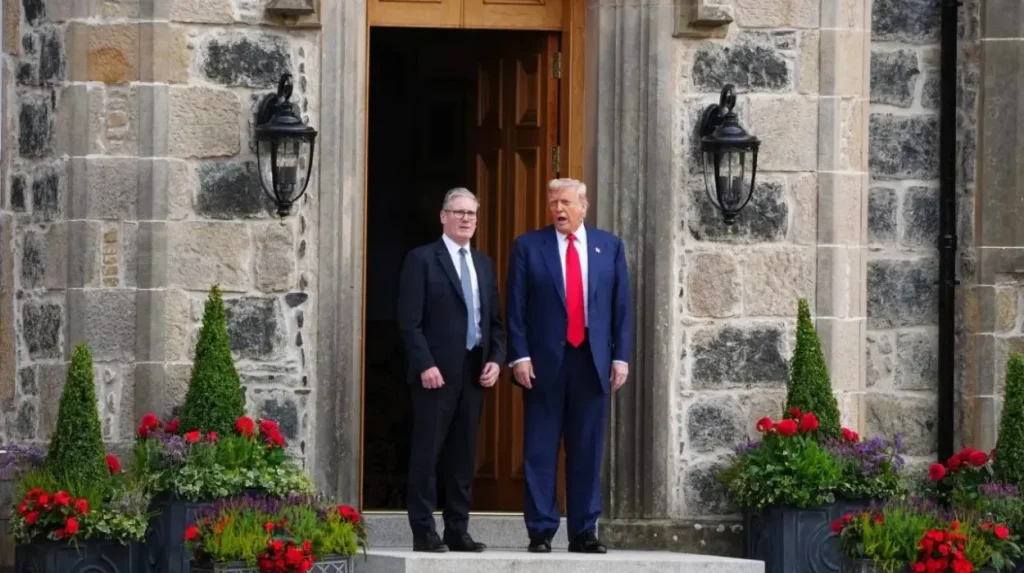
The US-UK special relationship has been a pillar of contemporary international relations over seventy years. Cast in common during World War II and reinforced during the Cold War, it is one of the oldest unions in the democracy world. Based on shared language, legal custom, and political culture, the partnership has had effects on both the international institutions and the reactions of the crisis, such as NATO operations, intelligence coordination, and nuclear cooperation.
This relationship remains symbolically and strategically important in 2025, but is being placed under an increasing pressure to change. The changing dynamics of power that the world is undergoing, which is characterized by technological competition, geopolitical repositioning, and climate-related problems, require a rebalance of the relationship. The tradition of historical cooperation is the cornerstone, yet in the current reality both countries must reconsider the meaning of what is meant by special in the multi-polar century.
Divergent Public and Political Outlooks
The current trends in the opinion show the sophistication of the individual opinion regarding the alliance. As the strategic importance of it is reaffirmed by political elites in London and Washington, the mood of people has been chilled. In early 2025, an Ipsos survey established that merely one-third of Britons consider the U.S.-U.K. relationship truly as something special, which is notably lower than it was in the past decades. This erosion is as a result of conflicting national priorities and views of the American foreign policy as erratic.
The exit of Britain out of the European Union has added more to foreign policy thinking. The United Kingdom now wants a middle way policy- to have close ties with the transatlantic and also to resume relations with the European partners and have an additional outreach to the Indo-Pacific. The U.S., in its turn, has turned their international policy towards confronting China and enhancing the domestic industrial capacity, making some U.K. policymakers wonder whether Washington still sees London as the first European interlocutor.
Recalibrating the Political Compact
These dynamics bring to light the redefinition of political trust. The British prime ministers have stressed practical diplomatic relations with the U.S. and have prioritized trade, cooperation in the defense sector, and digital advancement. Washington and the varying leadership still appreciates British alliance but in the context of regional alliances and not bilateral dependence.
This shift is reflected in the 2025 Joint Strategic Dialogue, a project aimed at implementing the cooperation with the expansion of traditional defense into the sphere of climate technology, cybersecurity, and clean energy. It is a shift between affections of cooperation and utility and is defined by common ambitions but attentive to domestic political circumstances on either side of the Atlantic.
Security, Intelligence, and Technological Synergies
The most powerful pillars of the special relationship are defense and intelligence. The two countries have been able to maintain unprecedented coordination in terms of strategic integration through NATO, Five Eyes net work, and constant military coordination. These are new joint programs in 2025 on hybrid warfare, quantum encryption of intelligence communication, and coordinated actions to maritime security threats in the Arctic and South China Sea.
This is something the U.K. Ministry of Defence has strengthened through its contribution as one of the key partners in U.S.-led operations, in the midst of debates of defense spending back at home. Analysts observe that though the military capabilities of Britain have become more specialized, integration with the U.S. systems has increased, a factor of quality over quantity in the common missions.
Innovation and Economic Interdependency
In addition to security other areas of transatlantic synergy have manifested in the shape of technology and economic cooperation. The 2025 Technology Prosperity Deal released in the White House Innovation Forum- reflects this development. It obliges both governments to engage in common development in the fields of artificial intelligence, quantum computing, green hydrogen, and space exploration.
The project has a common strategic need. The U.S. wants to find reliable partners in order to protect the technological supply chains, and the U.K. wants to ensure investment and relevance in the next-generation industries. The interdependent relationships, like the Stargate AI Consortium in Cambridge and the NASA satellite program on the Artemis, highlight how the economic relationships are now becoming the basis of political trust.
Managing Multipolarity and Strategic Competition
The greatest challenge to the special relationship is brought about by the new multipolar order in the world. The U.S. seems to persist in the aggressive approach to contain the technological and territorial ambitions of China, and the U.K. is balancing between the American orientation and the economic relations to Asian markets. Such a balancing act creates some subtle diplomatic strains because London is not willing to put its attitude toward the world into a pure Washingtonian perspective.
Pace and priority differences are also uncovered in climate policy. Although both nations support the idea of energy transition, political cycles and local lobbying impose unequal forces. Having coherent transatlantic leadership in international bodies such as COP30 will dictate whether the relationship will be able to convert common rhetoric into concerted action.
Domestic Political Volatility
The alliance is also complicated with internal political uncertainty. The pendulum of tone between multilateralism and strategic unilateralism in the U.S. is created by the changes of administration. Debate has been strengthened concerning the U.S. position in the world with the 2024 elections, and subsequent domestic economic adjustments. In the meantime, Britain faces economic stagnation and trade changes post-Brexit which is testing its fiscal ability to make long-term defense commitments.
In an attempt to maintain stability both governments have focused on institutional continuity through the expansion of joint parliamentary committees and coordination between various agencies. However, according to those in observation, unless there is sustained bipartisan agreement, even the most robust traditions will be lost in populist pressures and changing economic priorities.
Cultural and Social Dimensions
The U.S.U.K relationship goes beyond politics and policy. It flourishes in cultural, scholarly and scientific interaction. Bilateral education programs like the Fulbright 2.0 Initiative and digital learning partnerships between large universities have increased access to cross-border research, especially in biotechnology and climate science, in 2025.
Cultural diplomacy still remains soft power glue. The cooperation between film, literature, and media fosters the goodwill and the sense of identity of the population. Besides, collaborative actions in misinformation mitigation, advancing open internet regulation, and democratic resiliency in other countries also show the relationship changing to align with the challenges of 21st century society beyond military competencies.
Such soft-power relationships allow making sure that although strategic interests may change, the emotional and intellectual connection between the two societies will not be lost, which is a necessary guarantee against political drifting.
The Evolving Essence of the Special Relationship
The U.S.U.K. A special relationship in 2025 is at a crossroad. It still has its roots in common history and ideology, but the mechanisms that hold it together must be able to represent modern realities. Neither of the countries is redefining leadership as dominance, but as cooperation with its basis on innovation, ethical leadership, and collective resilience.
This evolution represents neither decline nor romantic nostalgia but transformation. The partnership now functions as a living framework adapting to shifting power balances, integrating technological revolutions, and confronting global crises with renewed purpose. Whether through cybersecurity alliances or climate partnerships, the relationship’s relevance lies in its capacity to evolve.
As the world moves deeper into a digital, multipolar age, the question is no longer whether the special relationship endures, but how it reinvents itself to guide a new century of democratic cooperation. Its ability to do so will shape not only the transatlantic future but the very architecture of international diplomacy for decades to come.