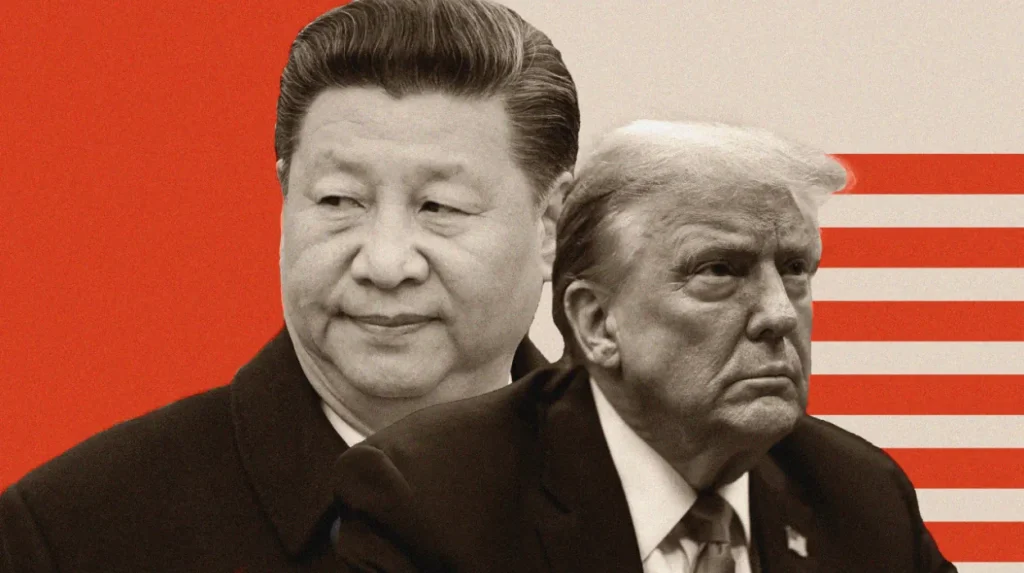
The Chinese policy towards the renewed Trump presidency in 2025 can be understood as a calculated accommodation and resilience, which is planned to respond to a greater extent of pressure in the economy and geopolitics towards the United States. The second Trump administration has reverted to old confrontational tactics, such as tariffs swept across the board, restrictions on exports of Chinese technological sectors, and more aggressive rhetorical action towards Taiwan.
Such developments come at a pivotal moment in the life of the domestic economy of China where the country is struggling against the evidence of deflation and turbulence in the capital market. As Trump has increased the external pressures with his policies, Chinese leadership has chosen a careful strategy that claims sovereignty and economic interests but leaves room to engage in de-escalatory approaches. The question is how to avoid potential short-term threats and crash long-term strategic priorities.
Tactical responses to trade and technology pressure
One of the foundations of the new strategy of Trump has been the imposition of high tariffs on a wide range of Chinese imports. In April 2025, the US declared the imposition of new tariffs on the imported rare earth magnets up to 200 percent which was widely viewed to be directed at the dominance of production of rare earths in China, which is the biggest producer of these magnets in the world. The reaction of Beijing was in terms of retaliating against US agricultural imports and also bans in exports of major constituent elements utilized in semiconductors.
But China did not take a complete trade war position, which is an indication that it would like to maintain the negotiation lines open. The leadership of President Xi Jinping was based on internal resiliency with preferences on diversification of markets and stabilization of the domestic production chain to absorb the future tariff shock. This of two poles resisting economic coercion and permitting diplomatic off-ramps characterizes the new Chinese approach under Trump 2.0.
Strategic autonomy in advanced technologies
Coupled with retaliation, China has intensified the process of shielding its technology industry against the pressure of the West. The State Council guidance of 2025 put more focus on the localization of supply chains in such strategic technologies as AI, quantum computing, and semiconductors. It also involves the growing cooperation with Russia and some Southeast Asian countries to build parallel infrastructure and minimize the reliance on the US-oriented systems.
Although external limitations are still evident, the Chinese government considers technology self-sufficiency as one of the pillars of national security. This agenda was consolidated by the National People’s Congress of 2025, which provided extra funding to state-sponsored research centers and innovation zones, especially those located in the inland areas with new industrial specifications.
Managing diplomatic optics amid intensified rivalry
The transactional position taken by the Trump administration has made China re-define its diplomatic message. The official statements do not take Trump directly to task, but rather address the issue of inconsistency of US policy in general. This rhetorical tactic enables Beijing to fault the course of action but not individualize the confrontation, thus leaving space to hold high-level negotiations and resets of the tactics.
Between 2025 and 2027, the Chinese and the US foreign ministry officials held several meetings in neutral forums including the city of Geneva and Singapore. The Chinese media framed these engagements as positive despite the setbacks; this was an attempt by Beijing to assure international stakeholders of its stability especially in Asia Pacific supply routes and investment corridors.
Regional rebalancing and alliance hedging
Due to the US-China tensions, China has been more active in its interaction with ASEAN and the Central Asian countries since they are considered as the shield against the encircling of economies of the West. In early 2025, trade agreements with Indonesia and Uzbekistan were reached and were aimed at developing infrastructure and cooperation in digital finance.
At the same time, China has toned down its diplomatic pace with Europe. As long as trade goes on, the EU has been wary in aligning itself with the US technology restrictions, and this has made it difficult to cooperate directly on major innovation initiatives. China has adopted a more practical approach within this environment and focused more on long-term energy and infrastructure projects rather than politically sensitive digital projects.
Internal consolidation and risk mitigation
At home, the 2025 economic management plan in China involves achieving a growth of over 4 percent and reducing the current deflationary forces. In Q2 the People’s Bank of China introduced strategic liquidity policies by trying to support lending by the private sector and the housing markets, especially in middle-sized cities with capital flight.
Such internal changes do not exist outside of the external calculations of China. It is observed that economic stability is the key to maintaining strategic autonomy in a discontinuous global environment. The idea of the government is to show that China is able to assimilate exogenous shocks without sacrificing strategic priorities or internal integration.
Strategic signaling and narrative control
Internal narrative control has also been reinforced by the Chinese Communist Party as a result of fluctuating foreign policies. The focus of state media is on national pride, long-term perspectives, and strict restraint. This is a message that is useful in controlling the expectation of the people in the face of heightened competition with the US and a vote of confidence in the leadership style.
One of the lessons of the policy community that has been disseminated on Chinese social media is that there is a long-term rivalry with intermittent cooperation. The term protracted contestation is commonly employed by analysts and implies a change in direction toward the normalization of tensions in the short term to the strategic management of long-term tensions.
Global expert commentary and future risk landscape
Chinese analyst Wang Wenhaha made an interesting observation that further clarifies the internal view of the new dynamic between the US and China. In a post on social media in the mid-2025, Wenhaha said the current attitude of China under the new leadership of Trump was an act of calculated patience between external pressure and internal reform needs. Such remarks echoes the general opinion among Chinese scholars that the present stage of US relations is always unstable yet not irreversible.
This framing confirms the perception that the leadership of China is not likely to be overreactive, but rather build up diplomatic channels as it slowly sets up defensive mechanisms. It is also concerned with long-term stability as opposed to tactical escalation despite the unpredictable maneuvers of US policies.
Navigating an unstable international order
The global environment of 2025 is unstable, characterized by increasing nationalism, decoupling and alliances. Both resilience and resolution are secondary to the strategic calculus of China, which has been crafted due to the reappearance of hardline policy under the Trump 2.0 administration. It is symptomatic of a leadership that has become more relaxed in its approach to coping with uncertainty as it creates more and more alternatives to Western-centric institutions.
The next months will challenge the level of efficiency of Beijing to use its regional power, technological foundation, and domestic power to support its global objectives. The ambiguity created by a second presidency of Trump has compelled Chinese strategists to re-calibrate but this has simultaneously reinforced the principle of measured, adaptive policy in a world where traditional principles of diplomacy are increasingly challenged.