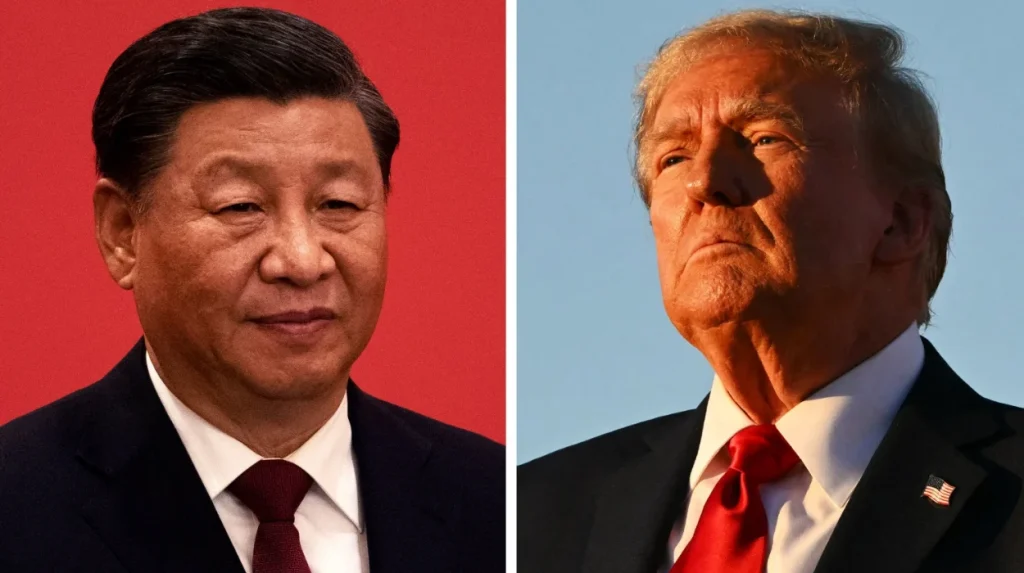
The trade policy of President Donald Trump is still influencing how the competition between the United States and China is changing in 2025. He has described his strategy as aggressive tariffs and export control in the name of national security and national industry. There is, however, an increasing concern that this risky policy could be undermining America economically on the world stage, instead of empowering it.
In the face of more and more complex global supply chains, and the growing pace of technological competition, the actual consequences of such policies are now beginning to be felt both in inflation and diplomacy, as well as in strategic leverage.
Trade policy escalation amid geopolitical rivalry
The U.S. has always had a weakness in its reliance on rare earth magnets, which Trump highlighted by threatening to impose 200 percent tariffs in August of 2025 in case China limits its exports. The US is dependent on rare earths that are produced in China and that are critical to defense production, electric vehicles, and clean energy products. The threat was meant as deterrence, but it also revealed that America had few choices as far as substitution in the immediate future was concerned.
Concurrently, the Trump administration intensified measures related to semiconductor and AI technology restrictions and directed new licensing limitations against Chinese companies. This was intended to reduce the supply of the dual-use technology to China but has led to retaliation measures that have complicated supply channels and have strained key sectors in the United States.
Strategic reasoning vs operational challenges
The more general idea of the Trump policies is to coerce China to alter its trade policies, intellectual property regulation, and subsidies. Implementation has been much less linear, however. The American companies in the switching market – especially within the technological, retail and manufacturing industries now have to navigate a sea of regulatory unpredictability, logistical upheaval, and retaliation by Beijing.
This kind of trade upsurge is indicative of a larger phenomenon in the world: the weaponization of economic interdependence. But when policies are uncharismatic or unevenly implemented, their tactical purpose may be counterproductive.
Economic friction and supply chain exposure
American businesses, particularly import-heavy firms, face sharp cost increases due to Trump’s layered tariffs. Retailers like Target and Walmart have passed rising costs to consumers, especially on household electronics, furniture, and toys. The cost of inputs has risen in various industries and the tariff on some commodities has risen to as high as 145 percent.
The ripple is also price inflation that has a disproportionate impact on middle- and low-income households. As the 2025 holiday season approaches, financial analysts expect even more consumer pressure, particularly as food and energy prices also have risen as more global uncertainty prevails.
Reshoring ambitions vs economic reality
Resourcing manufacturing to the United States is one of the pillars of the Trump strategy. However, even with tax subsidies and government propaganda, the bulk of big companies have not been completely outsourcing. Full-scale reshoring is economically infeasible in global production networks with complex structures and high labor costs, and many companies look to alternative suppliers in Southeast Asia rather than relocating to the U.S. soil.
This partial decoupling plan can lessen dependence on China at a small scale, but it does not provide the degree of supply chain dominance that the administration desires, at least not without colossal investments in infrastructure. Frontline tensions on a strategic platform other than the economic front.
Strategic tensions beyond the economic front
The protectionist trade policy of Trump has unwillingly triggered the second wave of technological autonomy in China. The 2025 budget of Beijing added to the budgets on AI, quantum computing and processing of rare earths, to avoid any dependency and be able to create parallel ecosystems resistant to Western domination. Chinese state-owned enterprises are now rapidly developing local substitutes to American semiconductors and production equipment.
This propels a two-track global economy, as different standards, suppliers and innovation networks are created across strategic divides that undermine global interdependence, and the common platforms that once supported global trade.
Limits of leverage in an interconnected world
Although Trump believes that tariffs provide the U.S. with leverage, the two-way nature of trade makes such mechanisms by definition limited. The Chinese reaction like suspending its export of certain forms of gallium and graphite shows how fast the U.S. can be struck when key supplies are discontinued. Unilateral pressure must not be overused without multilateral support as it will simply isolate the U.S. instead of empowering it.
Key allies in Asia have raised concerns over this go-it-alone approach of Trump with the European Union. This casts doubt on whether the U.S. can continue to lead strategically and disintegrate trade partnerships around the world.
Domestic policy meets foreign diplomacy
Outside China, Trump has been confronted by criticism of his trade stance by long time allies. Arguments with the EU over digital taxes and agricultural quotas and with Canada and Mexico over auto parts regulations have caused tension in previously relatively stable trade relations. These upheavals threaten concerted approaches to dealing with the rise of China.
The way Washington has tried to redefine all economic affairs using a national security prism has left allies with unease, who might prefer a middle way. This makes it harder to develop a front that would be able to counter the economic policies of China.
Internal political calculations
The repeated focus of his campaign on tariffs as a means to shield American workers appeals to a section of the electorate particularly in industrial and rural regions. However, in August 2025, national polling revealed that although voters believe that the nation needs to retain domestic employment, they are more concerned about prices and financial turmoil.
This domestic tension puts pressure on policymakers to justify whether high-cost trade conflicts produce real economic gains. Strategic endurance in trade wars often depends on public patience—an increasingly limited resource in times of inflation.
Technology, power, and global order
Perhaps the most lasting consequence of Trump’s trade policy will be its effect on the global tech order. Fragmentation in chip design, 5G networks, cybersecurity standards, and digital currencies is accelerating. As the U.S. limits exports and partnerships, China fills gaps with state-driven innovation—especially across the Global South.
This reshaping of the digital landscape has profound implications for global governance, internet freedom, and the future of economic norms. U.S. companies may find themselves locked out of emerging markets if protectionism limits their reach or forces unwanted political alignments.
Risk of eroding U.S. leadership
Trump’s policies, while designed to protect and project American strength, carry tradeoffs that now test the resilience of the U.S. economy and the adaptability of its alliances. As trade becomes both an economic and strategic weapon, the line between deterrence and self-inflicted harm grows increasingly thin.
The coming months will test whether the United States can recalibrate its strategy to maintain influence while reducing exposure, or whether escalating economic nationalism will redefine its place in a multipolar, contested world economy.