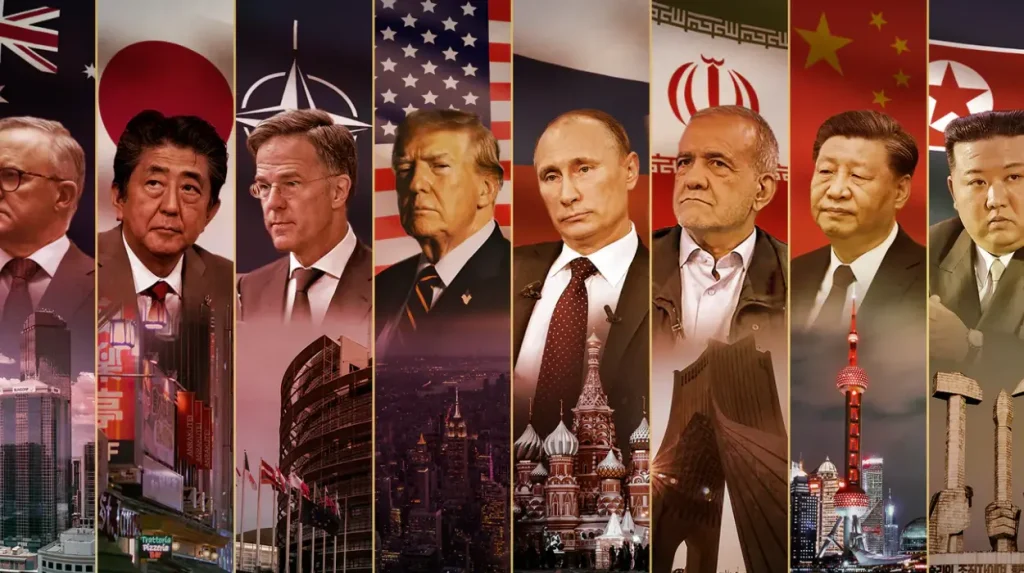
With the renewed government of President Donald Trump, it has been since early 2025 that the United States has started undergoing a paradigm shift toward becoming a global power. This shift—marked by retreat from multilateral institutions, coercive diplomacy, and resource-driven foreign policy—signals the end of America’s post-World War II legacy as a global guardian. The shift to an extractive and transactional approach has been frightening to its allies and has created a destabilizing factor in world politics where power is the overriding factor rather than principle.
Such metamorphosis symbolises a free deconstruction of the liberal international system, which has long been anchored to an American leadership. The shifting of global expectations is a massive dramatic change, as major institutions and alliances that could guarantee world security and economic integration no longer hold the capabilities in the face of an American foreign policy that is more unpredictable and self-serving.
Origins and structure of the post-war global system
The United States took the lead in creating a rules-based international order following World War II that was intended to prevent conflicts between superpowers and promote economic stability. Collective security, free trade and collaborative diplomacy had a framework in the central institutions like NATO, UN and WTO. It is through this system that the U.S was able to assert its powers as well as tether itself with the global regulations, with the balance between leadership and accountability.
Sustained commitment and strategic dividends
This system could be successful provided that the Americans continued to invest in it, economically, militarily and diplomatically. In exchange, the U.S. claimed global power, free markets and firm alliances. U.S. commitments provided the predictability that underpinned peace in Europe, security in East Asia, and coordinated responses to bilateral and international crises, whether in response to pandemics or to climate change. But this balance was increasingly contingent upon the further belief in American reliability and the disposition of Americans to exercise leadership out of a sense of greater good than at the moment of self-advantage.
Trump’s 2025 agenda: From cooperation to conditionality
In February 2025, President Trump issued an executive order launching a 180-day review of U.S. obligations to multilateral treaties. The objective: identify and eliminate arrangements deemed contrary to national interest. This sweeping directive threatens withdrawal from institutions like the UN Human Rights Council, the WHO, and global arms control regimes, severing longstanding frameworks of collaboration.
NATO and militarized economic extraction
Simultaneously, Trump’s NATO demands—requiring allies to commit 5% of GDP to defense—represent a strategic shift. European governments, facing domestic constraints, have described this as coercive burden shifting. Because most of their defense purchases are sourced from U.S. arms manufacturers, these requirements effectively redirect European defense budgets into the American economy. The U.S. thus leverages its security role not to reinforce alliances but to extract financial returns.
The policy extends to aid recipients. Ukraine, for instance, reportedly must grant U.S. firms disproportionate access to mineral wealth as a condition for continued military aid. Such arrangements redefine strategic partnerships in economic terms, replacing solidarity with rent-seeking.
Trade coercion and declining economic leadership
Trump’s trade policy reinforces this extraction model. Renewed tariffs on goods from allies and adversaries alike have reignited trade wars, damaging U.S. exports and prompting widespread retaliation. Canada, the EU, Mexico, and China have responded with countermeasures, further destabilizing supply chains and diminishing confidence in the U.S. as a trading partner.
Strategic competitors seize economic space
As the U.S. pulls back from cooperative institutions, China and Russia increasingly promote alternative models. Beijing’s Belt and Road Initiative and deepened trade relations with BRICS partners highlight a new global economic reality—one where American-led liberal trade is no longer dominant. The U.S.’s unilateralism may accelerate the decline of the very order it once created.
Diplomatic fallout and the erosion of alliance trust
Europe’s response has been swift. At the June 2025 Brussels summit, EU leaders signaled increased investment in strategic autonomy and reduced dependency on U.S. military support. France and Germany, in particular, called for a standalone European defense architecture. As U.S. guarantees grow conditional and unreliable, NATO’s cohesion is increasingly questioned.
Collapse of cooperative diplomacy
Traditional U.S. leadership in multilateral diplomacy has nearly vanished. The dismantling of USAID, withdrawal from climate negotiations, and elimination of pandemic cooperation programs leave allies skeptical of Washington’s long-term commitments. Foreign ministries now plan around U.S. unpredictability rather than coordination, weakening global responses to transnational threats.
The diplomatic impact is compounded by controversial U.S. positioning in conflicts. Unilateral peace initiatives that bypass allies—such as direct talks with Russia on Ukraine—further erode trust. In such a climate, many nations are reassessing security and trade arrangements once built around American leadership.
Fragmented global order and multipolar emergence
The U.S. retreat accelerates global power diffusion. BRICS expansion, Sino-Russian military coordination, and ASEAN’s growing institutional coherence illustrate the emergence of a multipolar world. U.S. withdrawal from global leadership has provided these blocs both opportunity and impetus to shape rules according to alternative standards—less democratic, more transactional.
Social commentary and public response
Public observers have noted the implications of this transformation. Commentators such as the account behind this post express concern about the U.S.’s strategic priorities, noting the shift from diplomacy to dominance and the risks posed to global cohesion. These concerns underscore a growing recognition among citizens and analysts alike that U.S. behavior may be reshaping the world in unforeseen ways.
Power consolidation and domestic justification
These policies are advocated in the Trump administration by the labels of sovereignty and fairness. A case made by officials is that America has been unfairly asked to carry too much and it has to now kick back and receive its payback on allies and institutions. This postulation is rhetoric being presented to local populations that are not only tired of war but are also wary of globalization. But the mode–coercive conditionality–has been enough to cause alarmist sentiments against the U.S abroad and it can eventually end up costing the U.S clout.
Personalization and unpredictability
The foreign policy strategy is also more individualized. According to analysts, the involvement of Trump with foreign powers seems to be preceded by branding, ego and transactional utility, not strategic continuity. The policy instability that awaits allies means that they may have to adjust suddenly-swinging views that are driven by individual and not institutional interests.
This volatility hinders diplomacy preparations, frustrates coalition formations and induces cautious attitude on the part of foreign governments that would have been more integrative with Washington.
Reconsidering American leadership in a changing world
The international system is at a crossroad because of the shift toward global guardian and extractive superpower. There will be no responsible and consistent U.S. leadership, the multilateral institutions can fall further to pieces and the world can become more volatile and increasingly competitive. Competitors can become stronger, partners weaker and the international norms less useful to control common problems.
The U.S. is destroying its post-war system at a time when it is risking reducing its relevance in the world. The retreat in favor of cooperation to dominance is a decision that attracts more criticism as not only the enemy but also amongst those people who used to consider the United States as a source of stability. The fate of the global order is dependent on where this strategy is likely to be a deviation on the long-term path or a recalibration of the path in the long term.