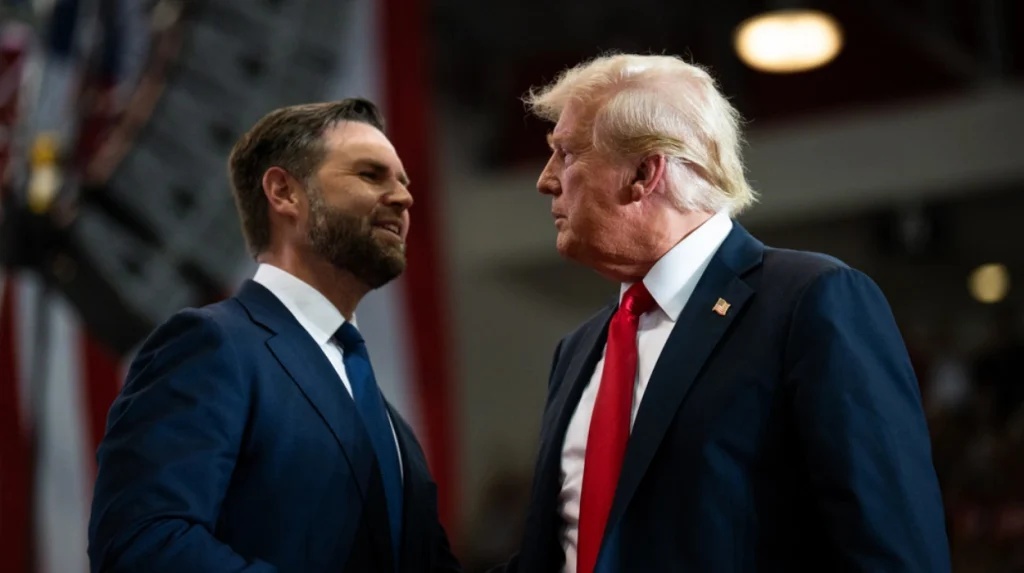
Vice President JD Vance has positioned himself as the intellectual force behind what he describes as the Trump Doctrine—an assertive yet contained vision of American foreign policy. Structured on three key pillars—defined national interest, aggressive diplomacy, and rapid military strikes with swift exits—the doctrine was most recently showcased during the June 2025 airstrikes on Iranian nuclear facilities.
Vance’s elevation of the doctrine as a formal policy framework signals a desire to present coherence in a foreign policy often criticized for unpredictability. However, the gap between strategic theory and presidential behavior remains wide. The question persists: is the Trump Doctrine a genuine articulation of geopolitical strategy, or merely a repackaging of instinctual, reactive decision-making?
The Iran Strikes: Doctrine in Action
A rapid escalation and de-escalation
On June 8, 2025, coordinated U.S. airstrikes targeted three nuclear facilities in Iran. Within hours, Iranian radar sites were disabled, but the White House initially avoided public acknowledgment. Days later, President Trump declared the operation “a perfect success,” then unexpectedly announced a ceasefire.
Vice President Vance hailed the strikes as “precise and proportionate,” reflecting what he called “the cleanest application yet” of the Trump Doctrine. In a speech to Ohio Republicans, Vance insisted the airstrikes demonstrated America’s ability to act decisively without being drawn into long-term conflict.
Messaging through political theater
Vance’s role was not just policy articulation, but performance. His media appearances were aimed squarely at the conservative base, emphasizing strength and deterrence. He said on Fox News:
“We told Iran what we wanted. They didn’t listen. We hit them hard. Then we left.”
This was both a selling point of the doctrine to the home front and a way to separate the doctrine with the foreign policy snarl of the previous administrators. However, the lack of a long term diplomatic/strategic plan after the airstrikes has received criticism by experienced diplomats and military strategists.
Domestic Reactions and Partisan Tensions
A public divided over consequences
The response by the US population was not obvious even though the framing by Vance was obvious. A poll conducted by Reuters/Ipsos one week after the attacks revealed that almost 80 percent of Americans were worried about the revenge attacks particularly on the U.S civilians in foreign nations. This fear transcended along the political alignments and rekindled discussion on the sustained cost of militarized foreign policy, both short-term or long-term.
There were also the critics who sought to challenge the selective transparency of the administration. The reluctance to reveal complete intelligence estimations combined with contradictory claims of Trump and Vance raised doubts that the operation had more political than geopolitical background.
Party tensions and ideological contradictions
Within the Republican Party, Vance’s embrace of the Trump Doctrine has created ideological friction. Some longtime Trump supporters, including Steve Bannon and Tucker Carlson, voiced unease over returning to aggressive military actions. They argue the policy veers dangerously close to the interventionism that Trump originally campaigned against.
Vance, who used to be a vocal critic of foreign interventions himself, has begun to adjust. There have been critics who accuse him of opportunism over his change of mind and disposition as an anti-interventionist to becoming an advocate of precision warfare. But his proponents retort that the world has modernised, and laxity in ideology is a symbol of practical leadership.
Strategic Framework or Justification?
Expert views on strategic coherence
Observers are divided on whether the Trump Doctrine represents a genuine strategic evolution. David Miller of the Endowment for International Peace said, “It’s hard to credit the Trump Doctrine as a strategy when so much of its execution hinges on presidential mood swings and domestic optics.” According to him, doctrines typically emerge from deep institutional deliberation, not retroactive justifications of spontaneous action.
By contrast, Clifford May of the Foundation for Defense of Democracies argues that the doctrine’s clarity could reshape U.S. foreign policy. Clifford May stated during a June 2025 roundtable:
“We now have a model—clearly defined interests, overwhelming force, and an exit strategy. It’s not perfect, but it’s a start.”
The illusion of restraint
While the Trump Doctrine promises to avoid “forever wars,” some experts suggest its short-term focus could inadvertently create conditions for renewed conflict. The absence of long-term stabilization plans, they argue, could leave power vacuums that adversaries exploit. This was evident in Iraq after the 2003 invasion and in Libya following Gaddafi’s fall.
In this context, critics worry the doctrine’s appeal to “hit and leave” strategies might win headlines but lose influence. Rebecca Lissner of the Council on Foreign Relations warned,
“Overwhelming force is not the same as sustainable outcomes. Stability isn’t achieved by airstrikes alone.”
Vance’s Political Evolution and Its Implications
From Hillbilly Elegy to the Situation Room
JD Vance’s rise from bestselling author and political outsider to Vice President has been characterized by rapid ideological shifts. Known in 2016 for his critique of Trump and skepticism toward elite foreign policy circles, Vance now acts as the administration’s foreign policy spokesperson.
His rebranding appears both tactical and sincere. Facing global instability—from China’s actions in the South China Sea to Russia’s continued presence in Ukraine—Vance has leaned into realism. Yet the transformation has unsettled supporters who once viewed him as a check on militarism.
Bridging factions or deepening divides?
Vance’s articulation of the Trump Doctrine attempts to unify traditional hawks with “America First” nationalists. By rejecting nation-building while endorsing military action, the doctrine threads a difficult needle. But the compromise is uneasy. Libertarians within the GOP remain wary of military overreach, while neoconservatives argue that deterrence without follow-through is hollow.
Whether Vance can keep these factions aligned remains uncertain. His success may depend on how the Trump Doctrine performs not only in crises like Iran, but in slower-burning tensions such as those with North Korea or Venezuela.
The Global Impact of the Trump Doctrine
How allies interpret American resolve
America’s allies have responded to the Trump Doctrine with mixed reactions. European leaders, while privately relieved that escalation in Iran was limited, have expressed concern over the erratic sequence of strikes and ceasefires. France’s foreign minister warned that “strategic consistency is essential in crisis management.”
On the other hand, NATO authorities have stated that they find it hard to respond to situations, as they do not know what the U.S. may do next. Some of the NATO planners were informed about the Iran attacks only once they had started, hence questioning the feasibility of joint defense planning under such a doctrine.
Adversaries testing the limits
Iran’s leadership has vowed to rebuild its nuclear infrastructure and continue development “with greater resolve.” Despite the fact that a ceasefire is holding at present, the successful test of ballistic missiles conducted by Tehran in July 2025 was seen as a clear indication.
In other parts, North Korea has rekindled short-range missile repatriations, China has mobilized more maritime patrols off the shores of Taiwan. These actions can be a clarion call that the opponents are probing the coherency of the U.S. deterrence as it relates to Trump Doctrine. The same dilemma exists in both occasions, which is to use overpowering military force in order to retaliate, or playing into the perception of being disjointed to its own words.
The Media Landscape and the Search for a Unified Message
Managing contradictions in public messaging
Despite Vance’s disciplined framing, the administration has struggled with internal coherence. President Trump’s tendency to revise his position in public, often contradicting his vice president, continues to challenge the doctrine’s legitimacy.
Some media analysts argue the Trump Doctrine functions more as political branding than a binding strategy. Others believe it represents an effort—however fragile—to impose structure on chaotic policy impulses.
Glenn Greenwald discussed this in an interview with CNN, arguing that
“The doctrine sounds coherent on paper, but its execution depends entirely on the temperament of whoever’s in charge.”
He noted that even limited military action can have unpredictable ripple effects if not grounded in long-term strategy.
In this single passage, JD Vance makes manifest the core lie driving US/EU foreign policy for decades: we claim everything we do is for "advancing democracy" when the goal is often the exact opposite.
— Glenn Greenwald (@ggreenwald) February 14, 2025
Never imagined a senior US official saying this:pic.twitter.com/xHxhRAS611
Testing the Doctrine in an Uncertain World
The Trump Doctrine, as promoted by JD Vance, promises clarity, efficiency, and restraint. But these qualities are rarely so easily achieved in global affairs. The doctrine will also be put into the test of reality as the U.S. makes the succession of choices concerning China, Russia and other hotspots.
The only thing that remains unknown is whether its focus of the decisive strikes and the rapid exits can sustain in the world where the complexity remains opposed to the simplicity. Is it going to be part of the permanent structure of American strength, or a piece of rhetorical overstatement dismissed as bold but not profound in its strategic implications? It is only a prelude to what will happen in 2025 and the repercussions are going to be experienced well beyond the term or even an administration.