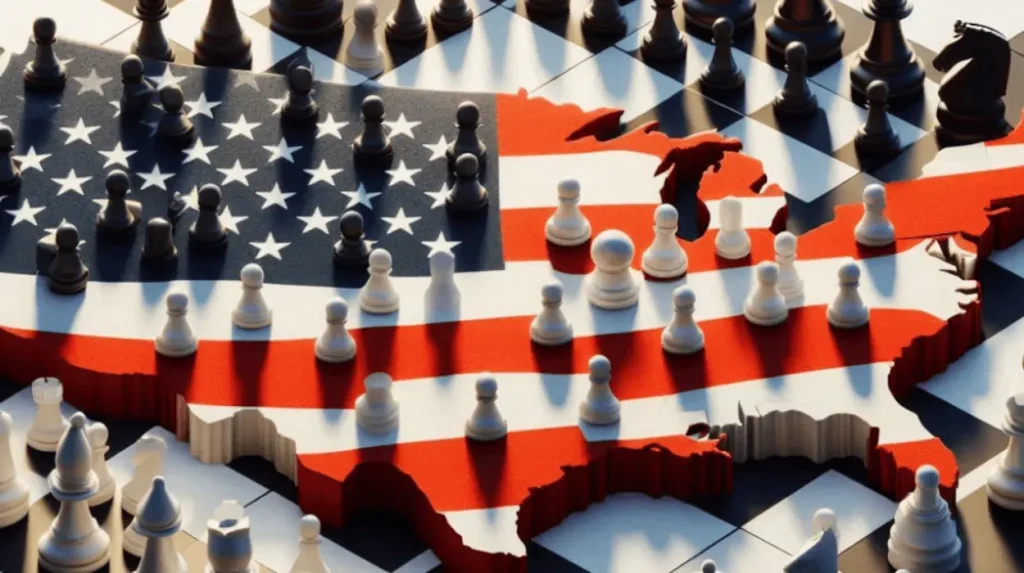
The partisanship in the U.S. foreign policy is rising, and it is hard to believe that this aspect is not noticed by other countries. In Europe and the Asian world governments are re-balancing their ties with the United States not because its power has shifted, but rather it is due to uncertainty that domestic political divisions now bring to diplomatic pledges.
The inconsistency of the changing policies of opposing regimes to what the previous administration has dictated has caused doubt over the credibility of the U.S denunciations. There are fears among the allies that the current proposals can be tomorrow discarded policies. The dysfunction is also seen by the enemies as the freedom to push the envelope and jump on to the bandwagon as they get to confront the American leadership in the global arena.
The erosion of trust in U.S. foreign policy
Domestic political divides go global
American partisanship is no longer solely a domestic affair. Georgetown University and the Quincy Institute senior fellow Paul R. Pillar makes a clear link between U.S. domestic polarization and its global effects.
“Intense partisanship is a familiar part of the contemporary United States,” he says. “But its consequences do not stop at the country’s borders.”
He emphasizes political leaders are increasingly giving party priority over country, something that is detrimental to world relations and empowering America’s foreign rivals. It has nothing to do with which party holds government—it’s the lack of continuity and the uncertainty of foreign policy being completely changed each time an election comes around.
Policy whiplash and fading credibility
Withdrawal of the Paris Climate Accord by President Trump and his rejoining under President Biden was just one of the many illustrations that showed this problem. The other situations that have only compounded the sense that the U.S. acts this way are the fluctuation that occurred with its stance on NATO, the Iran nuclear program, and climate funding.
European leaders have gone on record to say they are uneasy. In the absence of bipartisan agreements in Washington, allies find it hard to plan long, as they want to know that alliances and agreements will not fall because of a new government.
How partisanship shapes U.S. foreign policy
Congressional gridlock and executive unpredictability
The cooperation of Congress is necessary for the president of the United States to have the authority to implement foreign policy. Even crucial foreign policy measures, like delivering weapons, providing foreign aid, or reaching a military pact, are either delayed or fail to pass because of party interests in a Congress that is becoming more and more divided.
This dysfunction results in numerous backtracks. The presidency of Barack Obama to Donald Trump and then to Joe Biden came in with one of the changes that became theatrics concerning major international matters. Consequently, foreign leaders are wary of the fact that whatever deal they have done today could be reversed by any other subsequent government.
Public opinion and polarized media
The U.S. populace is today even more divided than before. As of 2024, a Pew Research Center survey conducted in the United States found only 56 percent of Americans thought the U.S. ought to be very active in world affairs, the lowest since the cold war.
Partisan news stations heighten the polarities, defining the perceptions of US citizens towards such phenomena as the case of Ukraine, the situation in Taiwan, or the NATO-related position. This media environment shapes the political mood and limits the maneuverability of policymakers since there has emerged an intimidated sense of policy-making and being party-centric according to the wishes of the members of the party.
The consequences abroad: anxiety and exploitation
Allies question U.S. reliability
Old partners are changing their foreign policy policies as a result of the increasing uncertainty of the U.S. leadership. France and Germany have increased the debate of extremity in defense autonomy in a bid to curtail European security in Washington.
It is not the issue of capability of Americans; the question is that will the U.S. work on what they have said? As has been experienced with the ups and downs of American assistance to NATO, or the appropriations to international organizations, the faith is being undermined, one election period at a time.
Authoritarian regimes see opportunities
Opponents have not been left behind. Partisan gridlock is a sign of weakness and of diversion to the foreign powers. Totalitarian governments see the division within their country as the opportunity to push boundaries.
Anne Applebaum points at alarming ideological convergence:
“The Republican Party is now ideologically nearly identical to right-wing parties worldwide and is increasingly sympathetic to Vladimir Putin.”
This consistency is encouraging enemies because they view the disunity in America as the chink in the international system. Division in Washington provides countries such as Russia, China, and Iran with a strategic breathing room in pushing back the U.S. influence even harder.
Historical patterns and modern parallels
Iraq and Iran: long-lasting partisan divides
The 2003 invasion of Iraq was thus strongly ideated by the Republicans leadership and strongly opposed by the Democrats creating a legacy of suspicion and division, which continues to characterize the debate on foreign policy.
The same partisanship was reflected in 2015 when the Obama administration succeeded in a nuclear agreement with Iran called the Joint Comprehensive Plan of Action (JCPOA). The withdrawal of Trump in 2018 also demonstrated to the rest of the world that bipartisanism was no longer a prerequisite to making major decisions in the foreign policy arena and consequently, that the decisions might be short-lived.
Missed chances for bipartisan progress
Although few instances of unity can be recalled, e.g. partnership after World War II concerning the Marshall Plan or bipartisan cooperation in the 1990s to deal with the nuclear threat, the instances of that kind are getting scarcer and scarcer. Bipartisan foreign policy is so vulnerable that it occurred in the form of a legislature fight in 2024 and 2025 over support of Ukraine and Israel.
Unpredictability discourages cooperation
The unpredictability of the U.S. foreign policy makes the prolonged cooperation more challenging. International partners are unwilling to sign an international treaty out of fear that the same will be repealed or defunded because of the next election in the United States.
The ramifications are very broad. Uncertainty inhibits negotiations in the areas of climate, trade, and international health. Countries which earlier depended on U.S. leadership now bet, diversify, and develop resiliency in the event of U.S. disengagement.
A recent Pew poll has revealed that the doubts over the American reliability have become enormous among the European and Asian locals. This is indicative of an increasing confidence that the U.S is no longer dependable to provide a stable leadership in world governance.
The global implications of political polarization
Paul Pillar warns of systemic consequences:
“The damage now extends to U.S. relations with the rest of the world. Too often, political leaders place their own party’s interest in gaining and keeping power ahead of the national interest.”
This prioritization undermines global democracy, as countries once looking to the U.S. for leadership and democratic models now question its institutional stability and consistency.
In 2025, this concern is more pronounced than ever. U.S. policy on Ukraine aid has wavered between strong support and delay, depending on congressional negotiations. Middle East policy remains unclear as debates rage over Israel and Gaza. Climate financing has also come under pressure as lawmakers disagree on funding allocations and treaty commitments.
What the 2025 landscape shows
The year 2025 has shown that American foreign policy is not only shaped by political divides but also paralyzed by them. A Fox News poll found that just 52% of Americans approved of the current presidential transition, while a significant portion of Generation Z voters were split on U.S. global leadership depending on party affiliation.
The international consequences are evident in slowed alliance-building, stalling global trade deals, and shifting military arrangements. Countries like India and Brazil are now focusing more on regional cooperation, having experienced delays and uncertainty in U.S. negotiations on energy and defense.
A voice from the field
Caitlin Crowley, a foreign policy analyst, addressed the issue in her recent interview with a major news channel. She remarked:
“America’s allies are watching closely, and many are worried that the next election could bring another abrupt shift in U.S. policy. This uncertainty makes it difficult for them to plan and undermines the trust that is essential for strong alliances.”
Her comments reflect the broader atmosphere of caution among global partners, particularly in NATO and Indo-Pacific coalitions.
Searching for stability through reform
There are ongoing efforts to reduce the impact of partisanship on foreign policy. Some policymakers advocate creating bipartisan commissions to oversee major decisions, particularly on arms sales, treaty enforcement, and military intervention.
Others push for increased State Department autonomy, enabling diplomats to maintain consistent relationships regardless of domestic politics. Public education initiatives have also been proposed, aiming to depolarize discussions on foreign policy and promote shared national objectives.
Paul Pillar, while skeptical about quick fixes, emphasizes the need for action:
“Entrenched political sectarianism makes [remedies] unlikely,” he warns, “but that does not excuse inaction.”
Restoring global trust in American leadership will require both institutional reforms and a cultural shift that places national interest above partisan victories. Without this change, the U.S. risks losing its influence—not because of diminished power, but due to self-inflicted uncertainty.