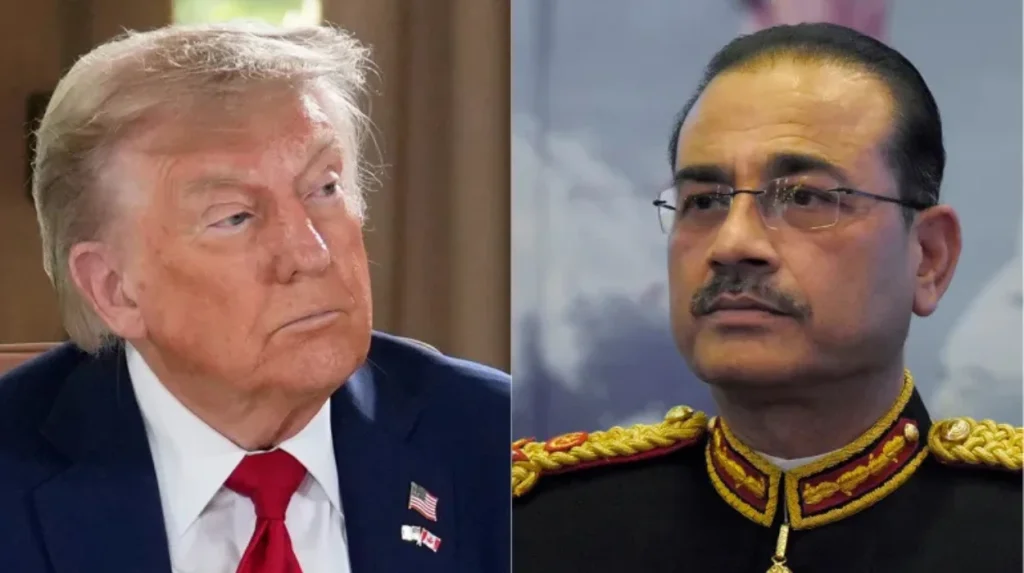
On June 18, 2025, an extraordinary meeting took place at the White House between the U.S. President Donald Trump and Pakistan’s Chief of Army Staff, Field Marshal Syed Asim Munir. This was the first occasion in which a sitting Pakistani Army Chief, without any other political office or martial law power, met face to face with a sitting U.S. President. Even more extraordinary was the two-hour meeting (it was intended to be an hour) on the critical issues of counterterrorism, trade, and regional security; a highlight of which was their discussion over their respective roles in preventing a possible nuclear conflict between India and Pakistan during the skirmishes of May 2025.
This analysis will highlight the importance of the meeting, the background to the India-Pakistan tensions, and how the public declarations from Trump and Munir assisted in stabilizing South Asia.
Down the Line |
— South Asia Times (@_southasiatimes) June 19, 2025
The Trump-Munir meeting at the White House on June 19, 2025, came amid escalating Iran-Israel tensions and India’s regional silence.
It marked Pakistan’s strategic pivot—emerging as a stabilizing voice in the Middle East, reaffirming counterterrorism… pic.twitter.com/BDPnC9JxGj
Historic Significance of the Trump-Munir Meeting
Breaking Diplomatic Norms
Field Marshal Munir’s visit to the White House was historic on multiple fronts:
- He became the first serving Pakistani army chief to formally meet a sitting U.S. president; and without also serving in a political office.
- Past military rulers, Ayub Khan and more recently Zia-ul-Haq and Pervez Musharraf, met U.S. presidents only after starting their position as head of state.
- Even while president Obama met with Pakistan army heads in informal meetings which were brief, this meeting was different.
Behind-the-Scenes Efforts
The meeting was planned through “unorthodox efforts” involving consultants, businessmen, and Republican-aligned lobbying firms instead of diplomatic channels. A senior Pakistani intelligence officer had been to Washington in weeks before to establish a foothold while U.S. The discussion was advanced in large part by Secretary of State Senator Marco Rubio and Middle East envoy Steve Witkoff.
Preventing Nuclear War: The May 2025 India-Pakistan Crisis
Background of the Conflict
- The crisis began in April 2025 after an April attack in Indian-administered Kashmir that killed 26 Indian civilians. India stated that the militants in Pakistan who were behind the attack were acting independently from the government in Islamabad whereas Pakistan refuted that claim and called for a full investigation of the attacks in a transparent manner.
- India launched missile strikes against Pakistan-administered Kashmir in May 2025, escalating an already tense situation with Pakistan immediately responding with counter-attacks with airstrikes.
- For a couple of days both countries traded drone strikes, and air strikes at each other’s military infrastructure and there was a heightened sense that a major conflict, or even a nuclear incident, could occur between two nuclear powers.
Trump and Munir’s Role
- President Trump directly credited Field Marshal Munir for keeping the war from escalating from the Pakistani side, saying that Munir had “an extremely influential” role.
- Trump also praised Prime Minister Modi for his restraint in saying that,
- “These two very smart people… decided not to keep going, with a war that could have been a nuclear war.”
- Munir expressed “deep appreciation” to Trump for this mediation which created a ceasefire and de-escalated the situation.
- Trump said that the meeting was partly to thank Munir personally for his role in avoiding conflict.
Broader Discussions: Counterterrorism, Trade, and Regional Security
Counterterrorism Cooperation
- Both leaders reaffirmed their commitment to further cooperation on counterterrorism matters, recognizing Pakistan’s essential contribution to combating extremist organizations that threaten regional and global security.
- Trump praised Pakistan’s recent efforts while calling Munir a “visionary leader” and a “friend” to counterterrorism.
- The meeting was not limited to an exchange of pleasantries, given that it included Pakistan’s National Security Advisor Lt Gen Muhammad, while emphasizing security.
Trade and Economic Collaboration
- Trump proposed a trade deal involving India and Pakistan, and characterized economic engagement as a means to peace.
- This observation highlights Pakistan’s strategic role as a regional mediator in the face of escalating Middle East tensions.
Regional Geopolitics: Iran and Israel
- When asked about the Iran-Israel conflict, Trump noted Pakistan’s nuanced position:
“They know Iran very well, better than most, and they’re not happy about anything. It’s not that they’re bad with Israel. They know them both, actually, but they know Iran better.” - This observation reflects the strategic moment for Pakistan acting as a regional interlocutor amid increasing tensions in the Middle East.
Reactions and Implications
U.S. Perspective
- White House spokesperson Anna Kelly called the meeting a “major step” in the U.S.-Pakistan relations.
- Trump’s comments about Munir and Modi both stopping nuclear war were viewed as a message, diplomatically, to South Asia and the world.
- After years of stalemate, the meeting signifies a realignment in U.S.-Pakistan ties, a step toward greater cooperation.
Pakistani Response
- Pakistani military and government officials realize that the meeting is an important step towards bilateral relations.
- Munir, in a sign of normalized bilateral relations, invited Trump for an official state visit to Pakistan, which illustrates the respect the two countries have for each other.
Indian Reaction
- There was controversy in India about Trump’s equal praise of the military chief of Pakistan and Trump’s invitation to act as mediator for U.S. mediation in Kashmir.
- Indian diplomats had wanted to use the G7 summit to isolate Pakistan, and Trump’s actions revealed a more balanced U.S. position.
Strategic Calculations Behind the Meeting
Regional Stability and Nuclear Risk
- South Asia is among the globe’s most unstable nuclear flashpoints considering the long history of conflicts and mutual suspicion between India and Pakistan.
- Skirmishes in May 2025 almost took the step across the nuclear threshold and required great diplomacy.
- Trump’s meeting with Munir indicates an understanding of Pakistan’s influence over militant groups and its ability to control escalation.
Counterterrorism and Intelligence Sharing
- Pakistan is a significant partner of U.S. counterterrorism objectives against groups like Tehreek-e-Taliban Pakistan (TTP) and Islamic State-Khorasan (IS-K).
- The meeting emphasized the importance of intelligence sharing and operational coordination to address terrorism.
Economic Engagement as Peacebuilding
- Encouraging trade and economic ties between India and Pakistan serves a bigger purpose of reducing incentives for conflict by creating mutual benefits and prosperity.
- Trump’s focus on technology and emerging sectors indicates a nice look to the future of bilateral relations.
A New Chapter in South Asia’s Stability
Donald Trump’s meeting with Field Marshal Syed Asim Munir at the White House in June 2025 represents a historic point in South Asian diplomacy. Understanding Pakistan’s key potential in reducing conflict, as well as cooperating potentially in counterterrorism, trade and others, this meeting ultimately shows progress when the world views stabilization in South Asia as a positive development. While historical political rivalries and security tensions exist, the fact that engagement between the United States and Pakistan is able to be productive, demonstrates that cooperation and partnership can avoid catastrophes and prepare itself and others for peace.