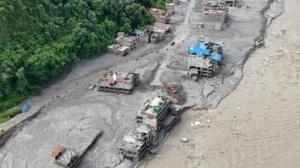
Nepal’s government has estimated that last month’s catastrophic Himalayan flash floods caused at least $2.56 billion in direct damage to homes, property and infrastructure, a figure that officials warn is only preliminary as more detailed assessments are underway. The disaster, triggered by a glacier collapse near the Tibet border, has killed more than 1,200 people in Nepal, left over 4,200 missing and exposed the country’s acute vulnerability to climate-driven extremes in a region where development, tourism and critical infrastructure are tightly packed into narrow mountain valleys.
A Preliminary but Staggering Damage Assessment
With an estimate of $2.56 billion, which is 387.5 billion Nepalese rupees, the damage has been reported on housing structures, public infrastructures and private properties in the hardest hit districts of central and northern Nepal. Dharma Raj Upreti, who heads the National Disaster Risk Reduction and Management Authority said to Reuters that
“these are estimated figures. We have done the calculation in collaboration with different concerned agencies and departments.”
A more detailed loss and damage assessment is expected to come out when the rescue teams reach remote areas.
Among the figures, there have been a few figures for the more visibly damaged structures. 20,000 houses need to be rebuilt in the flooded areas, while 7,500 have been destroyed by floods according to the calculation made by the disaster authority. Inroads, bridges and power related infrastructure have been severely affected or washed away in the Bhote Koshi region and valleys around.
The tourism infrastructure that constitutes the economy of Rasuwa and neighboring areas, which includes lodges and trekking trails, has been severely affected, resulting in livelihood-related worries of far greater magnitude than the immediate reconstruction costs that may follow. The government has independently estimated that during the first four months of the process, it would cost $52.6 million (7.95 billion NPR) to rebuild roads and set up temporary shelters and other basic amenities like water and power supply. Although this initial funding is to help stabilize the situation before the reconstruction begins, it is clear that this would not be an easy task considering the difficult terrain conditions due to landslides and clogged riverbeds.
Human Toll: More Than a Number
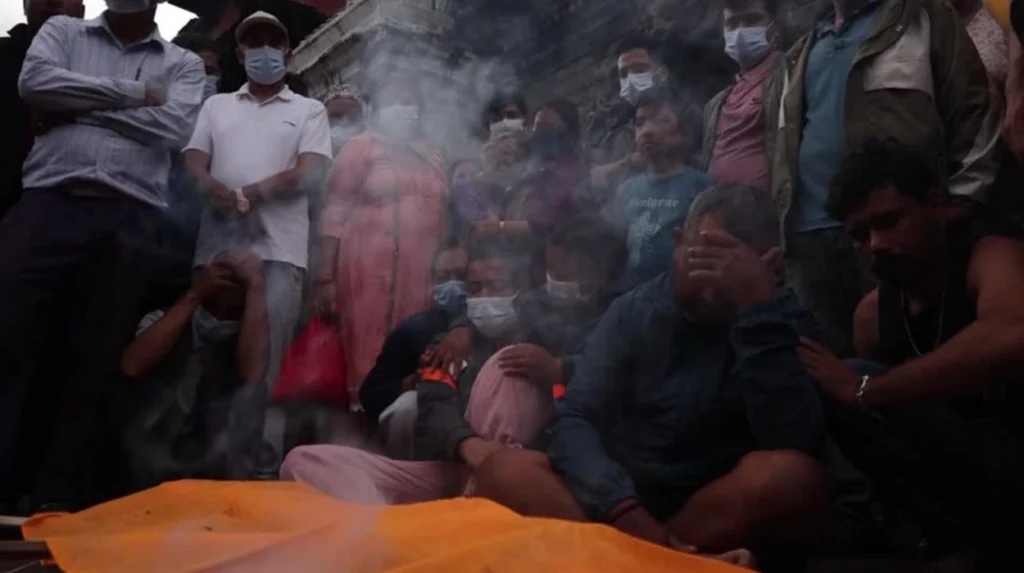
Behind the macroeconomic figures lies a human catastrophe that continues to unfold. At least 1,204 people have been confirmed dead in Nepal, with earlier counts ranging from the high 600s to over 900 as search teams recovered bodies from tunnels, riverbanks and buried settlements. More than 4,200 people remain missing, including large numbers of foreign tourists, pilgrims and migrant workers who were in the region when the glacier collapse unleashed a torrent of rock, ice, mud and water down mountain river systems.
On the Chinese side of the border, authorities in Tibet’s Gyirong County have noted deaths as well as several hundred missing, increasing total counts from Nepal and Tibet of missing persons to 2,500 to 3,000, of whom many were foreigners. Recovery efforts have concentrated on those who are buried within tunnels and fields of debris, with the chances of discovering survivors slowly decreasing, yet still alive despite the risks associated with moving around the area, which include unstable mountains and flood danger from the growing waters of lakes in the region. The magnitude of casualties has exceeded the ability of local resources for body recovery, identification, and storage. There is an urgent need for technical help in these areas from abroad, something Foreign Minister Shisir Khanal has called for explicitly.
Reconstruction Needs That Rival a Tenth of GDP
Although the estimate of $2.56 billion covers the immediate damages, Nepal’s finance officials are already making estimations for beyond. According to Reuters, Nepal’s Finance Minister Swarnim Wagle said that reconstruction needs might come close to $4 to $5 billion dollars. “Initial estimates have been placed at between $4-$5 billion. It is just an estimate,” Wagle said. This amount of money can be viewed as nearly one tenth of the country’s gross domestic product. As mentioned above, the costs might increase depending on the assessment of the damage caused by the earthquake.
The estimate also includes not only the cost of construction and reconstruction but the costs associated with creating an economic system which will be more resistant to the climate-related disasters in the future. For instance, in case of such events, it becomes quite important to rebuild the infrastructure and restore agricultural systems in order to ensure people can survive. It should be noted that the economic environment in Nepal plays an important role in the case. A reconstruction bill in the $4–5 billion range would require a mix of domestic reallocation, concessional lending, grants and possibly debt restructuring or relief, alongside coordinated support from multilateral institutions and bilateral partners.
Climate Justice and the Push for International Accountability
Nepal’s political leadership has not treated this disaster solely as a domestic emergency. Foreign Minister Shisir Khanal has used the crisis to reiterate long-standing demands for international accountability and compensation for climate-related losses, arguing that countries with minimal historical emissions are paying a disproportionate price for a warming planet. In practical terms, Kathmandu is seeking both financial support and technical assistance: cash and relief supplies to address immediate humanitarian needs, and specialized expertise to manage complex rescue and recovery tasks that exceed local capacities.
This framing aligns with broader Global South calls for operationalizing loss-and-damage mechanisms agreed in recent climate negotiations, where vulnerable countries have pressed for predictable funding streams to respond to disasters that science increasingly links to climate change. While the direct attribution of this specific glacier collapse to climate change will be studied by specialists, the event fits a pattern of intensifying hydro-meteorological extremes in the Himalayas, where warming temperatures are destabilizing glaciers and permafrost and altering monsoon dynamics.
International Aid Mobilizes, but Gaps Remain
The international reaction has been prompt, although there is apprehension that requirements would soon exceed the commitments made initially. India has airlifted relief supplies worth an estimated 50-60 tons, comprising shelters, blankets, hygiene packs, lamps, medicines, and food, apart from offering disaster response manpower, prefabricated bridges, and technical assistance, including tunnelling experts to help with rescue operations. China has coordinated emergency aid and money assistance besides deploying tunnel-rescue experts to help with efforts in Nepal. UN has mobilized resources and provided $2 million from its Central Emergency Response Fund (CERF) to help Nepal in its relief operation, while the International Federation of Red Cross and Red Crescent Societies has made a commitment of 1 million Swiss francs ($1.2 million).
Australia has promised $3.6 million worth aid and additional consular manpower to assist its nationals along with coordinating with Nepali government officials. Other governments and NGOs have provided cash, relief items and technical assistance, but the enormity of the destruction in remote districts of the mountainous country implies that logistics rather than finances will become an important bottleneck in the coming days.
Tourism, Livelihoods and the Risk of a Prolonged Shock
Beyond the immediate humanitarian and fiscal dimensions, the floods pose a serious threat to Nepal’s mountain tourism industry, a vital source of revenue and employment in regions already grappling with poverty and outmigration. The affected corridors are key routes for trekkers and pilgrims, and the destruction of lodges, trails and support infrastructure risks depressing visitor numbers ahead of peak seasons.
Industry observers warn that even if physical infrastructure is rebuilt, perceptions of risk could linger, especially if secondary hazards such as unstable slopes, glacial lake outburst risks and unpredictable weather patterns are not credibly addressed. For communities whose incomes depend on guiding, portering, lodging and transport, a prolonged downturn in tourism could be as damaging as the initial destruction of assets.
Governance, Coordination and the Test Ahead
In addition to putting pressure on the resources of the country, the incident has strained Nepal’s disaster governance and coordination between various agencies. The initial damage valuation of $2.56 billion was made after coordination between different agencies and departments; however, it was agreed upon by the authorities that a thorough damage assessment is necessary for reconstruction purposes as well as in terms of engaging international donors.
The early recovery budget of $52.6 million is designed to secure basic services, but implementing the above projects in challenging terrains with destroyed roads and further threats due to landslides and floods would require strong logistics. At the same time, the demand for international technical assistance in tunnel rescue, body identification, body storage and heavy engineering demonstrates the recognition that certain aspects of the disaster are beyond the scope of the capabilities of national authorities.
A Defining Moment for Climate-Resilient Development
Nepal’s $2.56 billion flood bill is more than a balance-sheet item; it is a stark indicator of how climate-driven extremes can overwhelm development gains in fragile mountain economies. The gap between the direct damage estimate and the $4–5 billion reconstruction projection underscores the difference between replacing what was lost and building back in a way that reduces future risk.
For policymakers, the challenge is to translate the urgency of this moment into a reconstruction strategy that prioritizes resilient infrastructure, diversified livelihoods and stronger early-warning and evacuation systems, while securing predictable international support that does not simply patch holes but addresses underlying vulnerabilities. For donors and multilateral institutions, the test is whether loss-and-damage rhetoric can be matched with timely, flexible financing and technical cooperation that reflects the scale of what Nepal now faces.
In the valleys scarred by ice, rock and mud, the human stories of loss and survival will ultimately define this disaster. But the policy choices made in Kathmandu and in donor capitals over the coming months will determine whether Nepal emerges from this shock with a more resilient development path—or remains trapped in a cycle where each new climate extreme erases years of hard-won progress.