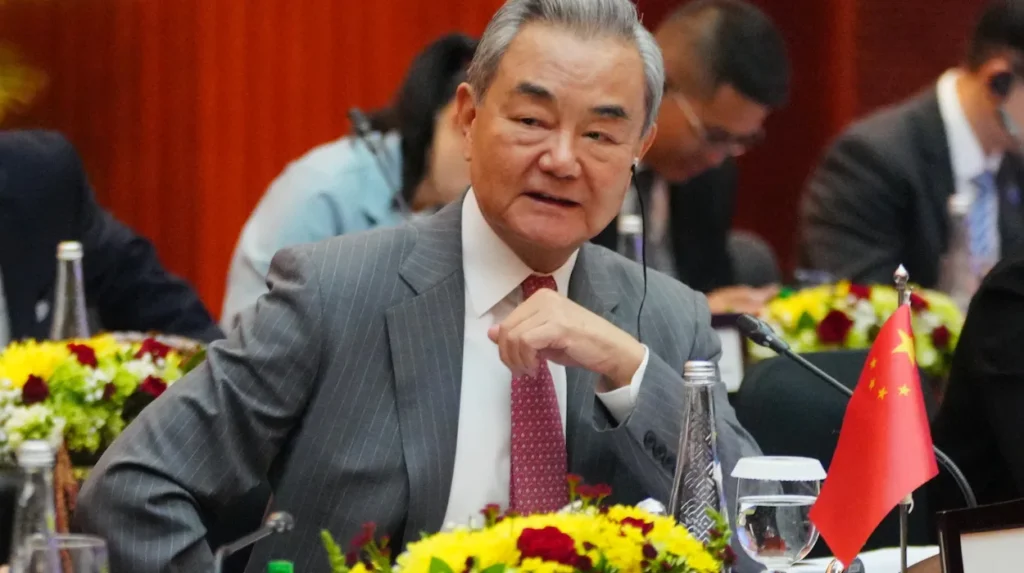
Beijing’s top diplomat is signaling both urgency and caution as Washington and Beijing prepare for a high-stakes leaders’ meeting. In a meeting with U.S. Ambassador David Perdue on August 26, Chinese Foreign Minister Wang Yi urged both sides to
“earnestly implement the important consensus reached by the two heads of state, and remove disruptions and overcome obstacles to high-level exchanges between the two countries,”
according to the Foreign Ministry’s readout released on August 27. The remarks, delivered in Beijing, are widely understood as a push to safeguard the political momentum for an expected September summit between U.S. President Donald Trump and Chinese President Xi Jinping, which has been reported as likely to take place on September 24 at the White House.global.chinadaily.
Setting the stage: a fragile truce under pressure
The diplomatic dance leading up to the meeting takes place within the context of competitive management. Trump and Xi met in May 2026 in Beijing, during which time the two committed to maintaining the stability of the bilateral relationship and a fragile trade truce despite the use of economic coercion by both parties. Subsequently, the United States banned Chinese-made robots while Beijing has banned the activities of Americans involved in trade and similar activities in China, thus showing the continued existence of tactical tensions behind the scenes of strategic engagement. In this context, Wang’s appeal to “focus on a positive agenda, properly manage differences, remove interference and overcome obstacles to high-level exchanges” can be seen as both an instruction for the policymakers and a political message intended to preclude any obstruction from getting in the way of their dialogue.
What Wang Yi said: the core message and its subtext
The three themes underlying Wang’s public statements in state and foreign media coverage are the implementation of leaders’ agreement, the management of the agenda and overcoming obstacles to the high level contacts. Wang spoke in future tense, stating that both sides need to “make efforts to take Sino-U.S. relations onto the track of stable, healthy and sustainable development.” This formula is usual in Chinese diplomatic language, but in this particular case, it acquires special significance: in about two weeks the summit will be held and its success largely depends on everyday management of conflicts as well as on any other kind of declarations.
At the same time, Wang admitted structural limitations. He stated that Sino-American relations “still face many risks and challenges,” which allows Beijing to show its realism regarding this issue, but to avoid mentioning responsibility in the public sphere. The concept of “risks and challenges” is general enough to cover all kinds of disagreements, including trade disputes, technology control issues and geopolitical conflicts, and specific enough to make sure that the door is not closed for compromise before the talks.
Wang also anchored his message in a normative claim about the benefits of engagement. He said,
“Facts have proven that improving and developing China–US relations, peaceful coexistence on the basis of mutual respect, and then win–win cooperation serve the fundamental interests of the two peoples and meet the common expectations of the international community.”
This is classic Chinese foreign policy rhetoric, but it is being deployed here to reinforce a specific objective: locking in the political space for the summit by appealing to domestic and international audiences who favor predictability over escalation.
The U.S. side: limited public detail, clear preparatory intent
While there is less publicly available information about the US side, its approach is discernible in the statements made by the US ambassador to China, Ted Osius. Ambassador Perdue characterized the meeting as a process of
“preparation for President Xi’s reciprocal visit to Washington,”
indicating that it was substantive and addressed issues of logistical preparations, agenda setting, and risk reduction.
The lack of a comprehensive statement from the US side does not mean that there is no parallel to China’s readout because the United States traditionally prefers to leave their negotiating position flexible before high-level meetings. However, what is relevant in analyzing the situation is the convergence of the two countries’ approaches to recognizing the upcoming September meeting as a concrete event that needs preparation. This convergence is important in the sense that despite all the tensions like the robot ban and reciprocal entity listings, both sides recognize the need to maintain the high-level communication channel. For Washington, this means the possibility to contain the competition and test whether Beijing will fulfill some requests. For Beijing, this means the possibility to stabilize the course of relations and present itself as a responsible stakeholder.
Why the language matters: decoding “remove interference” and “overcome obstacles”
The choice of words in Wang’s statement is deliberate. “Remove interference” is a phrase that often points to external or internal factors that Beijing believes are complicating bilateral ties—whether congressional actions, media narratives, or bureaucratic hurdles. By invoking it now, Beijing is signaling that it wants a clean runway for high-level exchanges, free from what it perceives as noise that could distort the summit’s outcomes. The companion phrase, “overcome obstacles to high-level exchanges,” broadens the scope to include practical barriers: visa issues, scheduling conflicts, or policy disagreements that could delay or dilute the leaders’ engagement.global.chinadaily.
Read together, these phrases form a diplomatic request for de-escalation in the run-up to the summit. They do not specify which obstacles must be removed, which is intentional: it allows Beijing to keep pressure on multiple fronts without boxing itself into a single demand. It also creates a benchmark for success. If the summit proceeds smoothly and yields joint language on stability, Beijing can claim that its call to
“remove disruptions and overcome obstacles”
was heeded. If the summit falters, the same language provides a ready-made explanation that external interference or unaddressed obstacles derailed progress.
The summit’s stakes: what a successful meeting could deliver
The successful summit would seek to produce three major deliverables: a joint statement committing both parties to sustainable relations, working level agreements in narrowly focused areas, and a mechanism for handling future crises. A joint statement would follow in the footsteps of Wang’s appeal to “stable, healthy and sustainable development.” Working level agreements could involve areas in which both China and the U.S. have reasons to work together, for example, certain steps towards the facilitation of trade or the creation of communication hot lines.
Crisis management mechanism will be the most valuable result of the September summit, as it would mean a well-defined method for avoiding miscommunications and misunderstanding. But the success is far from being assured. The very tensions which make the summit needed – technology restrictions, trade restrictions, geopolitical competition – also make it delicate. Any maximalist positions on any side might lead to the failure of the process. And for that reason, Wang’s appeals to “properly managing differences” acquire additional importance: not all disputes could be handled easily, and the idea is to contain them rather than let them dictate the tone of the negotiations.
Risks and challenges: the structural headwinds that remain
Wang’s recognition that the relations
“are still facing various risks and challenges”
is not only a diplomatic courtesy; it is an awareness of the structural headwinds that will not fade away after one summit. First, from the perspective of U.S. politics, there will always be domestic political pressure and bipartisan doubts about Beijing that may restrict the willingness of an administration to make concessions. On the other hand, China has to deal with its own economy and show its strength despite being under constant outside observation, which also creates certain structural limitations for any Chinese administration.
Thus, even a successful summit is going to be merely a milestone. Meanwhile, the continuing targeted measures – for example, the ban on Chinese-made robots by the U.S. and reciprocal bans on American entities by China – show how tactical competition takes place while there is a strategic dialogue going on. These measures are not only economic, but they are also signals of red lines and sensitive issues, and managing them requires certain balance: enough cooperation to demonstrate some achievements, and enough competition to keep the public happy.
What to watch next: the path to September
The three most important signals for the weeks preceding the summit will be the tone in which official statements are made, the tempo at which working-level discussions take place, and new information concerning trade and technology. Should both sides show signs of adopting a more conciliatory tone and taking concrete steps toward making exchanges possible, it would mean that Wang’s call for the “removal of disruptions and overcoming of obstacles” is actually put into practice.
Alternatively, should new restrictions be announced or rhetoric become harsher, it would mean that the structural headwinds prevail. Yet another sign of what may be expected from the summit is how detailed the agenda of the meeting is. A vague agenda makes a misunderstanding of each other’s intentions much more likely, while a detailed one shows that both parties have prepared for the summit properly. The inclusion of a crisis management mechanism in the agenda would be especially indicative of serious intent on both sides.