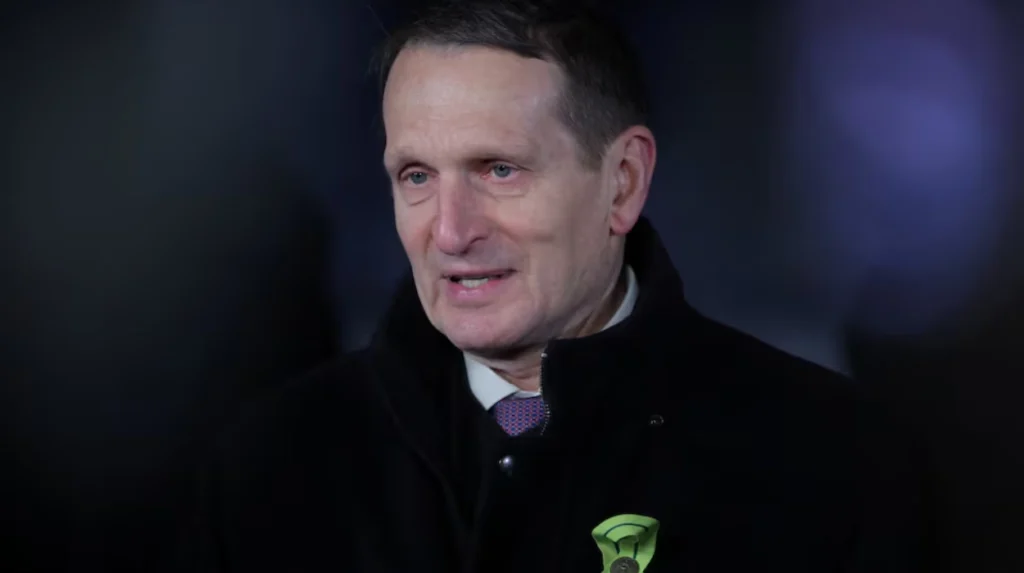
In the opaque world of intelligence diplomacy, public confirmation is itself a signal. On Thursday, August 27, 2026, Sergei Naryshkin, the long-serving head of Russia’s Foreign Intelligence Service (SVR), broke that silence, telling reporters that he had held a “working-level meeting” with CIA Director John Ratcliffe in Moscow earlier in the week.
“The meeting did take place, and there is nothing unusual to it,”
Naryshkin said, framing the encounter as a routine exchange on sensitive, agency-specific matters.
This was in response to a week of speculation after reports in American media about an unpublicized visit by Ratcliffe to the Russian capital, followed by a cryptic admission by the Kremlin that the CIA director had made “contacts” with Russian security officials. This is proof of the fact that even during the worst confrontation between the two powers since the Cold War period, both parties have maintained covert lines of communication in order to control escalation and resolve sensitive matters diplomatically.
The Visit: Timing, Secrecy, and Official Accounts
The initial report about Ratcliffe’s visit to Moscow, published by U.S. media on August 25, cited unnamed officials who were familiar with Ratcliffe’s travels. It was not an officially announced trip as the nature of contacts between intelligence services requires secrecy in times of ongoing warfare. It was only on August 26 that Kremlin spokesperson Dmitry Peskov confirmed that Ratcliffe had been in Moscow on Tuesday “for contacts of security services” and explained that although the CIA director had not met with President Vladimir Putin personally, the latter was informed about the visit. Peskov refused to provide any information regarding the content of the discussions, noting that they were part of the process of interaction between the special services of the two countries.
The confirmation from Naryshkin on August 27 became the most authoritative one. Characterizing the meeting as a working contact, he refused to comment on its content but stressed that it was not a break in relations.
“There is nothing unusual to it,”
Naryshkin insisted, claiming that although rare in public perception, such contacts represent just the pattern of crisis management. Russian media and commentators soon followed the line, presenting the discussions as a sign of the readiness of Moscow to conduct dialogue despite fighting the exhausting war in Ukraine.
The White House and CIA have remained largely silent on the details, a typical posture for backchannel intelligence contacts. U.S. officials have historically used such meetings to convey stark messages—on nuclear thresholds, escalation ladders, or detainee cases—without turning them into public negotiating fora.
Why This Meeting Matters Now
The timing of Ratcliffe’s visit is impossible to separate from the broader trajectory of the Ukraine war and U.S.–Russia relations. More than four years into Russia’s full-scale invasion, the conflict has settled into a brutal attritional phase, punctuated by long-range strikes, drone campaigns, and periodic escalatory rhetoric from both sides. In this environment, intelligence backchannels serve as a form of shock absorber: a way to reduce the risk of miscalculation when conventional diplomacy is frozen or insufficient.
Analysts have long noted that, despite the war, Moscow and Washington retained emergency hotlines and held sporadic direct conversations between defense and intelligence chiefs during 2022–2024 to
“deflate crises as nuclear risks rose.”
The last publicly disclosed contact between Ratcliffe and top Russian officials before this week was a March 2025 phone call with Naryshkin, after which the SVR said both sides agreed to maintain dialogue to
“promote international stability and security, as well as to reduce tensions.”
It would not be an exaggeration to say that the August 2026 meeting could very well be the continuation of the same logic: maintaining a channel when the stakes are at their highest. It has been noted in Western media that Ratcliffe might have issued a warning against escalation of the conflict, which could include using nuclear weapons or strikes against the Western countries’ allies, just like the CIA directors have done in such back channels in the past. While it remains to be seen whether the reports are confirmed officially or not, there is a pattern here that is recognizable. The November 2022 meeting between the CIA Director William Burns and Naryshkin in Ankara, where Burns warned Naryshkin against using nuclear weapons in Ukraine and brought up the cases of detained Americans.
Historical Precedent: Intelligence Backchannels in Crisis
High-level, face-to-face meetings between U.S. and Russian intelligence chiefs are uncommon but have occurred at critical junctures, often serving as a pressure valve when broader relations are in freefall.
- In 2021, CIA Director William Burns met in Moscow with Nikolai Patrushev, secretary of Russia’s Security Council, months before Russia’s full-scale invasion of Ukraine in February 2022. That contact is now viewed by analysts as part of a final round of U.S. efforts to deter or clarify Moscow’s intentions before the war began.
- In November 2022, Burns’ meeting with Naryshkin in Ankara became the first known high-level in-person U.S.–Russian contact after the invasion. U.S. officials said Burns warned against any Russian use of nuclear weapons in Ukraine and raised the cases of detained Americans; the White House stressed he was not negotiating a settlement.
- During 2022–2024, academic and policy analyses note that both sides retained emergency hotlines and held sporadic direct conversations between defense and intelligence chiefs to manage escalation risks as nuclear rhetoric ebbed and flowed.
Against this backdrop, Ratcliffe’s visit fits a recognizable template: a discreet, chief-level encounter designed to deliver a message, test intentions, or stabilize a dangerous moment without the baggage of formal diplomacy.
The Players: Naryshkin and Ratcliffe
Naryshkin has represented Russia’s foreign intelligence community in more than a decade of backdoor dealings with CIA directors, which included the 2022 meeting in Ankara with Burns. Naryshkin holds a rare and distinctive position in Russia’s security structure as the head of SVR: sufficiently close to the Kremlin to be influential, yet isolated enough to conduct deniable exploratory discussions if required. For his part, John Ratcliffe is a political appointee with a strong background in the second administration of Donald Trump. Ratcliffe was sworn in as the 25th CIA Director on January 23, 2025.
Prior to this appointment, he served as the Director of National Intelligence during Trump’s first presidential term (2020–2021), and was a member of the U.S. House of Representatives for the 22nd district of Texas. He is the only individual who has held two key positions in the intelligence community, namely, that of the Director of National Intelligence and CIA director. His Senate confirmation in January 2025 with 74 votes to 25 demonstrated the importance of Ratcliffe to the Republican national security community, despite some concerns about his neutrality.
Ratcliffe’s background—combining congressional experience, prior leadership of the U.S. intelligence community, and close alignment with Trump—makes him a potent messenger in a backchannel setting. If, as some reports suggest, he carried a warning on escalation or nuclear thresholds, his stature would lend that message additional weight in Moscow.
What Was Said—and What Was Left Unsaid
Public statements from both sides have been carefully calibrated, offering just enough to confirm the contact without revealing its substance. Naryshkin’s insistence that
“there is nothing unusual to it”
serves two purposes: it normalizes the meeting for domestic Russian audiences and signals to Washington that Moscow does not view the contact as a concession or a sign of weakness.
Peskov’s statements, however, clearly differentiate between intelligence relations and presidential diplomacy. In highlighting that Ratcliffe did not meet President Vladimir Putin, but rather that he was informed by him, Russia maintains the image that there are no politically significant negotiations taking place, while at the same time recognizing the benefit of the security service communications. It is presented in Russian media as a “positive process” that is still ongoing despite any difficult times, an expression that again emphasizes the fact that Moscow is a responsible power willing to speak.
On the U.S. side, silence speaks louder than words. Without detailing the topics of discussion, the Americans maintain their freedom of action and leave themselves room for using the channel in the future for crisis diplomacy. It is a well-known strategy from history; similar meetings were held in order to warn about the consequences of actions, such as nuclear strike, attack on NATO territories, or detention of people.
Strategic Implications: Escalation Management and Detainees
Two issue areas stand out as likely components of the Ratcliffe–Naryshkin talks: escalation management and detainee cases.
As for escalation, while the war in Ukraine has brought about many instances in which the parties have pushed the threshold of nuclear use, in particular, through the nuclear rhetoric of the Russian side and expansion of the territorial and technological boundaries of strikes, intelligence backchannels may help delineate red lines and prevent measures that would escalate into broader war. The meeting between Burns and Naryshkin in Ankara in 2022 is often mentioned in this regard as an example of a direct and private message about the issue of the use of nuclear weapons and the importance of strategic stability.
In case the message sent by Ratcliffe follows the same pattern, it would be consistent with the previous practice of the United States: deliver a clear message about the consequences of escalation without making any fuss about it publicly. As for detainees, U.S.-Russia bilateral relations have been marked by the fact that there have been several high-profile cases when Americans were detained in Russia, ranging from journalists to ex-Marines. In the case of detainees, it is customary for the heads of intelligence services to discuss these issues in backchannel settings.
What This Signals About U.S.–Russia Relations
The confirmation of Ratcliffe’s visit and Naryshkin’s meeting does not signal a thaw in U.S.–Russia relations. Rather, it signals a pragmatic recognition that, in a protracted conflict with nuclear-armed adversaries, some forms of communication must survive even when everything else is frozen. The language used by both sides—“working-level meeting,” “contacts between security services,” “nothing unusual”—is designed to lower the political temperature around the contact while preserving its utility.
At the same time, the episode highlights the limits of transparency. Neither Moscow nor Washington has offered a detailed account of what was discussed, and both have incentives to keep the content ambiguous. For Moscow, ambiguity allows it to claim openness to dialogue without appearing to concede under pressure. For Washington, it preserves the ability to use the channel for future warnings or exchanges without being locked into a public narrative.
Open Questions and What to Watch Next
A number of issues remain open. First, the precise agenda of the meeting between Ratcliffe and Naryshkin is yet to be clarified. Did the talks mostly revolve around the issue of escalation or were the issues of detainee cases discussed? Second, it remains unclear whether this encounter will result in any kind of future interaction or even any concrete achievements, such as prisoner exchanges or informal agreements regarding restrictions on strike operations. Finally, the issue of Ukraine in all of this needs to be considered.
There have been rumors that the United States coordinated their action with Kyiv, although no official statements have been made in support of this suggestion. Over the course of next several weeks, experts will be watching any change in tone coming from either Moscow or Washington, any changes in the frequency of long-range strikes and progress in detainee cases. The only certainty in this case is that, despite the highly confrontational relationship, intelligence backchannels are absolutely essential when it comes to managing war risks.