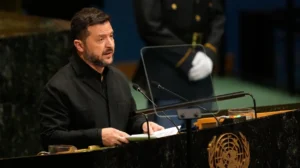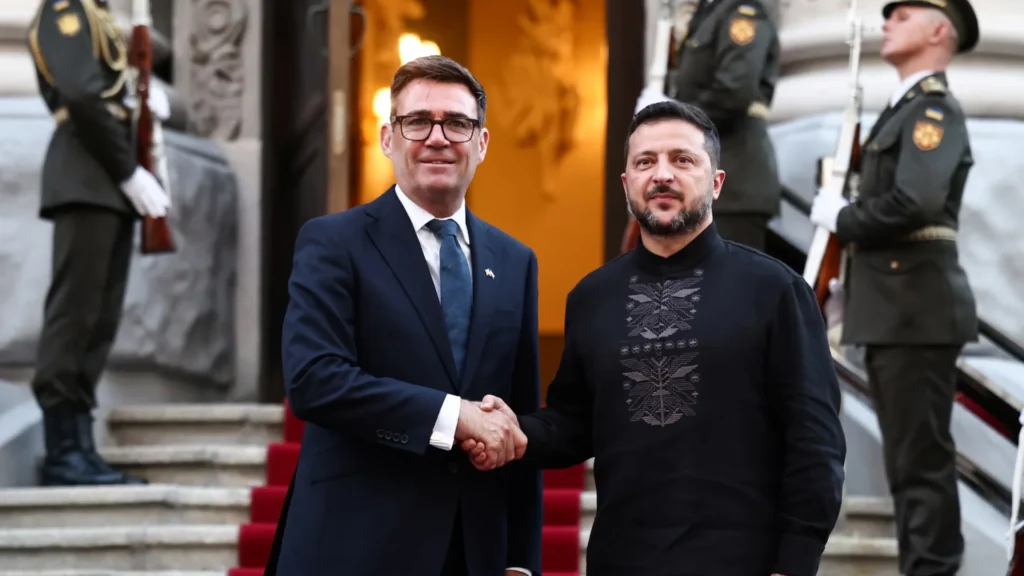
U.K. Prime Minister Andy Burnham stated that he and other European leaders intend to visit the U.S. in September and convince President Donald Trump to allow Ukraine access to some American Patriot missile stocks. The timing was strategic in the sense that it would coincide with the annual UN General Assembly session in New York.
Burnham framed the visit as likely but not yet fully finalized, telling Bloomberg in Kyiv on 24 August:
“I’m looking forward to going to New York in September… I’ve not fully confirmed the details yet but it’s likely I will go, particularly after today’s discussion.”
If confirmed, this would be Burnham’s first visit to the U.S. as prime minister since taking office in July, underscoring how central Ukraine’s air defense has become to his early foreign policy agenda.
Why Patriots Are Now the Centerpiece of the Debate
The urgency with which Burnham is to lobby arises from warnings by officials in Kyiv of dangerously low levels of Patriot interceptors. It is said that failure to restock the Ukrainian defenses with Patriot interceptors would result in the Ukrainian shield being inadequate to face the missiles and the unmanned aircraft from Russia.
President Volodymyr Zelenskyy has been explicit about the scale of the need, stating:
“I wanted to secure 300 Patriot missiles for the winter package… The request from our air force is 360.”
He has also pressed the point on timing:
“We need the Patriots yesterday.”
The method of Zelenskyy’s is based on a combination of two directions – purchases and the establishment of production facilities. The President is ready to purchase more U.S.-produced Patriot interceptors at his own expense rather than receiving those through aid programs, and at the same time, Zelenskyy is going to try to get a license for the production of such interceptors in Ukraine.
The Shifting U.S. Position Under Trump
President Trump’s public stance on Patriots has shifted in recent weeks, moving from signals of openness to a more cautious posture on technology transfer and large-scale transfers from U.S. stocks. In late July, Trump appeared to backtrack on earlier indications that Ukraine could manufacture Patriots, saying:
“We have not agreed to that. We’re talking about it. But it’s a hard thing to give away, that kind of technology.”
Previously, Zelenskyy claimed that Trump had promised Ukraine the opportunity to manufacture Patriots during the NATO summit; however, by the end of July, the U.S. president openly stated that there was no such deal between the two countries yet. The vagueness of the statement has provoked vigorous lobbying efforts from Kyiv and its European partners. Zelenskyy has been persistently pushing for the licensing to manufacture Patriots and purchasing them directly, even in his meetings with Trump at the White House.
Europe’s Two-Track Strategy: Build More, Buy More
This is precisely what Burnham and his European counterparts are doing – helping Ukraine produce more of its own longer-range weapons while urging the United States to either transfer or sell more Patriots. In terms of production, Burnham revealed that the UK will assist in Ukrainian production of long-range missiles by sharing classified data about their components, especially in regard to such types of long-range missiles as SCALP/Storm Shadow, produced by defense company MBDA. The point of this measure is to allow Ukraine to develop the ability to strike deeper inside Russia-controlled areas and destroy air defense and logistics targets used for missile and drone attacks on Ukraine.
Meanwhile, it is clear that the production process cannot provide instant assistance in creating the number of interceptors required for defending Ukrainian cities and infrastructure from the attacks. As Burnham noted, although the UK does not have any Patriots, Europeans must take more effort to ensure their transfer to Ukraine. During their meeting in Kyiv around Ukraine’s Independence Day, Burnham, Emmanuel Macron (President of France) and Friedrich Merz (German Chancellor) issued a joint statement pledging to increase the air defense capability of Kyiv “as an urgent priority.” The September meeting in Washington is the logical continuation of this endeavor: turning the political pledge into actual decisions made in the U.S. pravda.
The Numbers Behind the Ask
The quantitative aspect of the request adds weight to the urgency of the situation for the United States. Zelensky has made it public knowledge that his country requires 300 to 360 Patriot interceptors as part of a “winter package,” based on the current level of depletion and future anticipated need for these in light of intensifying Russian attacks. Ukraine’s military has reportedly depleted their Patriot interceptors made by the U.S. and needs to resupply before winter.
This number makes a difference because it shifts the generic request for “more air defense” to a concrete one that is measurable against U.S. supply stock, production capabilities, and burden-sharing within NATO. The timing of the lobbying campaign by Europeans in September, around the UN General Assembly session, is important from an operational perspective as well. Any agreement that will be reached in the fall season would mean supplies that could start arriving in Ukraine before the worst winter months hit, making energy infrastructure vulnerable and adding another complication to repairs.
Political Context: From Kyiv Streets to the White House
The push to Trump unfolds against a backdrop of continued Russian strikes on Ukrainian cities and infrastructure. In late August, attacks hit residential buildings on Ukraine’s Independence Day, including in Chernihiv and Sumy, reinforcing Kyiv’s argument that air defense gaps are life-and-death issues. These incidents are not abstract; they shape public opinion in Europe and the U.S., and they provide Zelenskyy and Burnham with concrete examples to cite when pressing for faster decisions.
At the same time, the debate in Washington is shaped by broader questions about the scope and duration of U.S. support. Trump’s caution on technology transfer reflects concerns about industrial capacity, proliferation risks, and the precedent of sharing advanced missile technology with a war zone. European leaders, by contrast, frame the issue as a near-term necessity: if Ukraine cannot defend its grid and cities, the war’s political and economic costs will rise for the entire alliance. Burnham’s planned September mission is thus both a technical negotiation over interceptors and a political test of transatlantic cohesion under a Trump administration.
What Success Would Look Like
For Burnham and his European colleagues, “success” in September would involve a set of U.S. decisions rather than one decision alone. They would have to secure the following: permission for Ukraine to acquire more Patriot interceptors from existing U.S. stocks; a timeframe for delivery of the interceptors; and some sort of licensing/technology arrangement that would enable Ukraine to produce or assemble the interceptors at home. Any such developments, even partial, such as delivery of a batch of interceptors now in combination with discussions about production, would already be considered an achievement in light of the sense of urgency conveyed from Kyiv.
Non-delivery, meanwhile, would have consequences of its own. First, it would reinforce Ukrainian views that Western resolve was faltering at a crucial moment. Second, it would strain unity among European capitals, as each would ponder whether to compensate for the setback with its own resources or to keep pushing Washington to act. For Burnham himself, the September mission will serve as an early test of his ability to deliver on one of his key foreign policy achievements: ensuring Ukraine’s air defenses remain intact until the winter.
The Broader Strategic Stakes
Beyond the immediate question of interceptors, this episode highlights a structural tension in the alliance: how to balance European initiative with U.S. technological and industrial dominance in high-end air defense. Europe can help Ukraine build long-range strike capacity and coordinate purchases, but the Patriot system remains a U.S.-controlled platform with complex supply chains and export controls. Burnham’s strategy—pairing UK technology sharing on long-range missiles with a direct appeal to Trump on Patriots—acknowledges this reality.
The outcome will also influence future debates over security architecture in Europe. If Ukraine secures a robust, sustainable air defense package this winter, it strengthens the case for deeper European integration in defense production and procurement. If not, it may fuel arguments for more autonomous European capabilities, even as leaders continue to rely on U.S. systems in the short term. In that sense, Burnham’s September mission is not only about Ukraine’s winter survival; it is also a data point in the longer evolution of NATO and European defense policy under a second Trump term.