Turkey’s NATO summit was meant to project unity, urgency, and strategic seriousness, but it ended with a far more unusual headline: President Recep Tayyip Erdogan reportedly gave visiting NATO leaders engraved revolvers with six live rounds as parting gifts. What might have been intended as a symbolic gesture quickly became a discussion about protocol, security, customs rules, and the strange optics of handing out firearms at a summit focused on international safety and defense.
Right from the start, it became clear how interesting and controversial the case was due to the contradictory nature of the situation. People who had come to Turkey to talk about collective security in a growingly unstable political world left with a weapon that had to be controlled, transported or even refused. It is this conflict that made the story spread across international press so quickly, and it is this same conflict that makes this case important beyond a diplomatic story.
What was reportedly given
According to several reports, the gifts were neither decorative nor symbolic; they were functional revolvers with engravings in red boxes wrapped in black fabric. Along with the weapons, there were six live bullets in the box, turning the gift into something far more serious and problematic than it initially appeared to be. According to one report, there was even a note in the box stating that the gift was excluded from the export regulations, thus adding another oddity to the case. In addition, the weapons themselves were supposed to be engraved with the names of the recipients, emphasizing the personal nature of the gift. Finally, according to some reports, the gun used was the .357 Magnum one – known also as Gümüşay revolver manufactured in Turkey as part of the country’s defense industry.
Who received the gifts
The reports named several prominent leaders and officials as recipients or affected parties. British Prime Minister Keir Starmer was among those identified as having received the gun. Belgian Prime Minister Bart De Wever reportedly discovered a handgun and ammunition in his luggage after returning home, turning the gift into a border and customs problem. Dutch Prime Minister Rob Jetten was said to have left his gift behind rather than carry it onward.
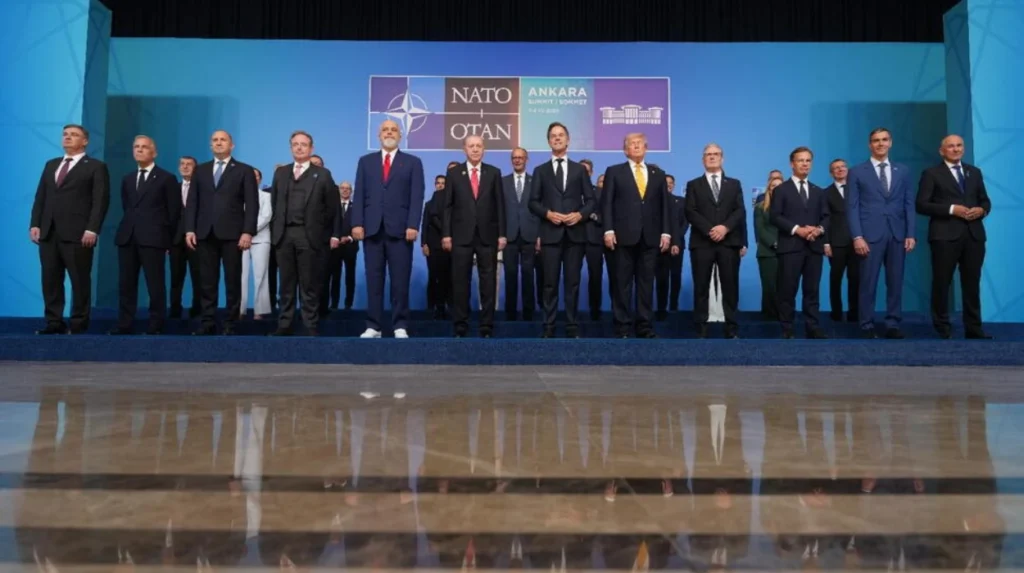
Other reports said German Chancellor Friedrich Merz, European Commission President Ursula von der Leyen, and European Council President Antonio Costa also received the weapons. Turkish President Recep Tayyip Erdogan, NATO Secretary-General Mark Rutte, and U.S. President Donald Trump were photographed together at the summit, underscoring the high-level nature of the event and the diplomatic weight of the gathering. The scale of the guest list is important because it shows the gift was not a side event but part of a major summit attended by some of the most powerful figures in the transatlantic alliance.
Why the gift caused concern
The more urgent challenge, however, was not one of symbolism, but of logistics. An operative gun with live ammunition cannot just be placed in a suitcase and transported via air travel as an ornament or even as a commemorative trophy. This made it necessary for the recipients and their entourage to contend with issues like airport security and customs regulations. Despite being a gift to a head of state or high-ranking official, such a gift still has to conform to the existing regulations on weapons. This explains the swift change from the humorous aspect of the story into the problematic dimension. What started out as an act of farewell turned into a puzzle both logistically and legally. One account referred to the presence of the guns as causing “security issues,” while other reports characterized the scenario as a “dilemma.”
The political symbolism
At one level, the gift can be read as a show of national identity and military confidence. Turkey has invested heavily in defense manufacturing and has often used military-industrial achievements to project strength. An engraved revolver may have been meant as a reminder of craftsmanship, sovereignty, and self-reliance. In that sense, the gift was not random; it likely carried a deliberate political message about Turkey’s place in the security order.
But symbolism cuts both ways. The optics of handing out guns at a NATO summit are hard to ignore, especially when the summit itself was about collective defense, security risks, and international stability. The image of leaders discussing war, deterrence, and alliance unity while leaving with firearms creates a jarring contrast. That contrast may be one reason the story resonated so strongly in the press: it had the elements of diplomacy, irony, and discomfort all at once.
The customs and transport problem
When it comes to the government delegations, the gift-giving procedure can hardly ever be viewed as informal. Governmental presents are usually checked, registered and sometimes declared to relevant authorities prior to traveling. However, with a firearm everything becomes absolutely different. It needs to be de-activated, delivered in another way, maybe even surrendered according to the special rules. If we talk about live ammunition, this situation becomes even more complicated, since the bullets are often regulated separately from firearms by aviation and customs regulations. This is why the information about how some leaders left the guns behind, whereas others brought them back home or even were detected to have such weapons in their bags became so important.
How the media framed it
Coverage of the incident was consistent on the core facts but varied in tone. Some outlets treated it as an odd, almost absurd diplomatic episode. Others emphasized the security dimension and the burden it placed on leaders and airport authorities. A few framed it as an example of how gestures at the top level can produce unintended consequences when they involve controlled items like firearms.
The best way to understand the media response is to see it as a blend of irony and seriousness. On the one hand, the story sounds almost unbelievable: NATO leaders leaving a summit with engraved revolvers and bullets. On the other hand, the consequences are real, because international travel, customs laws, and weapon regulations do not bend easily to diplomacy. That is what gave the story its staying power.
What this says about Erdogan’s style
Erdogan has often been characterized as someone who displays his political power and confidence in an overtly symbolic way. This particular story is one that continues to fit into that description, although the gesture seems very strange to anyone looking from the outside. For example, the act of gifting a gun is something that can be seen as being symbolic of power, confidence, and national pride, since it happened during a conference whose focus was security. On the other hand, the response to the gesture highlights the dangers of using such symbols. A gesture meant to impress can also be unsettling or even confusing.
The broader diplomatic lesson
There is a wider lesson in this episode about how modern diplomacy works. Statecraft is not only about speeches and communiqués; it is also about the small rituals that surround major summits. Gifts matter because they symbolize relationships, hierarchy, and national image. But when those gifts involve regulated or dangerous objects, they can undermine the calm professionalism that summit diplomacy tries to project.
The incident also shows how quickly an international meeting can be reframed by one unexpected detail. A summit organized around defense strategy and alliance solidarity ended up making headlines because of a firearm gift. That does not erase the substance of the summit itself, but it does show how personal gestures can compete with formal policy in the public narrative.