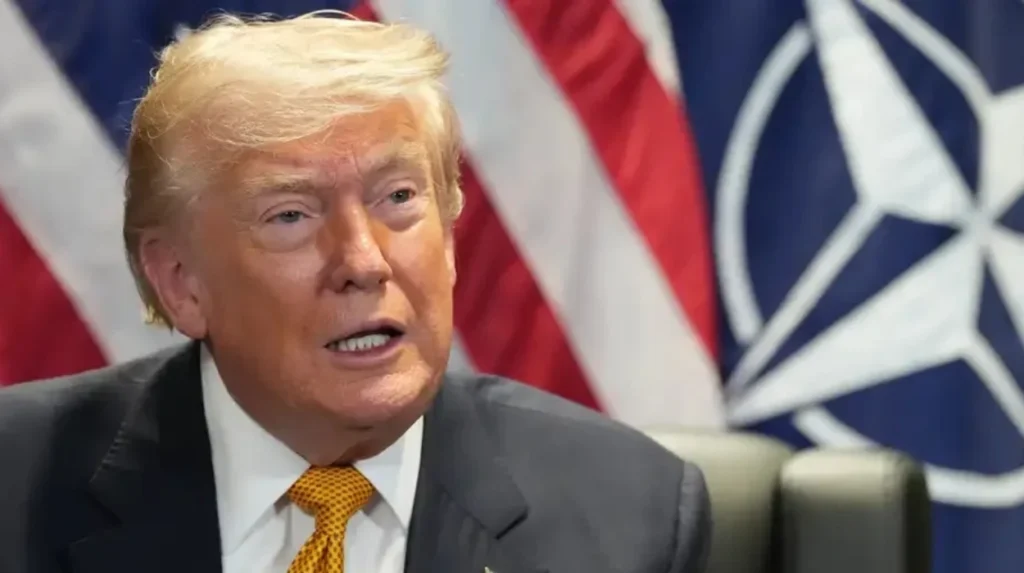
President Donald Trump’s declaration that the ceasefire with Iran is “over” marks a sharp political escalation in a confrontation already defined by strikes, retaliation and deep uncertainty. The remark came after the United States and Iran traded fresh attacks, and it effectively signaled that Washington no longer sees the ceasefire as a reliable framework for de-escalation. The comments, delivered as Trump was attending the NATO summit, also showed how quickly the crisis had begun to overshadow broader diplomatic business.
The importance of this statement, however, is not simply the harshness of its rhetoric, but rather the re-framing of the situation that the statement provides. By describing the ceasefire as something that had expired politically, Trump did not frame the situation as one in which the ceasefire was alive and could be saved, but as one where the situation has moved on from there. This is important as the statements of presidents at such times influence what happens next.
Fresh strikes reopen the crisis
According to the last report, the ceasefire ended due to yet another attack by the United States and Iran on each other because both of the sides have started attacking each other rather than maintaining the ceasefire. In the reports that are available, the new outbreak of violence seems to be the cause of President Trump’s statements because it looks like even without his comments, the ceasefire would have been very fragile by that time. The reports also suggest that the fight spread to the larger area of the Gulf region. According to the report published by Al Jazeera, after the U.S. attacks on Iran, Iran attacked U.S. forces’ bases in Bahrain and Kuwait. This raised concerns about the possibility of expansion of the conflict in other parts of the Gulf. One of the reports suggests that “85 military installations” were attacked in Bahrain and Kuwait by Iran.
The broader pattern is familiar to observers of the region: each strike invites retaliation, and each retaliation narrows the room for diplomacy. What has changed this time is the speed with which the ceasefire narrative has broken down. Instead of a managed pause leading to negotiations, the public story has shifted back toward escalation, with the possibility that the next move could come from either side.
Trump’s tone and language
Trump’s language was not diplomatic. BBC reported that he blasted Iran’s leadership as “scum” and “cuckoo,” reflecting a level of hostility that goes beyond standard crisis messaging. Other coverage said he told reporters,
“as far as I’m concerned, it’s over,”
when asked about the ceasefire, while also stating,
“I don’t want to deal with them anymore.”
The importance of wording in the case is obvious because it represents a contrast between official policy and a personal stance of the President. In the first place, it means that the administration is not entirely ruling out negotiations. However, secondly, it means that Trump’s statements reveal his frustration, repulsion, and readiness to put the idea of ceasefire into oblivion. From the practical perspective, it means that while negotiators might try to negotiate, the rhetoric of the president will definitely make it extremely difficult to start the diplomacy all over again. One of the most illustrative phrases used in the articles refers to the possibility of continuing peace talks but describing it as “a waste of time.” This phrase has great meaning as it suggests that Trump is not really preventing diplomats from making decisions; he is simply eliminating their sense of urgency and necessity.
NATO summit backdrop
The timing of Trump’s statements is significant. His statements were made when he attended the NATO summit, during which the White House normally expects attention to be paid to NATO cooperation and security issues in general. Instead, U.S. tensions with Iran started taking precedence in the media cycle and overshadowing the agenda of the summit, thus becoming an issue of discussion within the Atlantic Alliance. The situation also added a political dimension to the statement. Trump did not make his statement alone, but did so on the very forum where the purpose of the message was clear – to signal strength, cohesion of the alliance and strategic clarity.
The summit backdrop also highlights how interlinked these crises have become. A regional military exchange can now affect global diplomacy within hours, especially when a U.S. president uses such a high-profile platform to announce that the previous ceasefire framework has failed. That is one reason the story spread rapidly across major international outlets and live blogs.
Oil and shipping fears
This was an instant reaction on the financial market as per the report stating that the price of oil increased by more than 6% at the beginning of Wednesday after Donald Trump announced that the ceasefire agreement was over. This is not surprising since the Gulf region continues to play a vital role in the world’s energy supply. The Strait of Hormuz is one of the most important areas for the current crisis. Several media reports indicated worries about the strait as the situation worsened. This is indicative of the fact that this conflict is not merely a political issue but also a possible security threat.
That market response gives the story a second life beyond military reporting. Traders are not waiting for a formal war declaration; they are reacting to the possibility that another exchange of strikes could disrupt supply or widen the conflict. In this sense, Trump’s words functioned as both a political statement and an economic trigger.
Competing claims and uncertainty
As with any fast-moving conflict, the available reports contain claims from both sides that are not always independently verified in the snippets. For example, Iranian claims about hitting dozens of military installations should be treated as claims unless corroborated by additional sources. At the same time, U.S. and allied reporting framed the renewed strikes as evidence that the ceasefire had effectively broken down.
That is significant in terms of ethical journalism. In covering conflicts, leaders tend to rely on their messaging both as description and as influence. The message “the ceasefire is over” can have many connotations, including the ending of an official arrangement, that of the president’s support for the ceasefire, and the obsolescence of the ceasefire because of military realities. According to the reporting, all three meanings seem to be merging into one. There is also the more general ambiguity of where to go from there. While some reports indicated that discussions could go on despite the announcement that the ceasefire had failed, this implies the possibility that while rhetoric becomes firmer, behind-the-scenes diplomacy will survive. This, however, becomes less likely every time the reasons for retaliating are renewed on either side.
What Trump’s line means
Rather, it should be viewed as a political and strategic declaration, rather than a legal termination of the treaty by the US President. It means that the Trump administration considers the cessation of hostilities as an irrelevant limitation for its military actions. Furthermore, the administration will be ready to continue confrontational relations with Iran in case if the latter continues using military measures. From the viewpoint of Iran, such declaration can be interpreted as a warning as well as a challenge. If the US President declares that he does not wish to have anything with Tehran anymore, then the Iranian leadership will realize that the chances for diplomatic negotiations are becoming increasingly less and that the only chance to deter US is military actions.
For regional governments, the immediate concern is spillover. Kuwait, Bahrain and other Gulf states do not want their territory or infrastructure pulled deeper into a U.S.-Iran exchange. And for global markets, the concern is more basic: if the ceasefire is truly dead, then each overnight development now carries the risk of broader disruption, from shipping lanes to energy prices.